
A Ridgeline retriever is configured against a Data Library source containing discharge instructions for all clinics. Does this retriever configuration by itself control which pet owners can see which clinic's content through the agent?
Select an answer to reveal the explanation.
Short Explanation
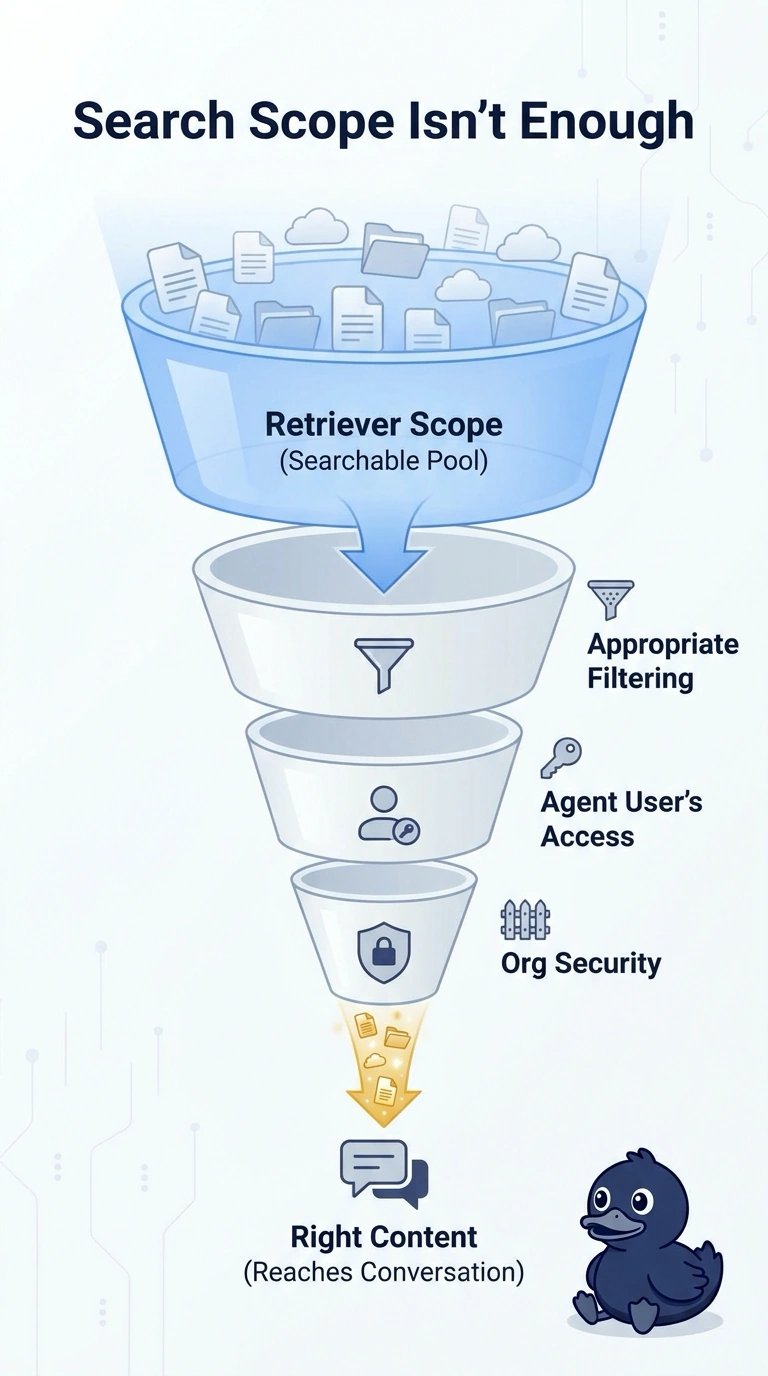
Scoping a retriever narrows what it can search, but it isn't a substitute for real access control — the Agent User's permissions and any filtering still decide whether the right owner sees the right clinic's content.
Full Explanation
Retriever scope determines the pool of content a retriever searches, which is a meaningful lever, but it does not by itself fully substitute for a security and access model — appropriate filtering (for example, by clinic or record ownership), the Agent User's permissions, and the org's broader sharing model all still play a role in ensuring the right content reaches the right conversation rather than, say, one clinic's owner seeing another clinic's discharge notes. Saying retriever configuration alone fully replaces sharing and security overstates what a search-scoping mechanism does; it narrows a search space, it doesn't enforce record-level access control on its own. Saying retrievers have no effect whatsoever contradicts their basic function of determining what content is even eligible to be searched and returned. There's also no requirement that Data 360 sharing be disabled for retrievers to function — that inverts the relationship between security configuration and retrieval and isn't a real platform behavior. For the exam, remember that grounding, retrieval scope, and security/sharing are related but distinct layers that all need to be considered together, not treated as one setting that solves everything.