
Given a business requirement to let the sales-focused agent draft a personalized outreach email referencing a specific pet owner's account history AND general boarding-service marketing copy stored as a PDF, which grounding combination is appropriate?
Select an answer to reveal the explanation.
Short Explanation
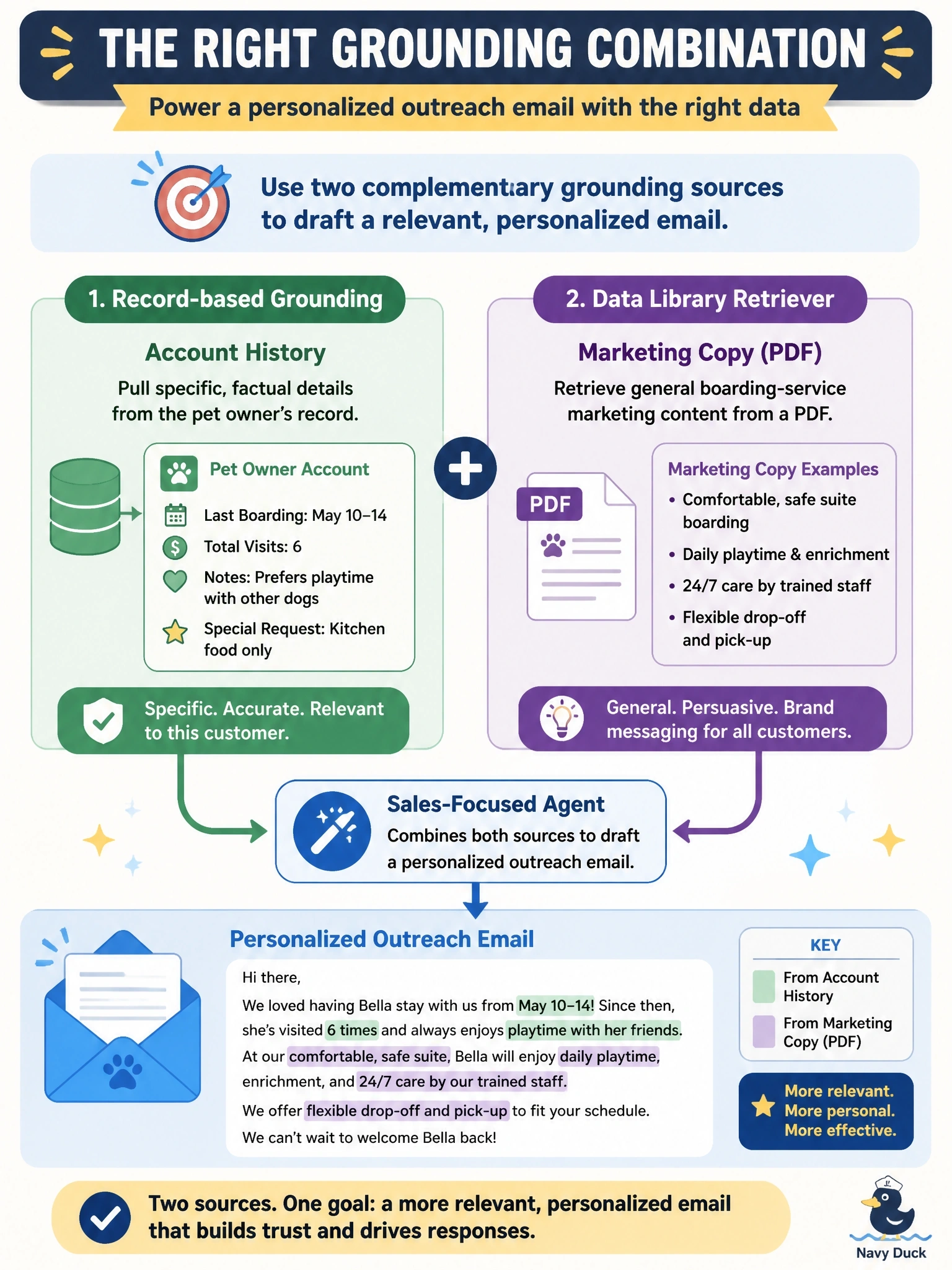
Same principle as always: structured account history goes through record grounding, and the unstructured marketing PDF goes through a Data Library retriever — mixing the two methods is the correct move, not a compromise.
Full Explanation
This requirement genuinely spans both grounding types, so the correct combination uses record-based grounding to pull the specific pet owner's structured account history directly and reliably, paired with a Data Library retriever to surface content from the general boarding-service marketing PDF, which is unstructured document content suited to chunking, indexing and retrieval. Retrievers are not a general-purpose way to read arbitrary structured Salesforce objects — that's exactly the job of record-based grounding and merge fields, which operate more directly and reliably on clean field data than a retriever built for document search. Treating structured account history as if it were an unstructured document to be chunked would be an unnecessary and lossy detour around a grounding method already built for exactly this kind of structured lookup. A PDF cannot simply be 'attached as a merge field' — merge fields pull discrete field values from records, not the free-text contents of a document, so that combination misunderstands both mechanisms. For the exam, this kind of two-part requirement is a common way exams test whether you'll default to one grounding method or correctly recognize that combining both is often the right answer.