
A pet owner's uploaded insurance claim PDF, used as grounding for an agent's answer, contains the owner's home address and policy number. What protects this sensitive information as it flows through the grounded prompt to the underlying LLM?
Select an answer to reveal the explanation.
Short Explanation
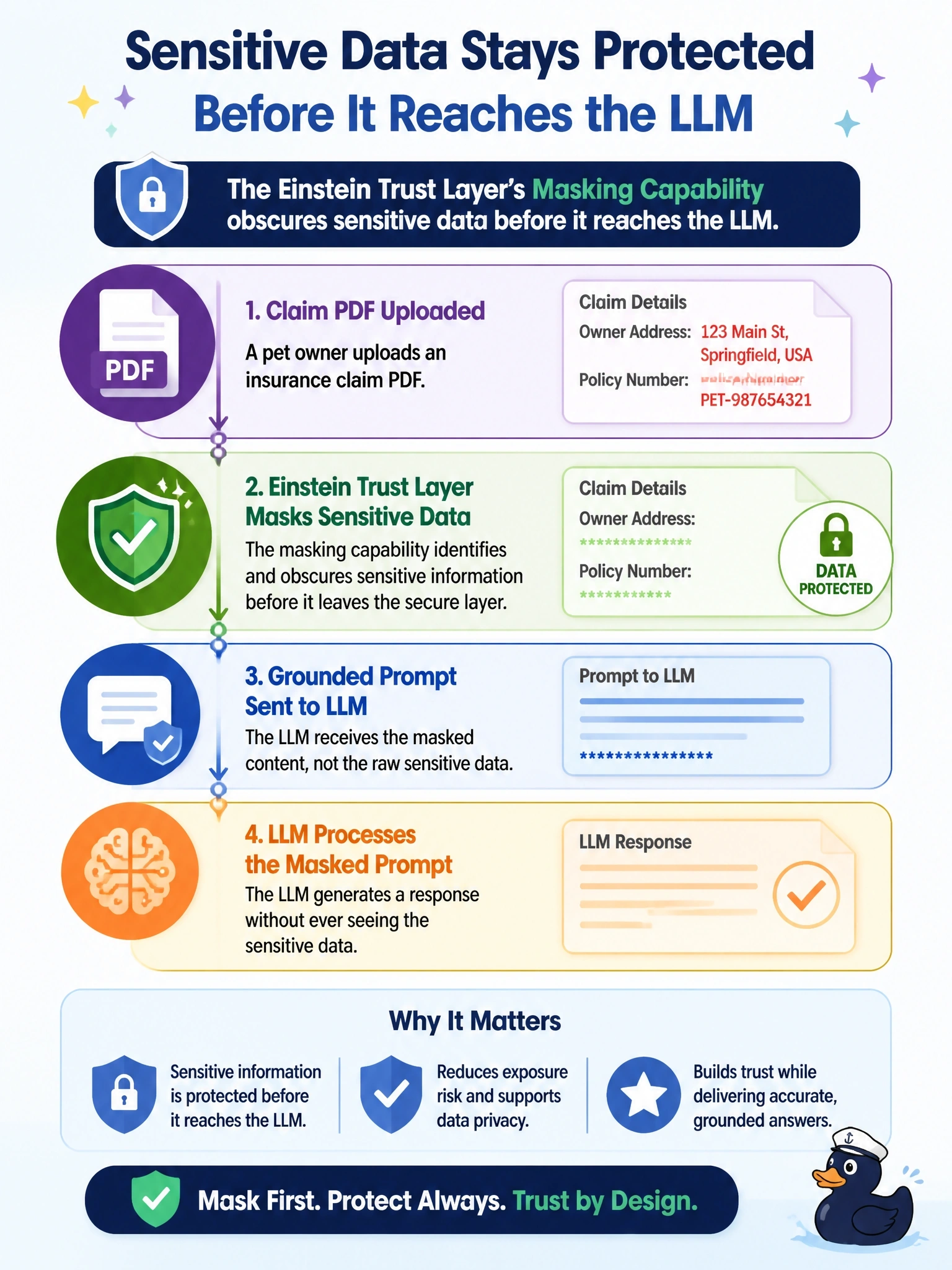
Retrieval finds the right passage, but it's the Trust Layer's masking that steps in to shield the sensitive bits — like the home address and policy number — before that content ever reaches the model.
Full Explanation
The Einstein Trust Layer includes masking capability designed to obscure sensitive data such as an address or policy number before that content is sent to the underlying LLM, which is precisely the protection relevant when grounded content from a document like an insurance claim PDF flows into a prompt. The Data Library doesn't automatically delete documents containing addresses before indexing — that would make ordinary business documents essentially unusable, and no such automatic deletion behavior for personal information is a documented feature. Vector search's embedding process is about capturing semantic meaning for similarity matching; it is not a privacy or redaction mechanism and doesn't strip personal information as a side effect of generating embeddings. Claiming that grounded content always bypasses privacy protections entirely contradicts the actual purpose of the Trust Layer, which exists specifically to apply protections like masking, toxicity detection, zero-retention, and audit trail regardless of where the content in a prompt originated. For the exam, keep grounding (retrieval of relevant content) and the Trust Layer (protection of that content in transit to the model) as two distinct, complementary layers of the same pipeline.