
A pet owner asks Ridgeline's agent a nuanced question about the clinic's exact cancellation-fee policy. Why is grounding the answer in an indexed Data Library policy document preferable to letting the underlying LLM answer from its general training knowledge?
Select an answer to reveal the explanation.
Short Explanation
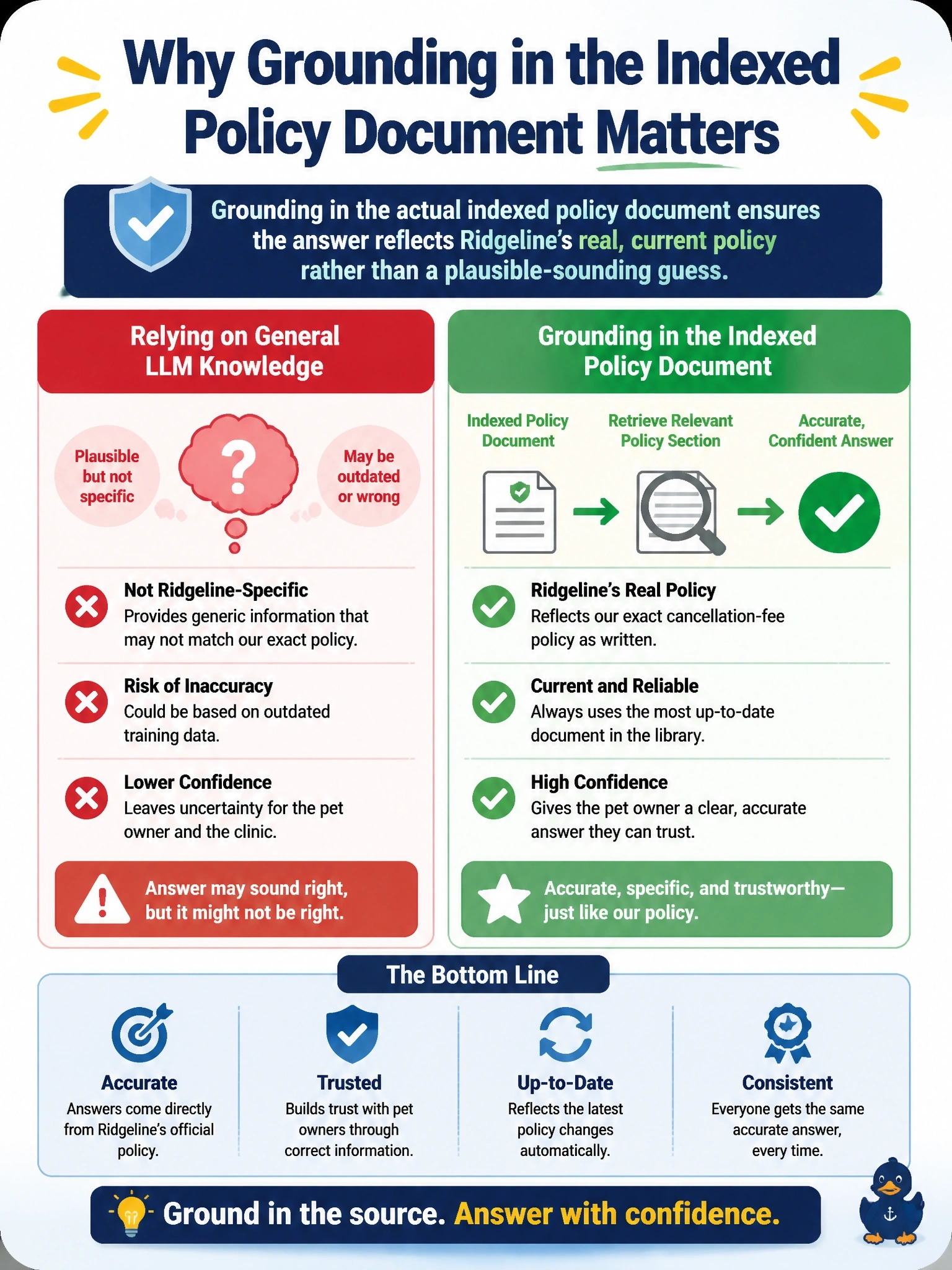
An LLM has never seen Ridgeline's actual cancellation policy — it can only guess at something plausible. Grounding trades that guess for the real document.
Full Explanation
Grounding an answer in the Data Library's indexed policy document ties the agent's response to Ridgeline's actual, specific, current policy text rather than the LLM's general pretraining, which has no knowledge of this particular clinic's internal rules and would otherwise have to generate a plausible-sounding but potentially fabricated answer — exactly the hallucination risk grounding exists to reduce. It is false that an LLM's general training automatically includes every organization's private internal policies; those are not public information the model could have learned during training. Grounding is a general technique for retrieving relevant text or data before generating a response, and it fully applies to text-based policy questions, not only to some image-specific use case — that claim invents a limitation the platform does not have. It's also inaccurate that an LLM can never answer without a configured retriever; ungrounded responses are possible but risk being generic or wrong for org-specific facts, which is exactly why grounding is recommended for anything requiring accurate, current, org-specific information. For the exam: grounding exists precisely to replace the model's guesswork with verified, sourced content for facts like company-specific policy.