
In a vector-based retriever, how are the chunks that get returned to ground a response typically selected?
Select an answer to reveal the explanation.
Short Explanation
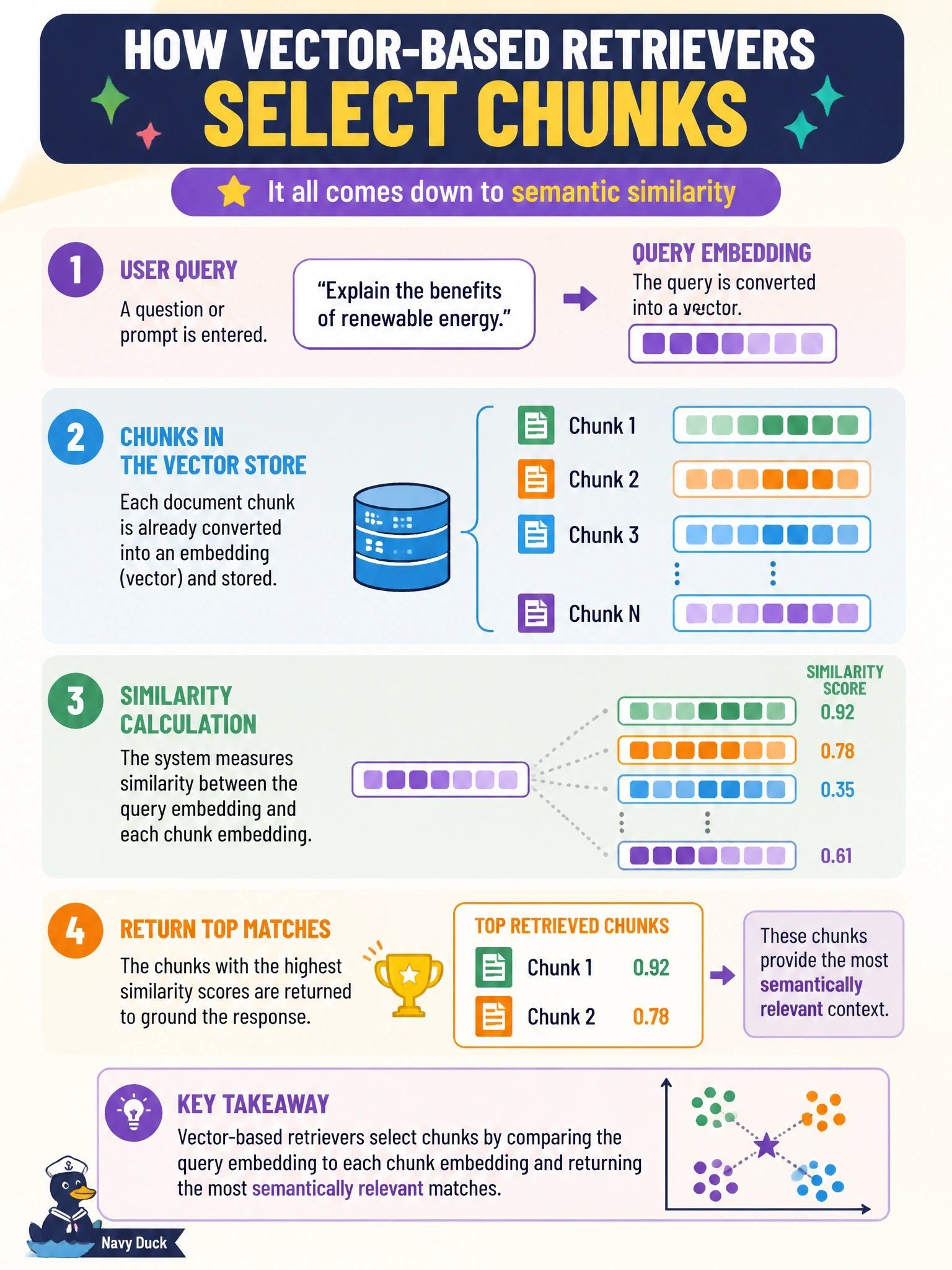
You can think of a vector retriever as matching meanings: it compares the query’s embedding with each chunk’s embedding and returns the most semantically relevant matches. Similarity guides retrieval, not chance, title order, or upload recency.
Full Explanation
A vector-based retriever represents the incoming query and each indexed chunk as embeddings, then measures similarity between the query embedding and chunk embeddings to return the chunks that are most semantically close to what was asked. This similarity-based ranking makes vector search useful even when a question is paraphrased or loosely worded. Random selection would introduce arbitrary variety rather than surface relevant content, defeating retrieval’s purpose and risking accuracy. Alphabetical ordering by document title does not measure content relevance, so it can return chunks disconnected from the query. Returning chunks only from the most recently uploaded document ignores relevance and can surface unrelated content simply because that document was uploaded last. An exam caveat is to distinguish embedding similarity in vector search from keyword search’s exact-term matching. As a practical check, inspect whether the returned chunks are semantically relevant to the query and whether their embeddings have high similarity to the query embedding.