
A general-practice clinic within Ridgeline refers a patient to the cardiology specialty hospital. The specialty team wants the agent to surface both the structured referral record (referring vet, reason, date) and the unstructured discharge notes from the original visit. What grounding approach fits this combined need?
Select an answer to reveal the explanation.
Short Explanation
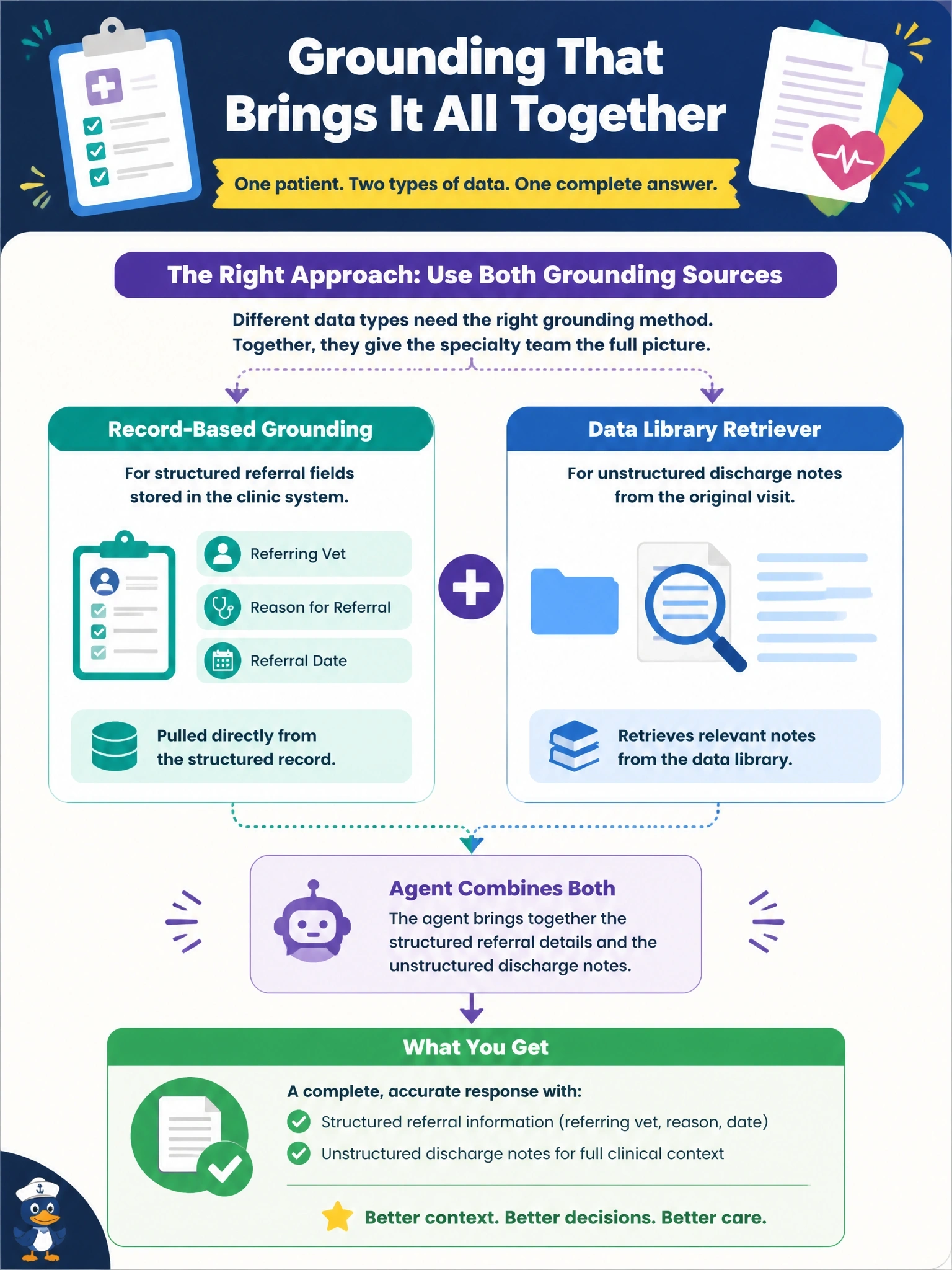
Two different kinds of content need two different tools — pull the clean referral fields straight from the record, and send a retriever after the free-text discharge notes.
Full Explanation
This scenario genuinely needs both grounding approaches working together: record-based grounding (or merge fields) pulls the structured referral fields like referring vet, reason and date directly and reliably from the record, while a Data Library retriever handles the unstructured discharge notes that live as free text rather than clean fields. Relying solely on a Data Library retriever for everything misunderstands what retrievers are for — they are not a general mechanism for pulling arbitrary structured record fields, which is what merge fields and record grounding do more directly and reliably. Forcing free-text discharge notes into picklist values to avoid needing two grounding methods is impractical and lossy — discharge notes are naturally narrative and variable, not a small fixed set of choices a picklist could represent, and cramming them in would destroy their informational value. Keyword search across all org data indiscriminately, mixing structured and unstructured together, ignores the fact that structured data isn't retrieved via search types at all — it's grounded directly. For the exam, remember that real-world scenarios often require combining record-based grounding with Data Library retrieval rather than treating them as mutually exclusive.