
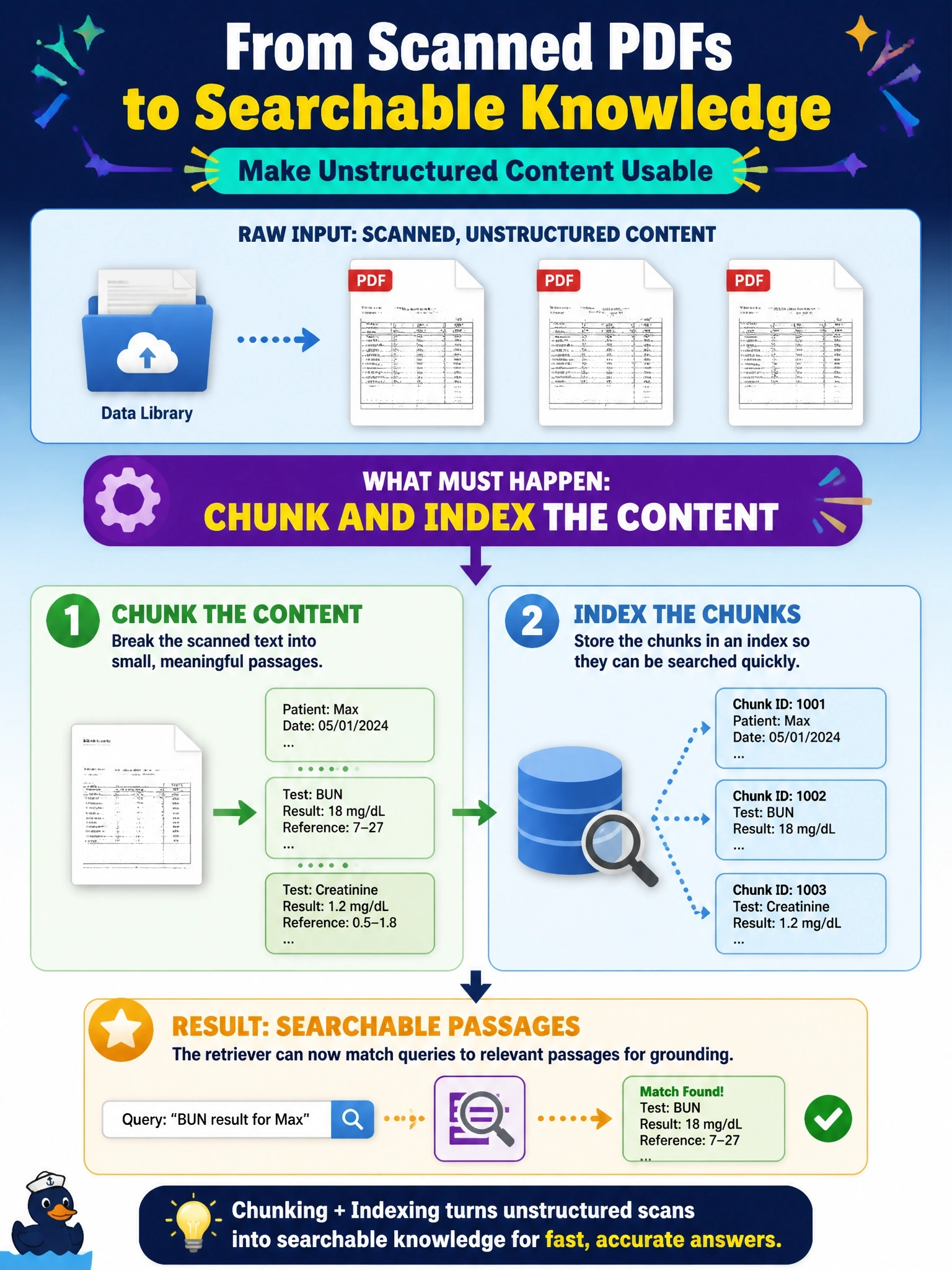
A Ridgeline emergency hospital uploads scanned lab-result PDFs to the Data Library so an agent can help vets quickly find historical values. What must happen to this scanned, unstructured content before a retriever can use it for grounding?
Select an answer to reveal the explanation.
Short Explanation
Same rule as any unstructured document: it has to be broken into chunks and indexed before a retriever has anything to actually search through.
Full Explanation
Like any unstructured document added to the Data Library, scanned lab-result PDFs must go through chunking and indexing before they become searchable passages that a retriever can match a query against — this is the standard pipeline for making unstructured content usable, regardless of the document's specific subject matter. It is not accurate that retrievers can query any uploaded file immediately with zero processing; retrieval depends on the index that chunking and indexing produce. Converting the content into custom Salesforce objects with individual structured fields would be a data-modeling approach more associated with structured record-based grounding, not how unstructured document content is made retrievable — and it would defeat the purpose of using the Data Library for free-text content in the first place. The Einstein Trust Layer handles data protection concerns like masking and toxicity detection, not clinical-accuracy review or approval of content before indexing — it has no role in validating whether lab values are medically correct. For the exam, keep the pipeline straight: unstructured content always needs chunking and indexing regardless of its topic, before any retriever can use it.