
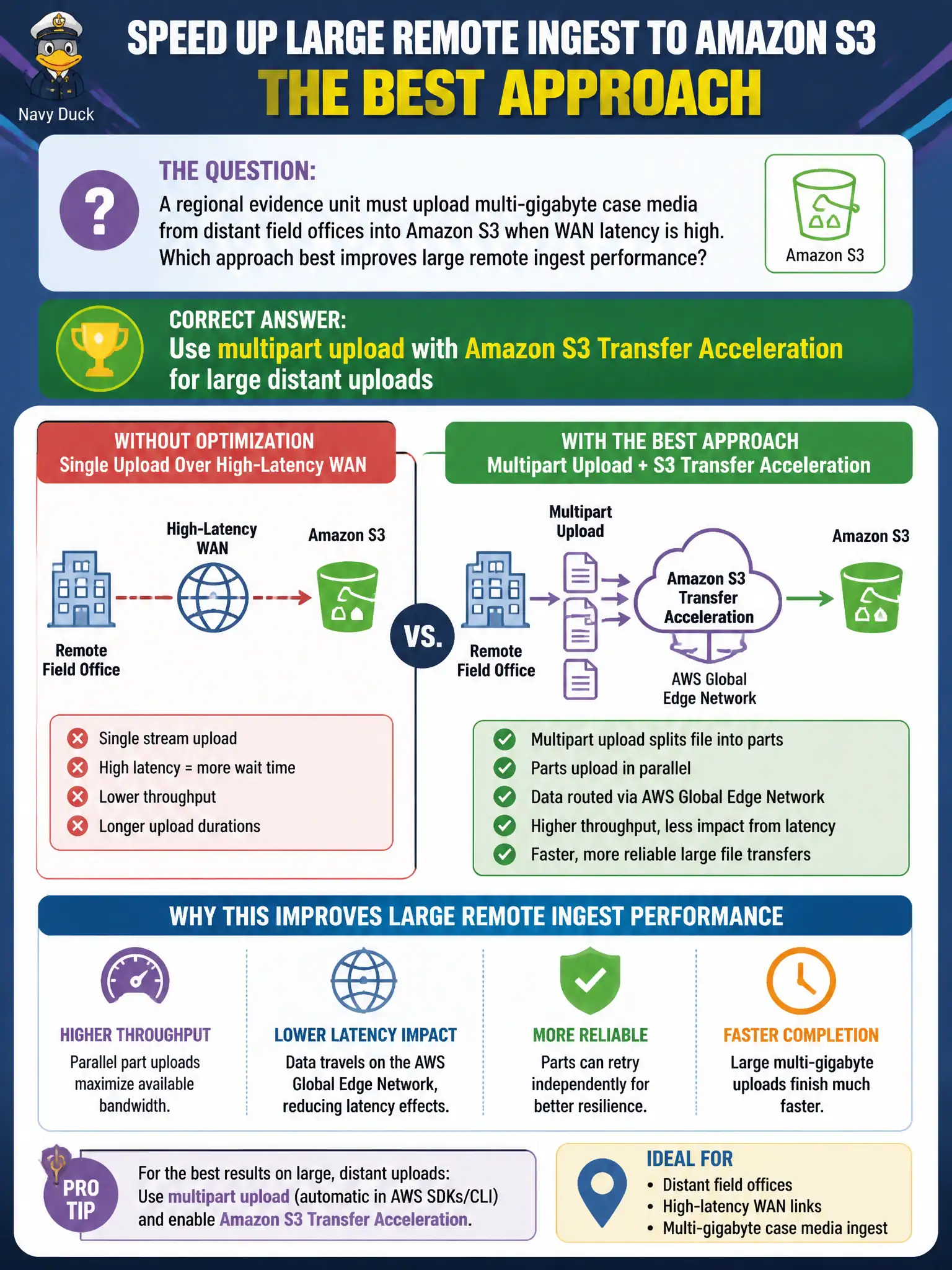
A regional evidence unit must upload multi-gigabyte case media from distant field offices into Amazon S3 when WAN latency is high. Which approach best improves large remote ingest performance?
Select an answer to reveal the explanation.
Short Explanation
Big remote uploads hate chatty single-stream transfers over high latency—think mailing a library one page at a time. Multipart upload plus S3 Transfer Acceleration chops the work and uses edge-optimized paths so distant offices finish sooner. Turning multipart off, waiting on monthly disks, or funnelling everything through one NAT just slows the pipeline.
Full Explanation
Large multi-gigabyte evidence uploads from distant field offices suffer when a single TCP stream contends with high WAN latency. Multipart upload splits each object into parallel parts that can retry independently, while Amazon S3 Transfer Acceleration steers traffic through CloudFront edge locations so long-distance ingest reaches the destination bucket over an optimized path. Together they are the associate-level pattern for improving remote civic evidence ingest performance without waiting on physical media shipping. That combination directly addresses Task 3.1 storage performance for high-latency regional networks. Disabling multipart uploads so each file transfers as one continuous TCP stream fails because a single long-lived stream is more fragile under packet loss and cannot exploit part-level parallelism, which is the opposite of what distant offices need. Storing each evidence file as a local EBS snapshot and shipping disks monthly fails conceptually as a primary design: offline media movement adds days of delay, operational handling risk, and is not an online performance optimization for WAN ingest. Forcing all uploads through a single NAT gateway in one Availability Zone fails because it concentrates bandwidth and creates a choke point and single-AZ dependency instead of improving long-haul transfer efficiency to S3. Exam caveat: Transfer Acceleration helps many long-distance uploads but is not universally faster for every geography or already-local path; validate benefit for the field-office network path, and multipart part size still needs tuning for reliability. Operational check: enable multipart for large objects, turn on Transfer Acceleration on the evidence bucket when appropriate, measure ingest duration from a representative distant office, and confirm checksum or multipart completion validation before case media is marked accepted.