
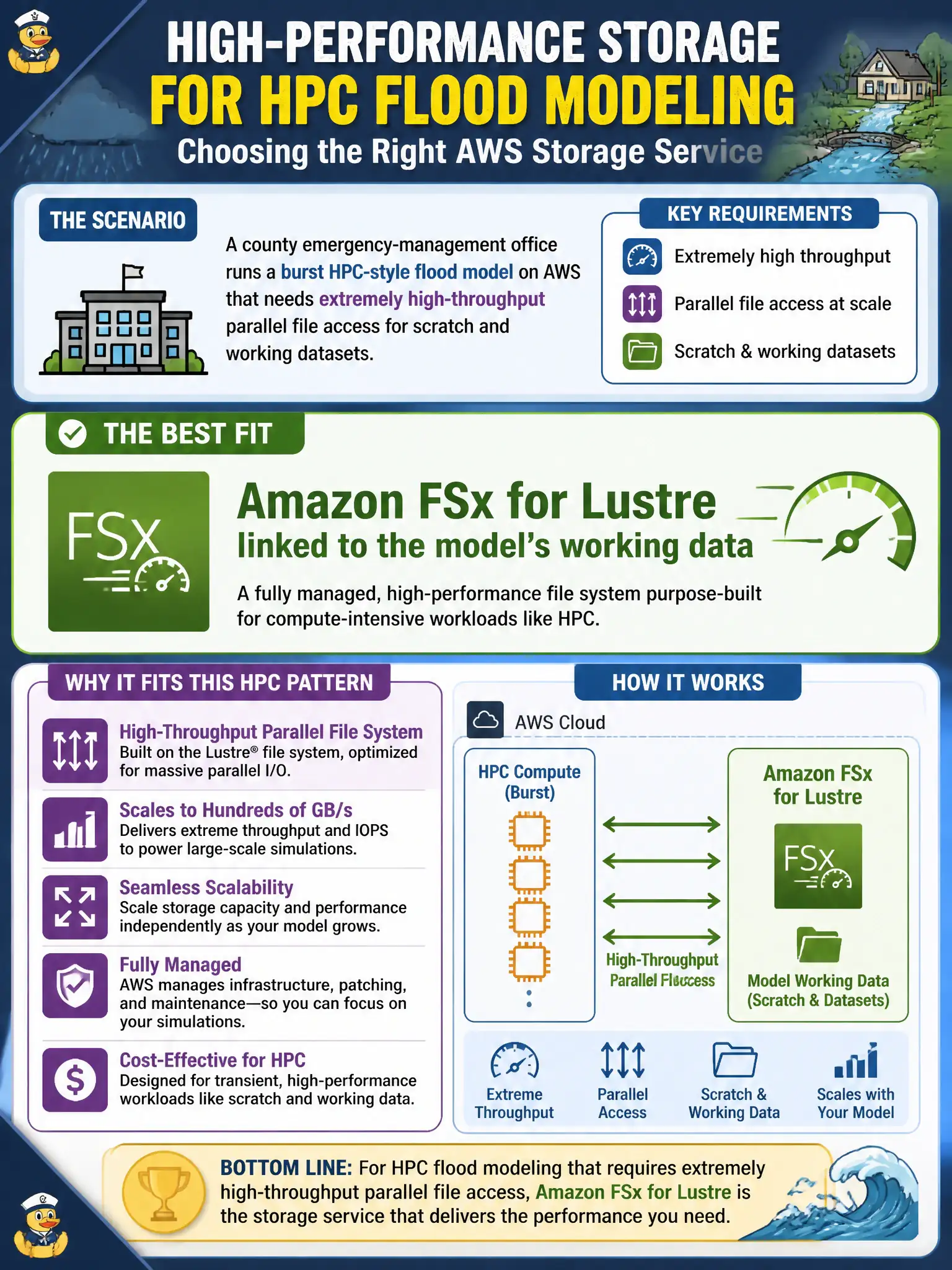
A county emergency-management office runs a burst HPC-style flood model on AWS that needs extremely high-throughput parallel file access for scratch and working datasets. Which storage service best fits this high-performance compute pattern?
Select an answer to reveal the explanation.
Short Explanation
Flood models chew through parallel scratch like a fire hose, not a filing cabinet. FSx for Lustre is the AWS high-performance file system built for HPC-style bursts—fast, parallel, and happy next to compute. Glacier is cold archive, remounted EBS isn’t a shared parallel FS, and crippling EFS won’t give Lustre-class throughput.
Full Explanation
Amazon FSx for Lustre is the high-performance parallel file system that fits HPC-style scratch and working datasets, which is exactly what a county emergency-management flood model needs when many compute nodes must read and write large working sets concurrently. Linking the Lustre file system to the model’s working data gives the throughput and parallel I/O pattern Task 3.1 expects for burst scientific compute, while still allowing durable datasets to live alongside or be staged from object storage as the municipal workflow requires. That is why FSx for Lustre is the correct storage selection for this civic HPC pattern. Amazon S3 Glacier Deep Archive fails as a live scratch workspace because it is an archival object class optimized for rarely accessed long-term retention with retrieval delay and cost trade-offs, not parallel POSIX-style high-throughput scratch for active model runs. A single gp2 EBS volume remounted across all compute nodes fails conceptually because EBS is block storage attached to an instance (or limited multi-attach cases), not a parallel shared file system designed for HPC concurrent scratch; remounting one volume does not magically create Lustre-class parallel file semantics. Amazon EFS One Zone with bursting disabled fails because even when EFS is a shared file system, intentionally constraining throughput and narrowing to One Zone does not deliver the extreme parallel HPC scratch performance profile the flood model requires, and One Zone also reduces the availability posture for critical emergency workloads. Exam caveat: FSx for Lustre is optimized for performance scratch and working data; do not confuse it with the durable system-of-record archive for finished civic evidence, and remember Lustre deployments still need sizing, networking, and data lifecycle planning relative to S3. Operational check: confirm compute clients can mount the FSx for Lustre file system, measure parallel read/write throughput under a representative flood-model job, and verify working data is staged or exported so finished outputs land in durable municipal storage after the burst completes.