
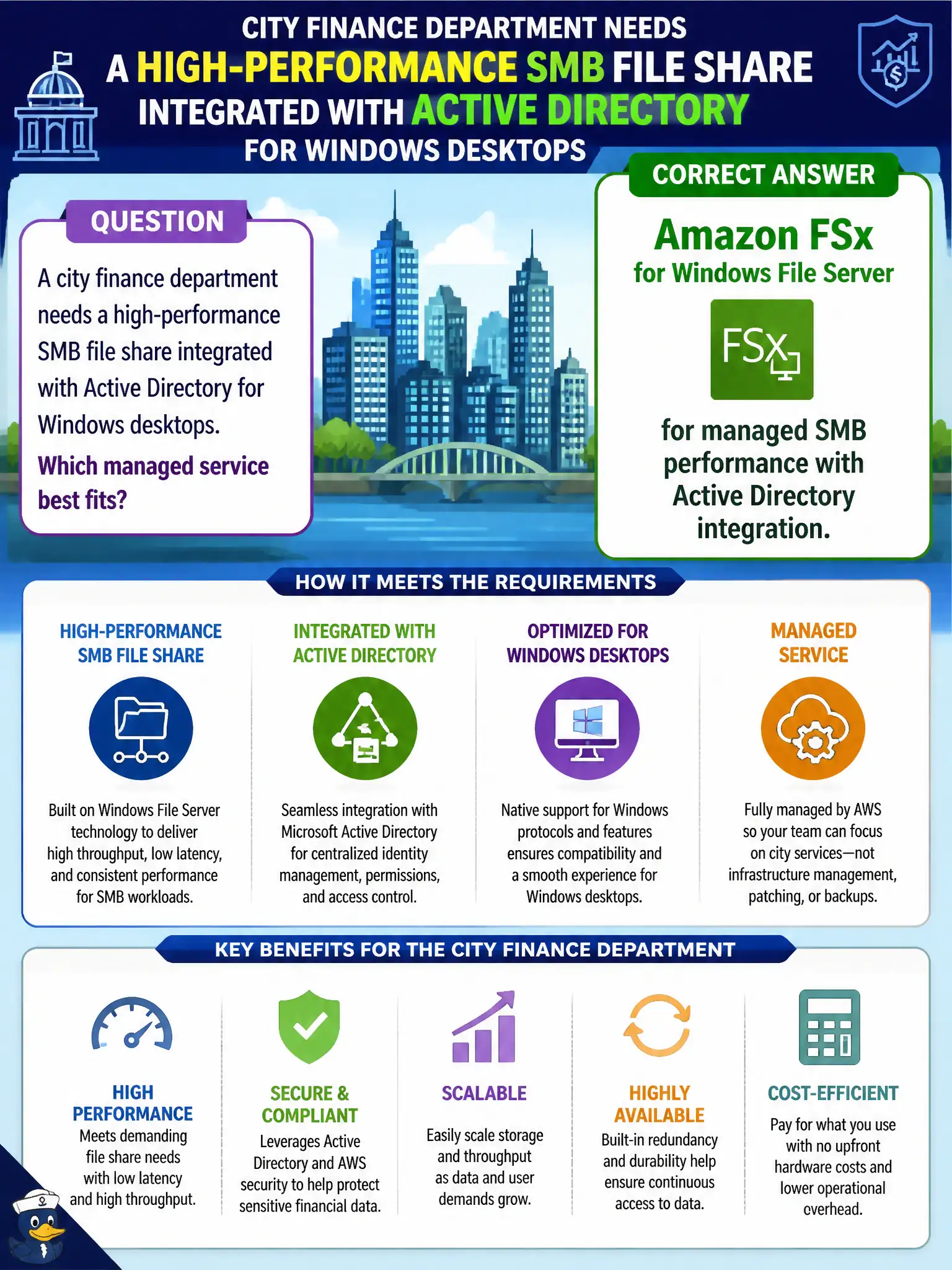
A city finance department needs a high-performance SMB file share integrated with Active Directory for Windows desktops. Which managed service best fits?
Select an answer to reveal the explanation.
Short Explanation
Windows shops that live on SMB and AD want FSx for Windows—managed, fast, and directory-aware. Plain EFS is the NFS lane; a lone Samba box is a SPOF with chores. Pick the file service that speaks the desktop’s language.
Full Explanation
A city finance department that needs a high-performance SMB file share integrated with Active Directory for Windows desktops should use Amazon FSx for Windows File Server. FSx for Windows provides a managed Windows file system with native SMB support and Active Directory integration, fitting municipal finance shares that depend on Windows ACLs, DFS namespaces, and familiar desktop drive mapping without babysitting a single Samba VM.
Amazon EFS configured only with NFSv4 and no SMB/AD integration path fails Windows-native SMB and AD-centric desktop requirements even though EFS is excellent for Linux NFS. A single self-managed Samba container on one EC2 instance in one AZ fails as a managed, Multi-AZ-capable finance share and recreates a SPOF with patching chores. Amazon S3 with IAM users typed as drive letters on every PC fails because S3 object access is not a high-performance AD-integrated SMB file server for Windows finance workflows.
Exam caveat: FSx for Windows still requires correct AD connectivity, Multi-AZ deployment choices for HA, and backup configuration—managed does not mean zero design. Operational check: deploy FSx for Windows joined to the city AD, validate SMB performance from finance desktops, confirm NTFS/share permissions, enable Multi-AZ where required, and test restore from backup.