
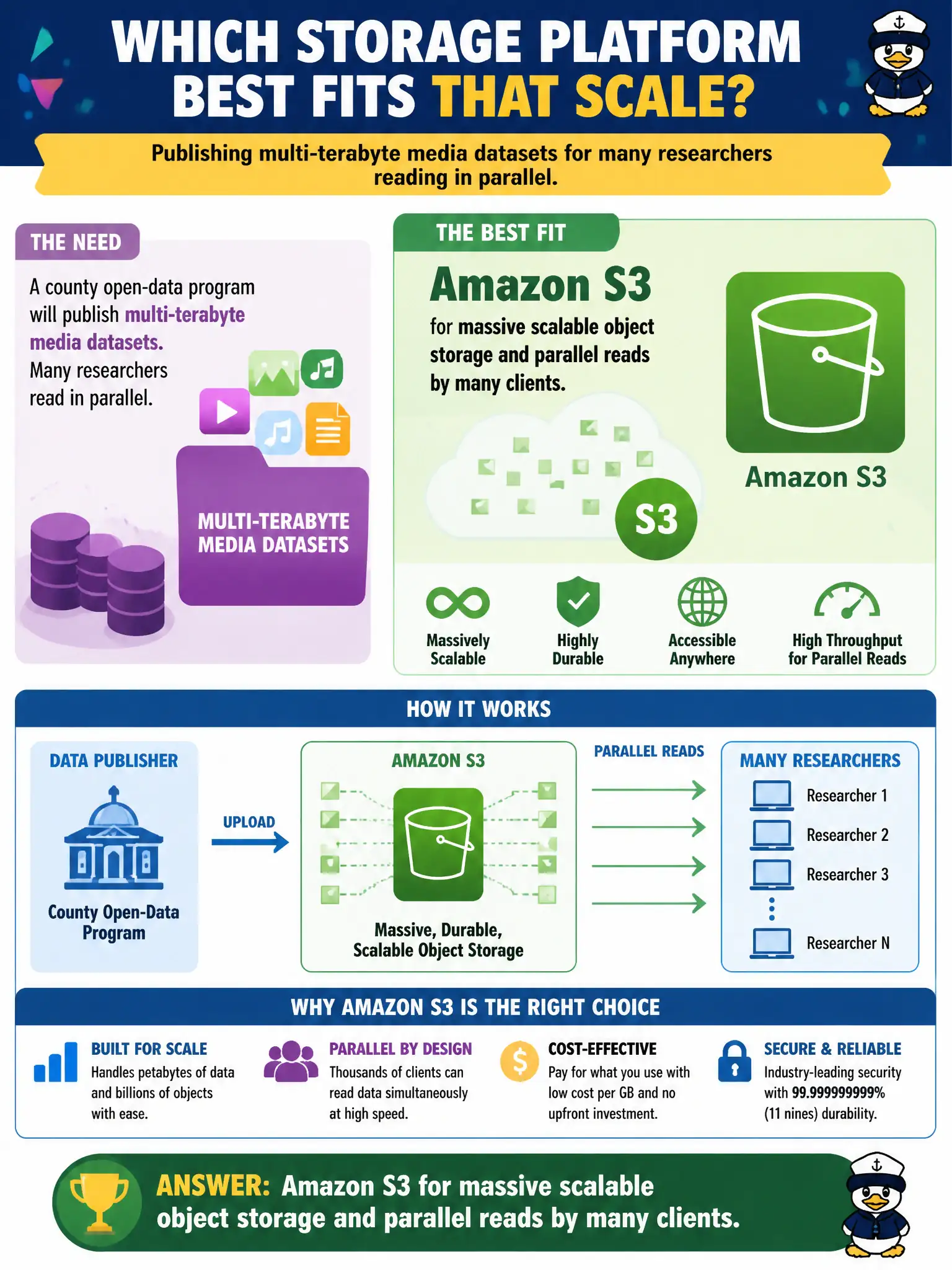
A county open-data program will publish multi-terabyte media datasets that many researchers read in parallel. Which storage platform best fits that scale?
Select an answer to reveal the explanation.
Short Explanation
A multi-TB open-data lake wants a warehouse with loading docks for everyone—that is S3. One EBS volume or a workstation disk becomes the bottleneck and the SPOF. Object scale beats single-disk nostalgia.
Full Explanation
A county open-data program publishing multi-terabyte media datasets for many researchers reading in parallel needs Amazon S3 for massive scalable object storage. S3 is built for extremely large object corpora and concurrent reads from many clients without requiring a single EC2 gateway as the choke point. That pattern fits civic open data where parallel download and analysis across universities and vendors is the success metric.
A single 16 TB EBS volume shared through one EC2 SMB gateway fails as a lake of record because capacity, throughput, and availability all concentrate on one volume and one gateway host. Local disks inside one researcher’s workstation mirrored weekly fail scale, concurrency, and durability for a countywide publishing program. An Auto Scaling group of instance stores treated as the durable lake of record fails conceptually: instance store is not durable object storage, and ASG replacement would destroy the “lake.”
Exam caveat: S3 solves durable parallel object distribution; analytical query layers (Athena, inventory, CloudFront) may still be added but are not required to choose S3 over single-disk designs. Operational check: store datasets in S3 with appropriate storage classes, enable inventory and access logging, test parallel downloads from multiple clients, and publish IAM/S3 access patterns that do not funnel all traffic through one EC2 proxy.