
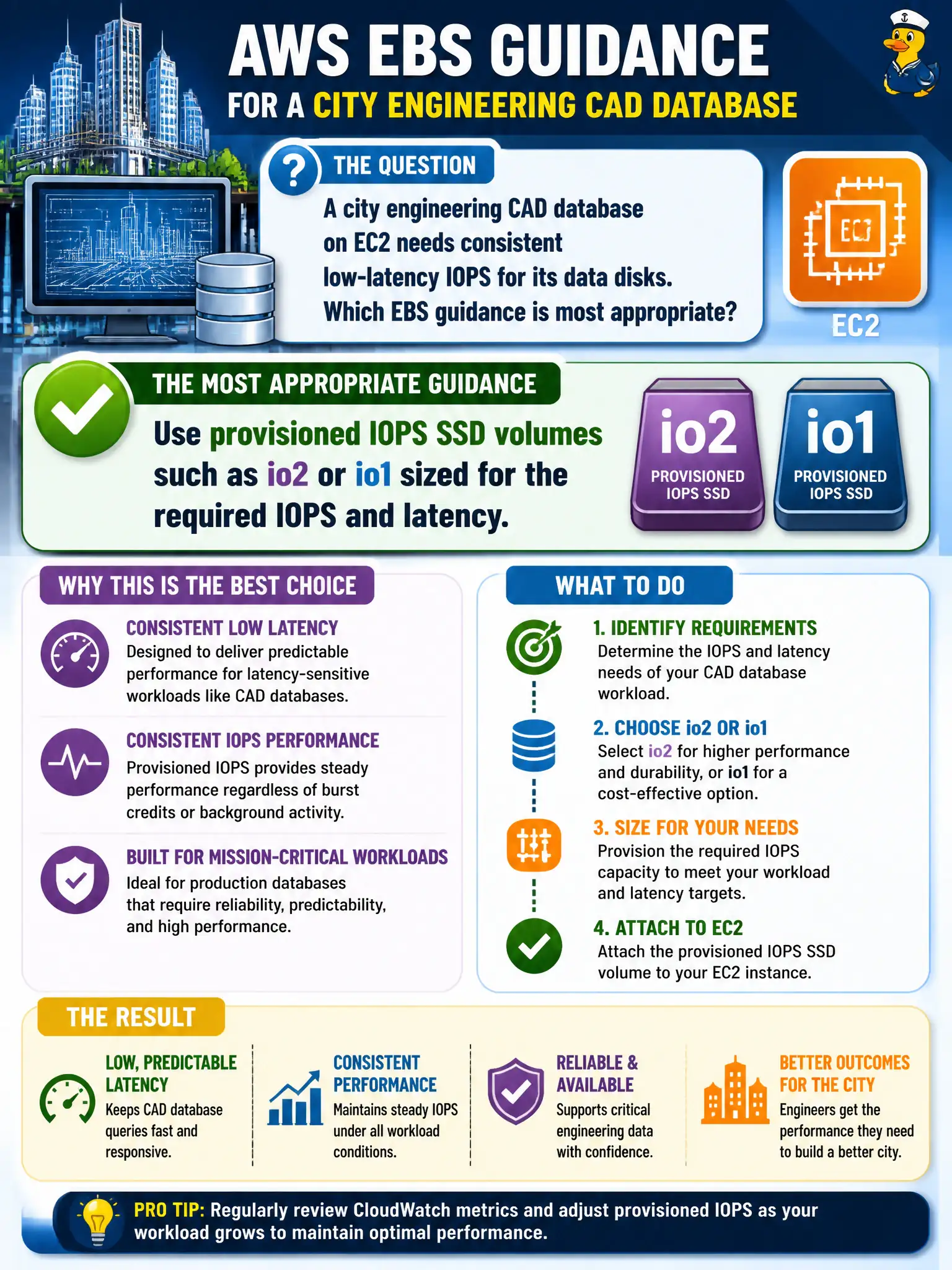
A city engineering CAD database on EC2 needs consistent low-latency IOPS for its data disks. Which EBS guidance is most appropriate?
Select an answer to reveal the explanation.
Short Explanation
CAD databases hate waiting in line—provisioned IOPS SSD is the express lane with reserved tickets. Throughput HDD is for big sequential streams, not twitchy random reads. Pick the volume for the I/O pattern.
Full Explanation
A city engineering CAD database on EC2 that needs consistent low-latency IOPS for its data disks should use provisioned IOPS SSD volumes such as io2 or io1 sized for the required IOPS and latency. Provisioned IOPS SSDs are the EBS family intended for latency-sensitive transactional database workloads where random I/O consistency matters more than cheap sequential throughput. Right-sizing IOPS and volume size lets municipal CAD indexes and transactional writes meet engineering SLAs.
Using throughput-optimized HDD (st1) alone for all random transactional database I/O fails because st1 targets large sequential workloads, not low-latency random database patterns. Using cold HDD (sc1) as the primary volume type for latency-sensitive CAD indexes fails even more clearly: sc1 is for infrequent sequential access, not hot indexes. Storing the database only on instance store and accepting data loss on stop fails durability and operational continuity for an engineering system of record.
Exam caveat: gp3 can serve many databases, but when the question stresses consistent low-latency provisioned IOPS, io1/io2 is the intended answer class. Operational check: measure required IOPS and latency under CAD peak load, provision io2/io1 accordingly, separate data from boot volumes, and alarm on volume queue length and latency.