
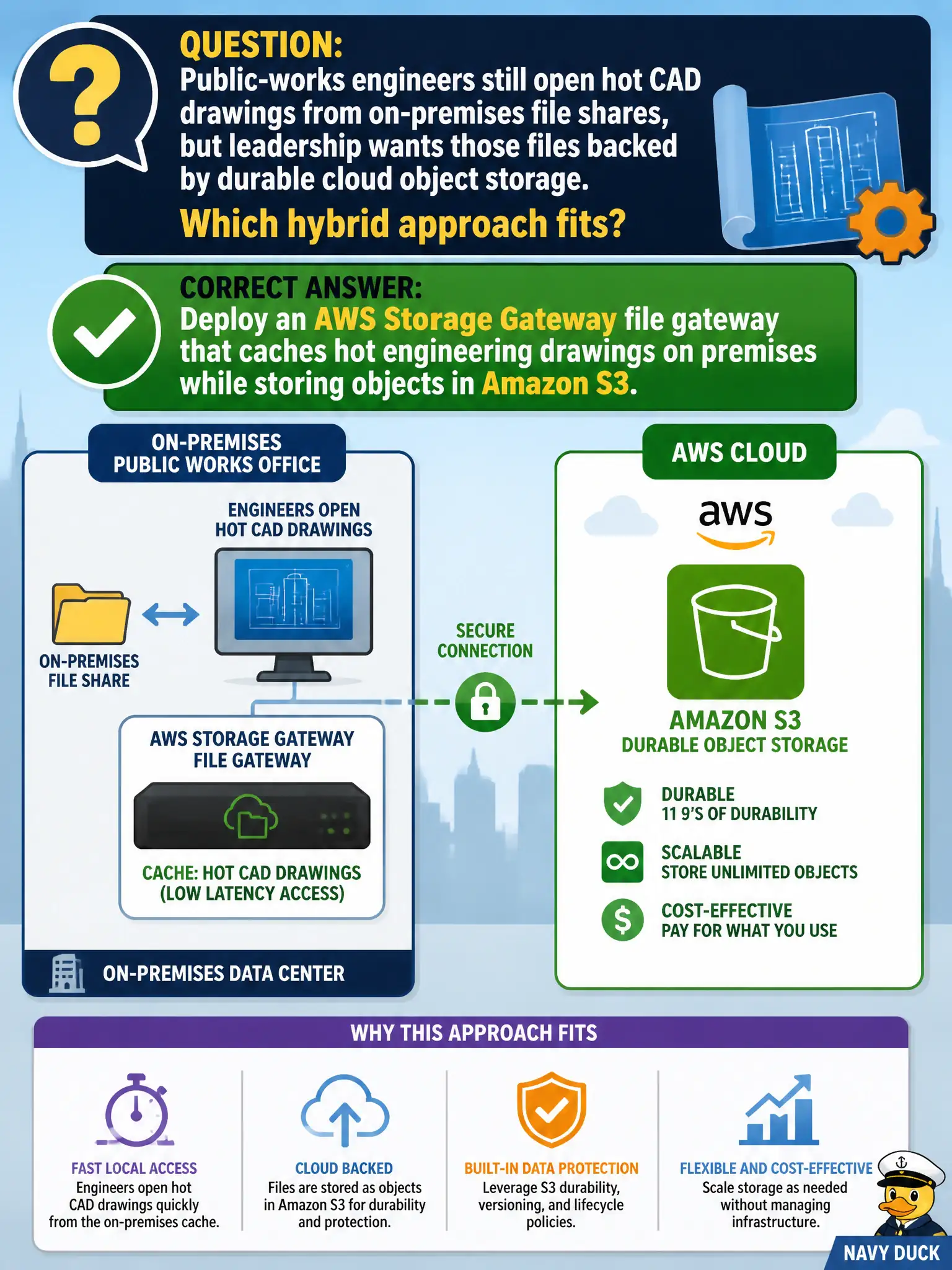
Public-works engineers still open hot CAD drawings from on-premises file shares, but leadership wants those files backed by durable cloud object storage. Which hybrid approach fits?
Select an answer to reveal the explanation.
Short Explanation
File gateway is the neighborhood library branch—hot drawings stay on the shelf upstairs while the durable copies live in the S3 central stacks. Engineers keep SMB/NFS habits without losing cloud durability. Deep Archive for every open is a multi-hour wait at the desk.
Full Explanation
Public-works engineers who still open hot CAD drawings from on-premises file shares, while leadership wants durable cloud object storage behind those files, are a classic hybrid file gateway case. Deploying an AWS Storage Gateway file gateway caches hot engineering drawings on premises while storing objects in Amazon S3. Engineers keep NFS/SMB open semantics for active drawings, and the durable system of record becomes S3 instead of aging NAS alone.
Copying drawings only to Glacier Deep Archive and requiring multi-hour restores for every open fails interactive CAD workflows that need hot reads. Mounting S3 directly as the sole block boot volume for every engineering workstation fails because S3 is not a block boot device for desktops. Disabling on-premises caches and forcing all CAD opens across the internet with no local buffer fails operationally for large drawings and WAN variability even if objects live in S3.
Exam caveat: file gateway still needs backup, AD integration planning where required, and clear tiering so “hot” versus archive paths are understood by public-works staff. Operational check: deploy the file gateway appliance, map CAD shares to S3-backed file shares, verify cache hit behavior for hot drawings, and confirm objects appear durably in the S3 bucket with encryption and lifecycle policies.