
A municipal analytics warehouse on Amazon Redshift is busy only during weekday business hours and sits idle nights and weekends. Which cost control best matches that usage pattern?
Select an answer to reveal the explanation.
Short Explanation
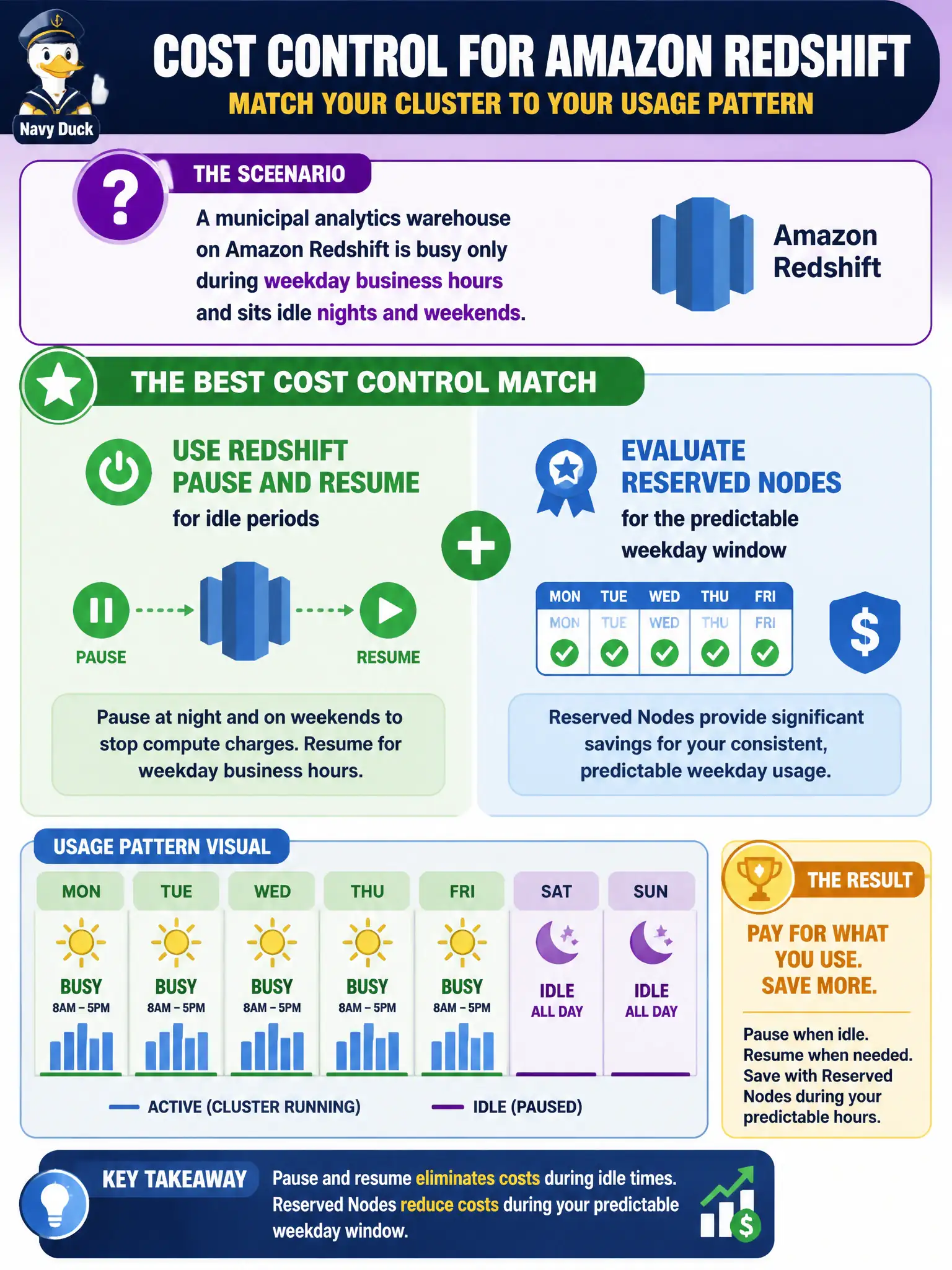
A warehouse that sleeps nights should not burn electricity all night. Pause and resume Redshift when the city hall lights are off, and reserve capacity for the predictable weekday grind.
Full Explanation
Municipal analytics warehouses often mirror city hall hours: heavy Redshift use on weekdays for council dashboards, finance closes, and program reporting, then idle nights and weekends. Amazon Redshift pause and resume stops compute billing during those idle windows while preserving data on the managed storage layer, directly matching the usage pattern. For the predictable weekday on window, evaluating Reserved Nodes (or other commitment discounts appropriate to the cluster) further lowers the cost of capacity the city knows it will run every business day. Together, pause/resume plus weekday reservations attack both wasteful idle hours and steady daytime rates.
Leaving the cluster on 24x7 on-demand nodes fails by concept: idle nights still accrue node hours with no analytic value. Migrating the warehouse into Amazon SQS FIFO queues confuses a message queue with a columnar MPP warehouse—SQS cannot replace SQL aggregations, vacuum/analyze workflows, or BI tool connectivity. Duplicating the cluster in every AWS Region spreads idle spend globally and multiplies storage and node cost without addressing the business-hours pattern.
Exam caveat: pause/resume is ideal for non-24x7 warehouses; latency-sensitive always-on citizen-facing analytics may need a different sizing or concurrency strategy. Also confirm snapshot and resume time fit the morning report window so clerks are not waiting on a cold start.
Operational check: chart Redshift CPUUtilization and query activity by hour in CloudWatch or Query Monitoring, schedule pause after the last weekday job and resume before the first morning extract, compare on-demand versus reserved pricing for the measured weekday footprint, and validate that month-end and council-packet jobs complete within the resumed window without leaving the cluster burning overnight.