
A township finance Aurora cluster feels slow, and staff want to jump to a much larger instance class immediately. What should the architect do first to avoid unnecessary cost?
Select an answer to reveal the explanation.
Short Explanation
Don't buy a bigger truck until you check whether the trailer hitch is the problem. Performance Insights and CloudWatch tell you what to right-size before you open the wallet.
Full Explanation
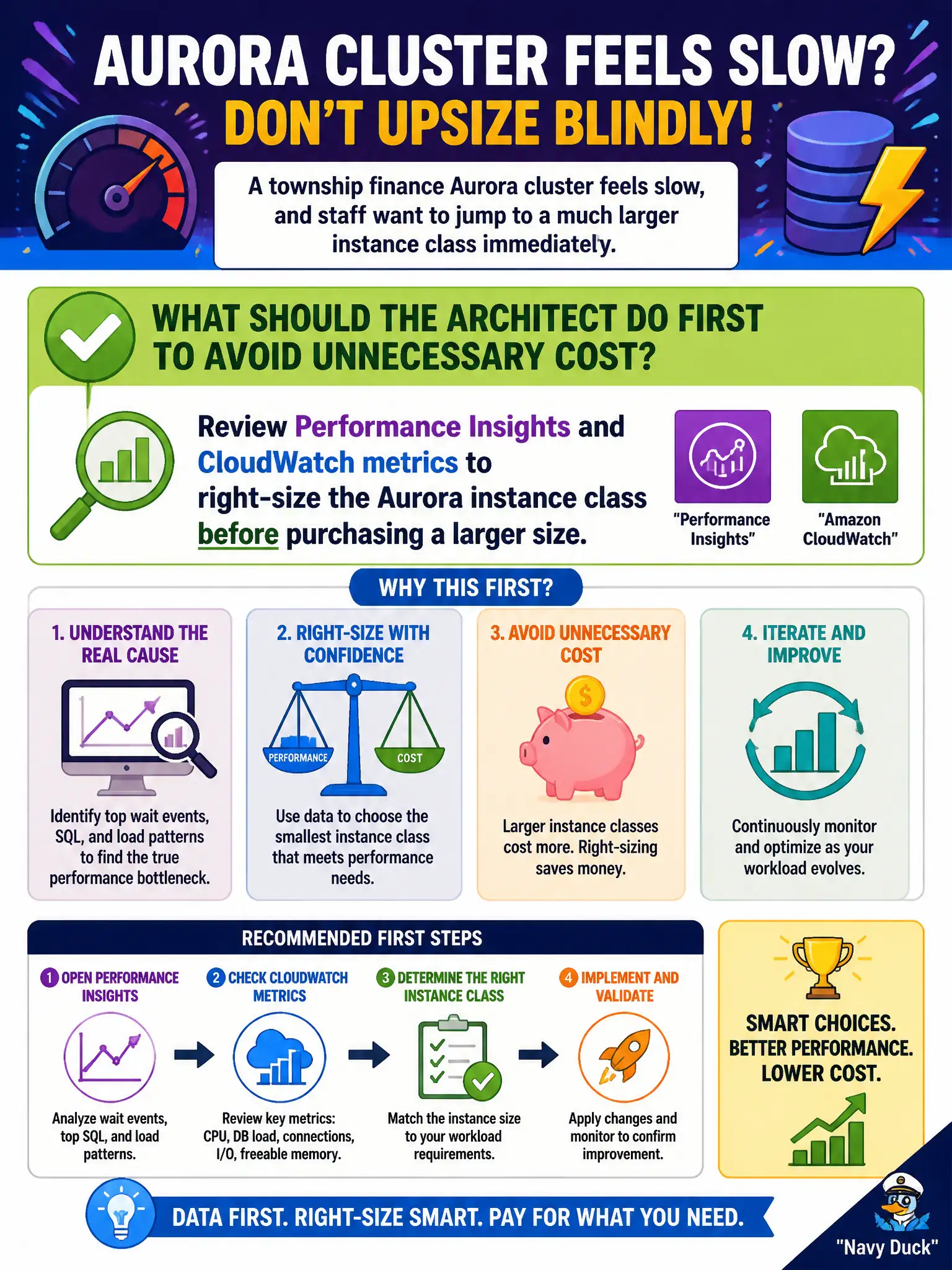
When a township finance Aurora cluster feels slow, jumping straight to a much larger instance class is a common cost anti-pattern. The architect should first review Amazon RDS Performance Insights and Amazon CloudWatch metrics—CPU, freeable memory, database connections, disk queue depth, commit latency, and top SQL wait events—to determine whether the bottleneck is CPU-bound, I/O-bound, lock contention, missing indexes, chatty application patterns, or a few pathological queries. Right-sizing (or query/index remediation) often restores SLA without purchasing a larger class, preserving municipal budget for citizen services rather than oversized databases.
Immediately buying the largest Aurora instance in every Region fails by concept: spend multiplies without evidence and does not fix bad SQL. Disabling Performance Insights and CloudWatch to save monitoring cost before upsizing removes the only data that justifies capacity decisions—false economy. Adding cross-Region read replicas first addresses geographic locality or DR, not unexplained local slowness, and adds replication transfer plus remote instance cost.
Exam caveat: Performance Insights and metrics guide action; they do not replace the need to act. If metrics prove sustained CPU saturation with healthy SQL, upsizing or adding Aurora replicas for read scale can be correct—just not as a blind first step.
Operational check: capture a baseline week of Performance Insights for payroll and AP workloads, identify top wait events and SQL digests, correlate with CloudWatch CPUUtilization and FreeableMemory, remediate indexes or connection pooling where indicated, then size the instance class to measured demand and re-check finance batch windows and interactive clerk latency before approving a larger purchase.