
A field office needs block storage for a legacy application but wants to avoid buying a full on-premises disk array for mostly cold data. Which hybrid approach best minimizes local disk purchase while using Amazon S3 as durable backing store?
Select an answer to reveal the explanation.
Short Explanation
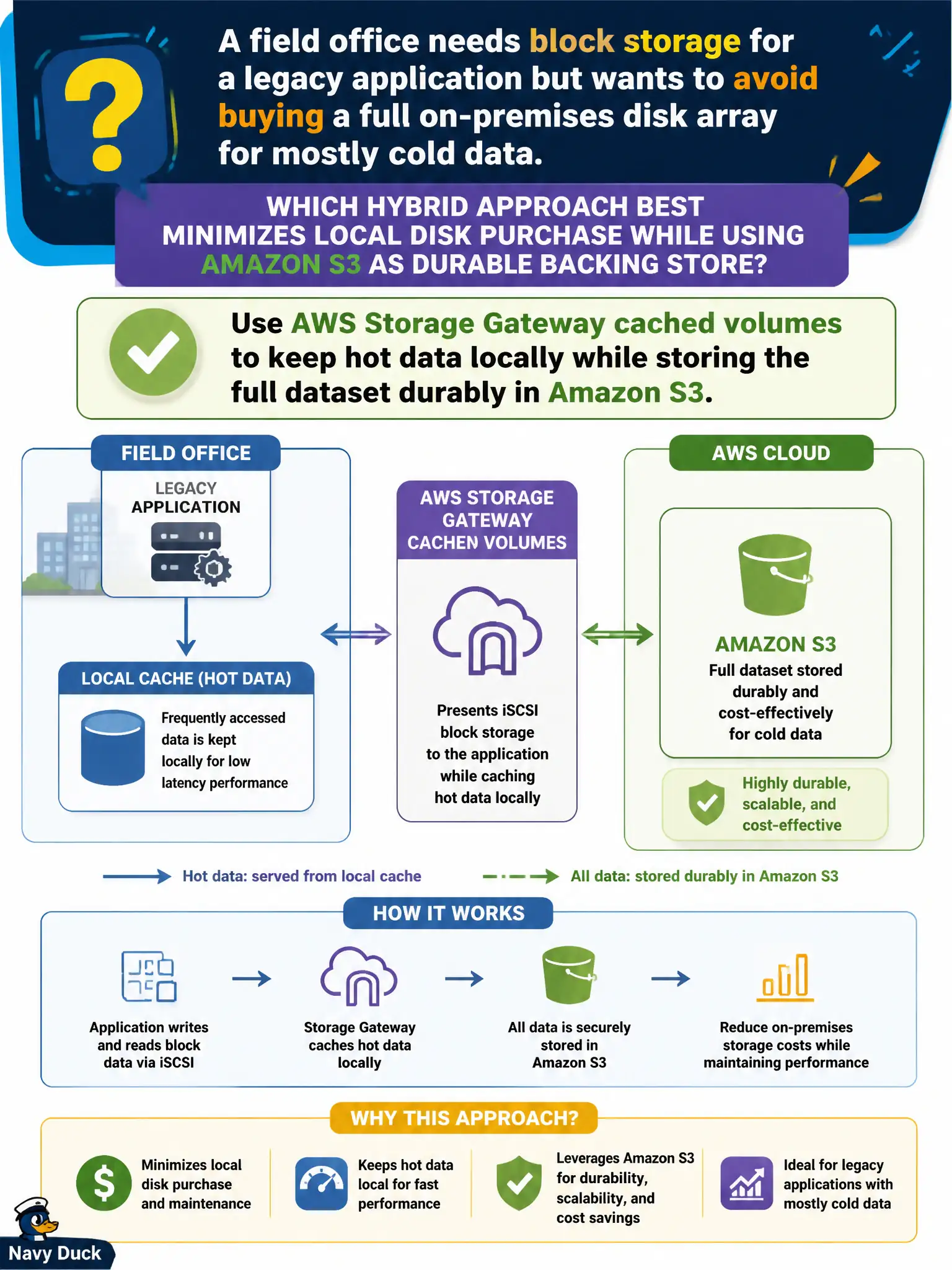
Cached volumes are like a desk drawer for today’s folders while the warehouse holds everything else in S3. You buy less local disk and still feed the legacy block app. Full SANs everywhere, Deep Archive without a cache, or raw S3 REST to a block app miss that hybrid cost trick.
Full Explanation
AWS Storage Gateway cached volumes minimize local disk purchase for a field office legacy block application by keeping hot data in a local cache while storing the full dataset durably in Amazon S3. The legacy app continues to speak block protocols, but the city avoids buying a full on-premises disk array sized for the entire cold working set. Purchasing a second full SAN for every satellite office regardless of working-set size maximizes capital expense and ignores hybrid cloud economics. Storing application block data only in Amazon Glacier Deep Archive without a gateway cache cannot meet interactive block I/O needs and lacks the protocol translation layer. Running the legacy block application directly against public S3 REST APIs without protocol translation fails because the application expects block semantics, not object GETs/PUTs. Exam caveat: cached volume performance depends on cache sizing and working-set locality; cold-cache misses retrieve from AWS and add latency, so size cache for the true hot set. Operational check: size the local cache from observed working-set metrics, run the legacy application against a pilot cached volume, measure miss latency under field-office workflows, and document upload buffer and recovery procedures.