
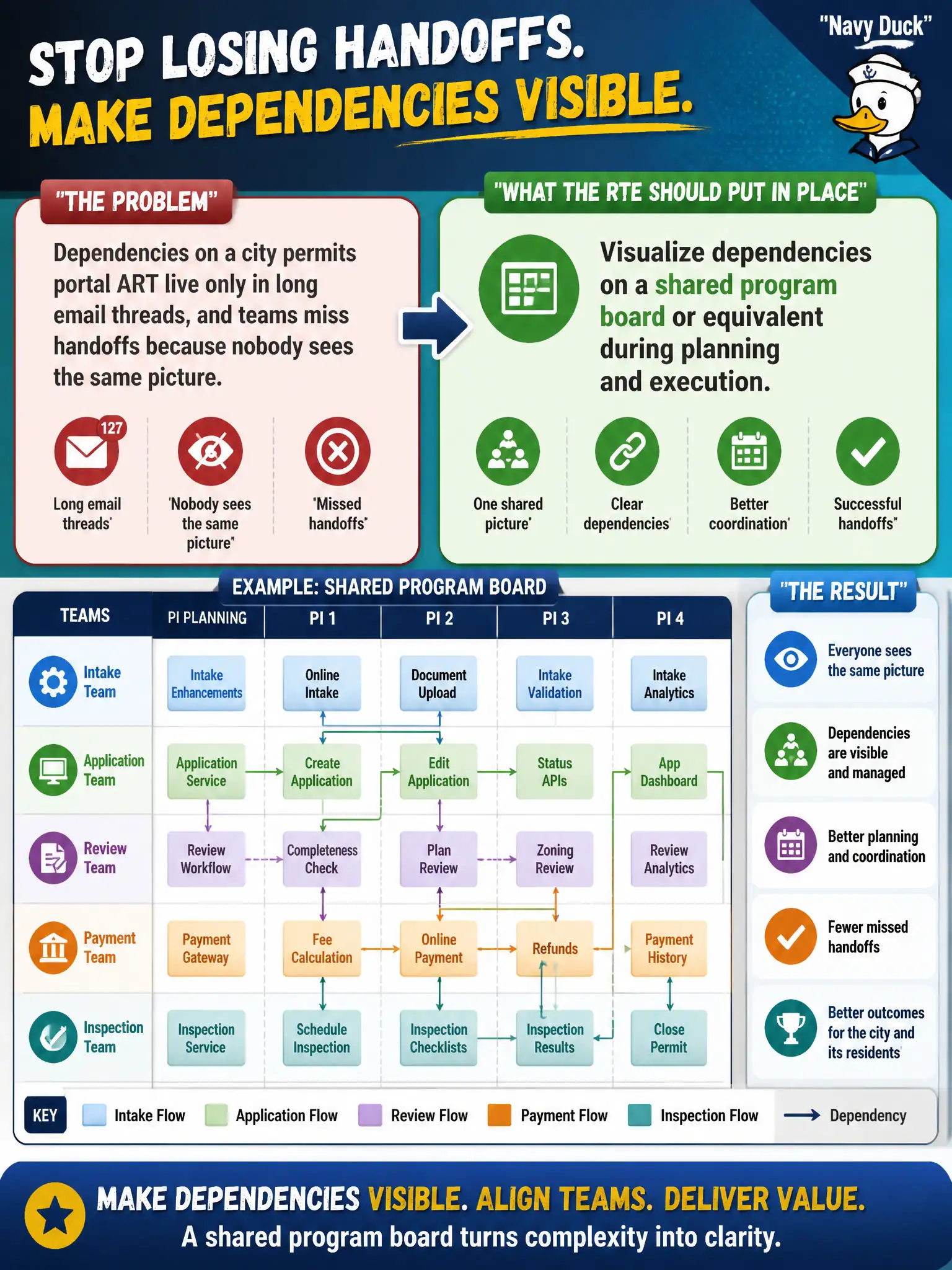
Dependencies on a city permits portal ART live only in long email threads, and teams miss handoffs because nobody sees the same picture. What should the RTE put in place?
Select an answer to reveal the explanation.
Short Explanation
Email is a hallway conversation. A dependency board is the intersection with traffic lights. Permit teams cannot see a red light buried in someone's inbox.
Full Explanation
Dependencies must be visualized on a shared program board or equivalent during planning and kept alive during execution so teams share one picture of handoffs. When city permits portal dependencies live only in long email threads and teams miss handoffs, the RTE should put shared visualization in place. Requiring every dependency to stay in email for an audit trail prioritizes archive over coordinated action and still leaves no common picture. Assigning all cross-team permits work to a single hero team to eliminate dependencies on paper concentrates risk and often exceeds that team's capacity. Discussing dependencies only at Inspect and Adapt after missed handoffs have already occurred is forensic, not preventive. 911 dispatchers cannot absorb uncoordinated CAD/RMS changes; the ART Sync exists to align teams on public-safety integration work in flight. Exam caveat: email can notify, but it is not the system of record for ART dependency state. Operational check: migrate open permits dependencies onto the program board with owners and dates, and review stale items each ART sync. Keep CAD/RMS dependency and risk topics first on the ART Sync agenda when public-safety go-lives approach.