
Mid-PI, an open-data and civic-engagement ART treats this iteration's team goals as a replacement for the PI Objectives agreed at planning. What distinction should the RTE reinforce?
Select an answer to reveal the explanation.
Short Explanation
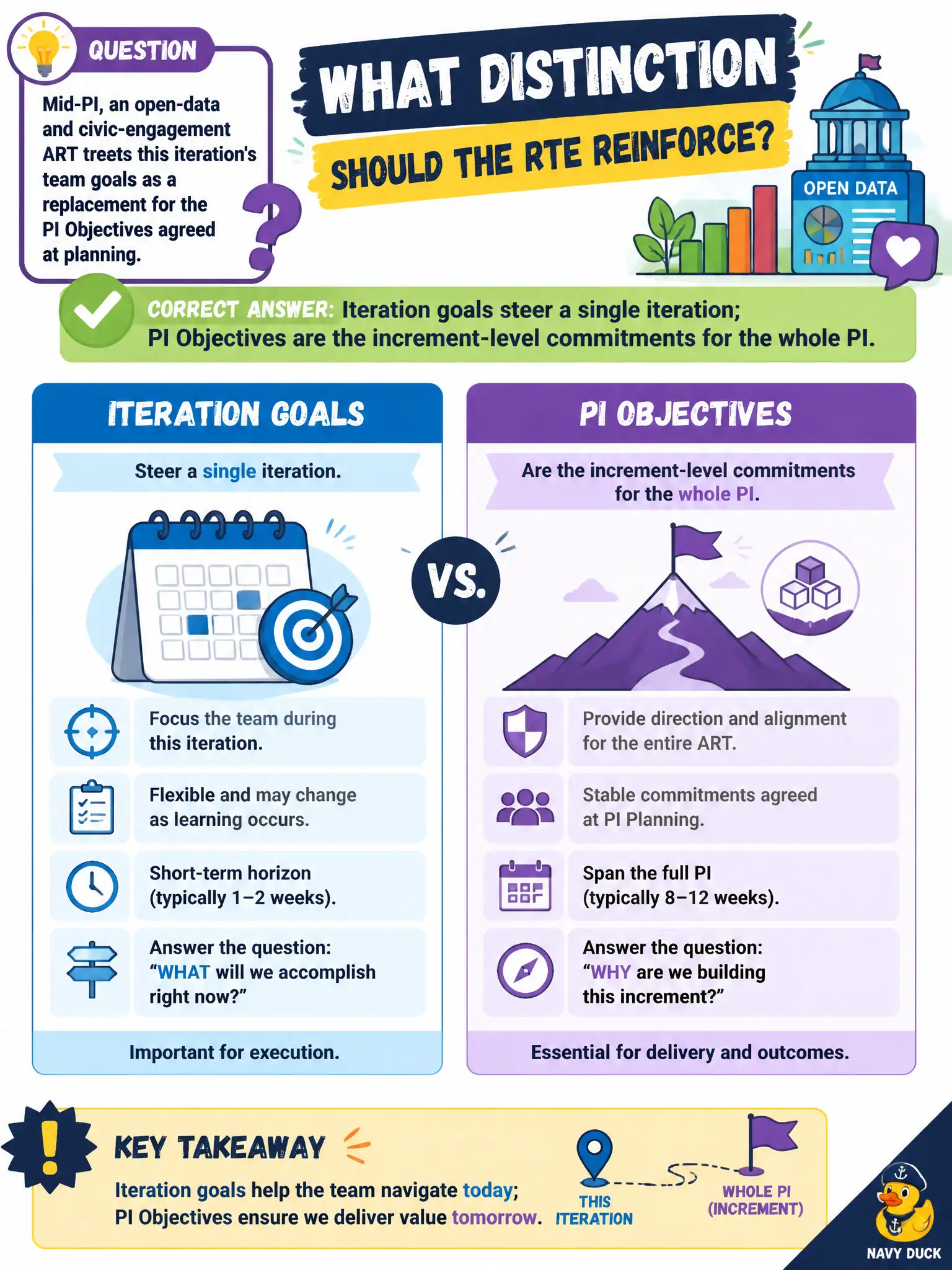
Iteration goals are this week's grocery list. PI Objectives are the month's meal plan. Civic-engagement teams still need both, and one does not overwrite the other.
Full Explanation
Iteration goals steer a single iteration; PI Objectives are the increment-level commitments for the whole PI. Mid-PI, when an open-data and civic-engagement ART treats this iteration's team goals as a replacement for PI Objectives agreed at planning, the RTE should reinforce that distinction so the train does not lose the PI baseline. Treating iteration goals and PI Objectives as the same list reprinted every two weeks collapses planning horizons. Claiming PI Objectives expire after Day 1 of the first iteration abandons the PI plan immediately. Claiming iteration goals replace ART PI Objectives as soon as the first System Demo occurs confuses demo scope with PI commitments. Immunization clinics and public-health partners need ART risks managed in the open; hiding registry risks protects no one who relies on the data. Exam caveat: iteration goals should advance PI Objectives—they are nested, not competing replacements. Operational check: in planning the next iteration, show each open-data team's iteration goals mapped upward to PI Objectives still in play. Update ROAM owners each ART Sync and escalate stuck risks that threaten clinic-facing registry outcomes. Hold the civic standard in facilitation notes so the next RTE inherits the same expectation for resident-facing outcomes.