
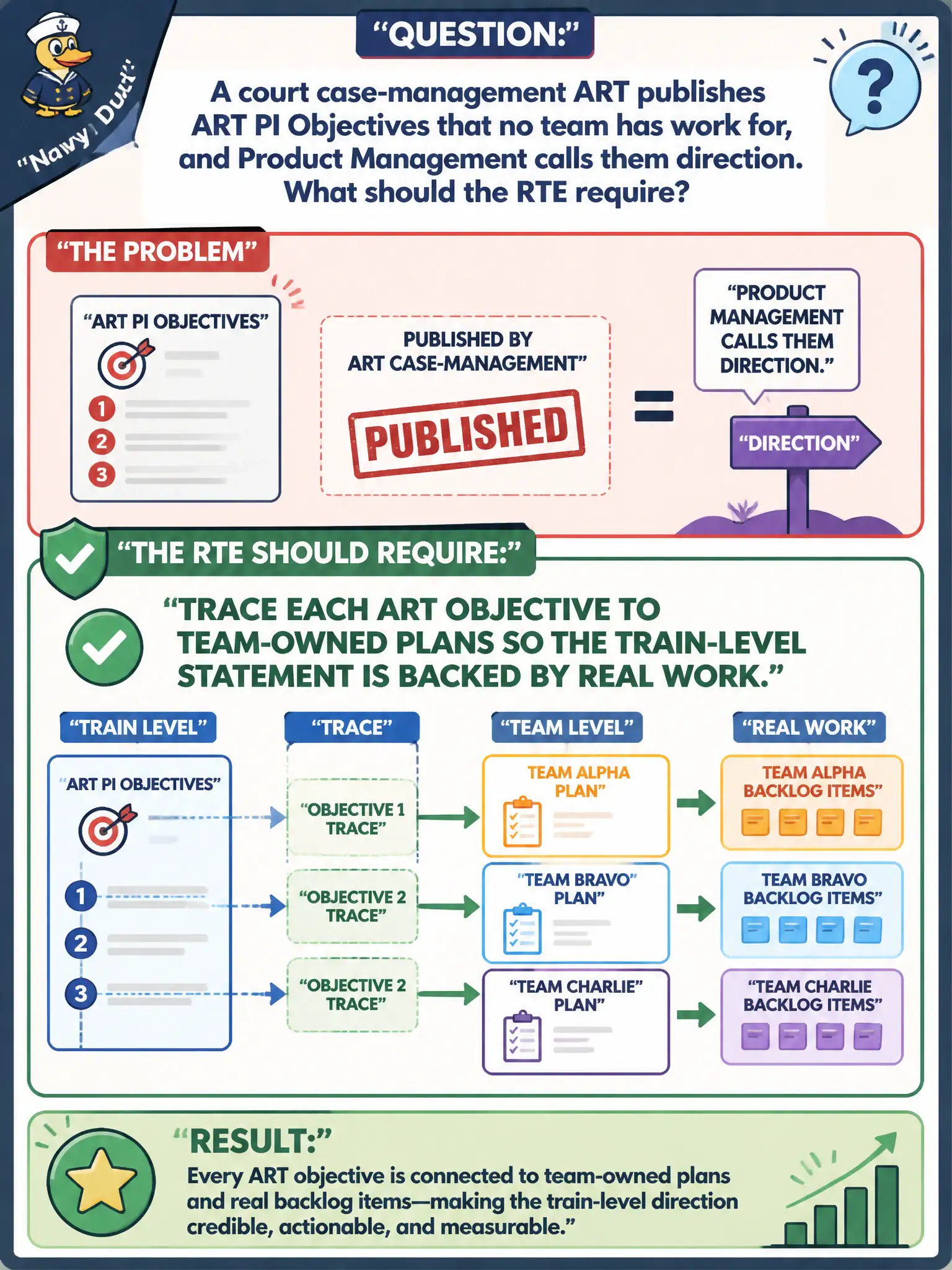
A court case-management ART publishes ART PI Objectives that no team has work for, and Product Management calls them direction. What should the RTE require?
Select an answer to reveal the explanation.
Short Explanation
An ART objective nobody owns is a slogan on the courthouse lawn. If no team has a plan under it, it is not a commitment. Tie every train-level line to team work.
Full Explanation
ART PI Objectives must be backed by team-owned plans; orphan train statements with no team work are posters, not commitments. When a court case-management ART publishes ART objectives no team has work for, and Product Management calls them direction, the RTE should require tracing each ART objective to team-owned plans. Keeping orphan ART objectives as motivational posters above the planning room creates false leadership confidence. Assigning orphan objectives to the RTE as a personal backlog confuses facilitation with delivery ownership. Converting unowned ART objectives into portfolio epics without team involvement escalates fiction instead of creating capacity. Library patrons and member libraries feel integration failures; early integration reduces late civic demo risk on digital-services trains. Exam caveat: ART objectives can be broader than a single team, but they still require identifiable contributing team objectives or features. Operational check: before publishing the court ART objective set, map each item to one or more team plans and remove any with zero mapped work. Check that at least one cross-team integration slice appears in each iteration review before the PI System Demo.