
A team on a public works work-order ART silently drops a committed PI Objective mid-increment and does not mention it in any ART sync. What should the RTE expect?
Select an answer to reveal the explanation.
Short Explanation
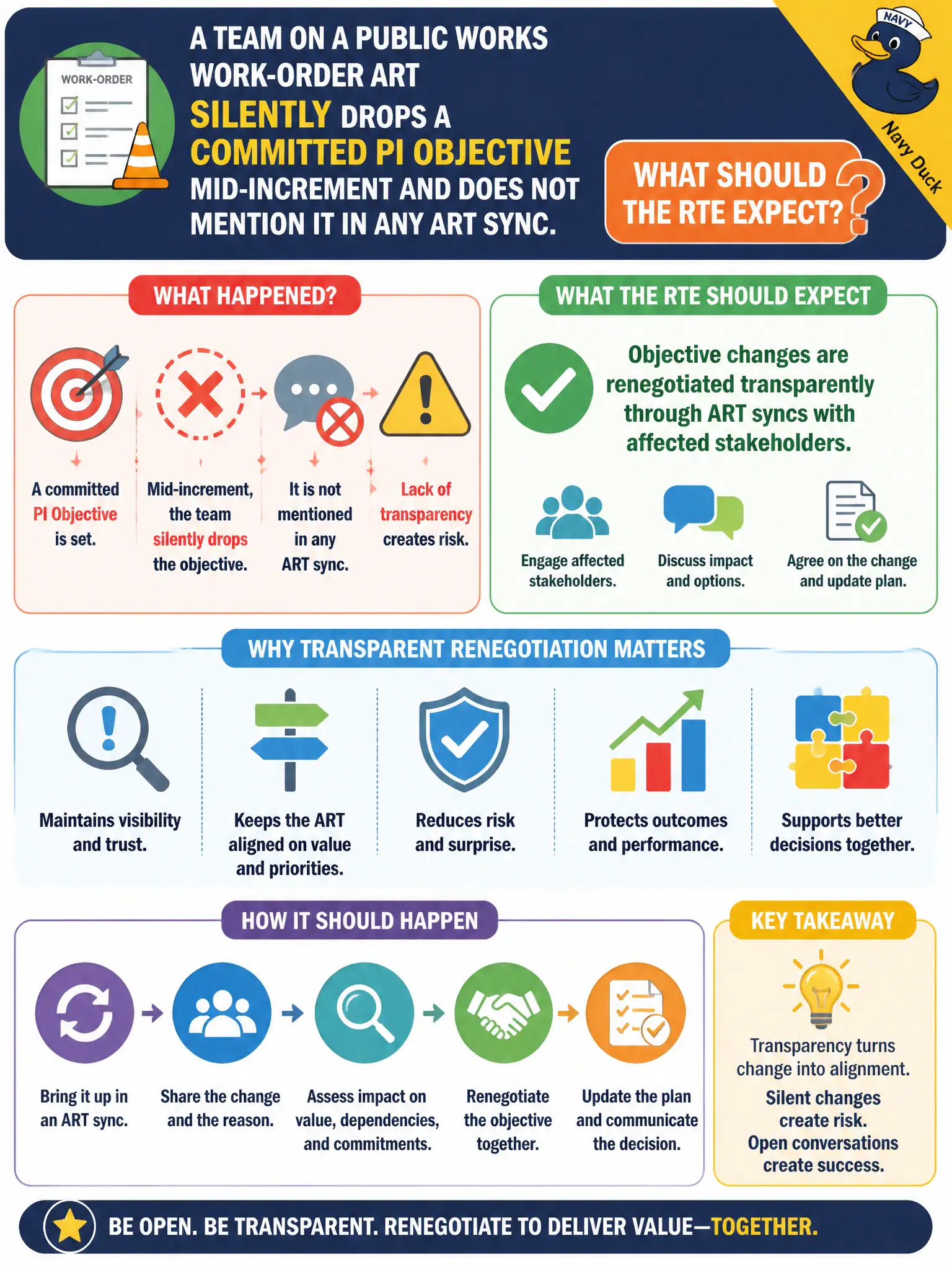
If a work-order team dumps a promised objective in the night, the rest of the train is still driving toward it. Say it in the sync. Renegotiate in the open.
Full Explanation
Committed PI Objectives are renegotiated transparently through ART syncs with affected stakeholders when reality changes; silent drops hide risk from the train. When a public works work-order team silently abandons a committed objective mid-increment without mentioning it in any ART sync, the RTE should expect transparent renegotiation, not quiet disappearance. Accepting silent drops if the team backfills with extra chores rewards opacity and breaks dependency partners who planned around the objective. Forcing unpaid overtime after the PI to complete an abandoned objective punishes people instead of fixing planning and communication. Privately rewriting ART PI Objectives so the gap never appears in Inspect and Adapt falsifies results. Public-works crews and residents waiting on work orders are harmed when committed objectives vanish without ART visibility; silence is a transparency failure. Exam caveat: dropping scope can be legitimate under capacity shock—but only when surfaced and agreed. Operational check: in ART sync, require any objective status change to be stated aloud, with Business Owner or Product Management acknowledgment recorded on the ART board. Require any objective drop or renegotiation to appear on the next ART Sync agenda with impact to dependent teams.