
On a municipal utilities billing ART, Business Owners assigned planned business value during PI Planning and never looked at those scores again. What should the RTE restore during execution reviews?
Select an answer to reveal the explanation.
Short Explanation
Planned business value is the grade on the syllabus. Actual value is the grade after the test. If billing Business Owners never come back, the ART is studying a course it never scores.
Full Explanation
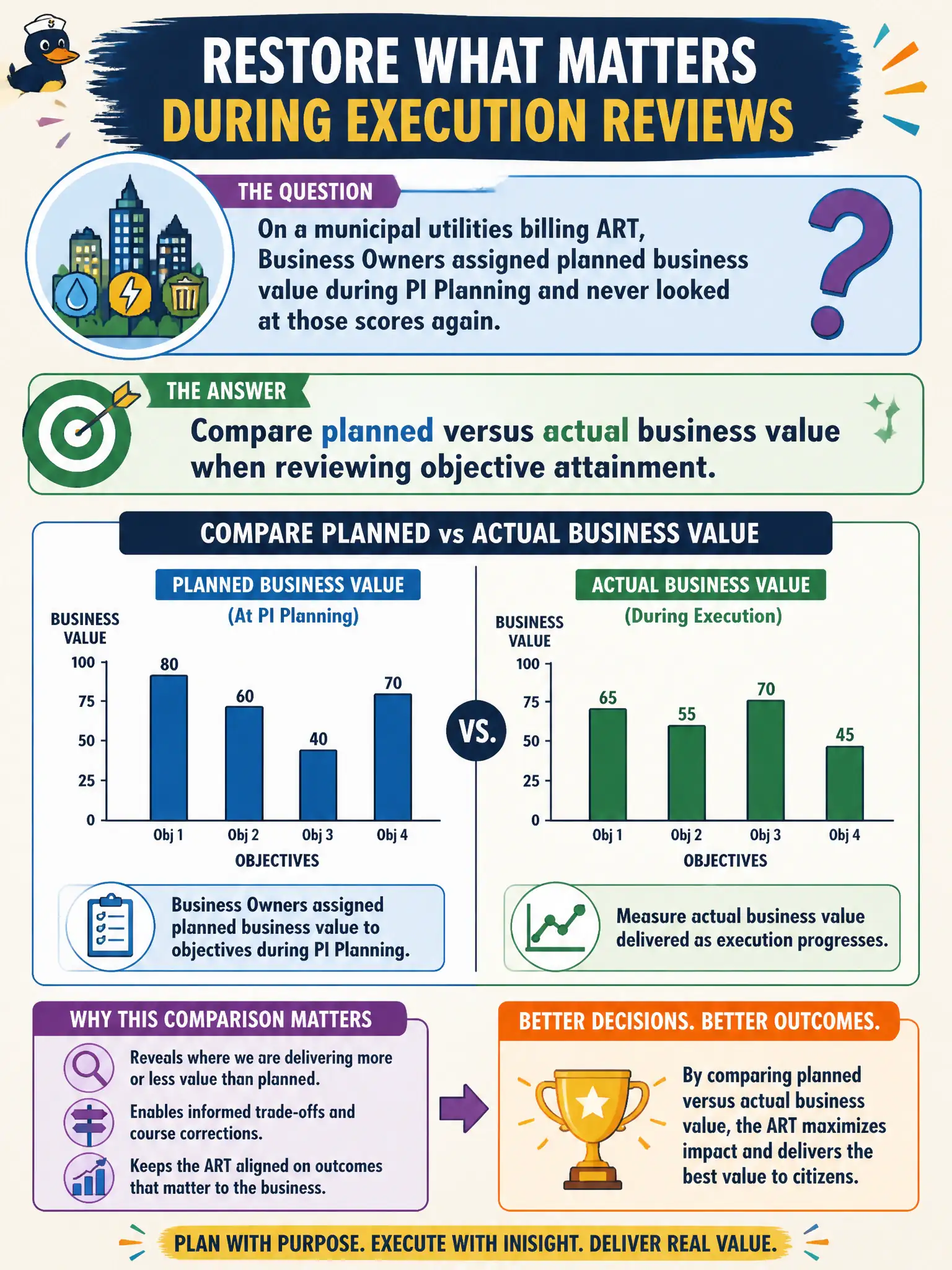
Business Owners assign planned business value during PI Planning and later compare planned versus actual value when reviewing objective attainment. On a municipal utilities billing ART where scores were assigned once and never revisited, the RTE should restore planned-versus-actual comparison during execution reviews and Inspect and Adapt. Deleting planned scores so no one can compare them to results erases the learning loop. Letting teams assign their own actual business value in private so Business Owners stay out of Inspect and Adapt usurps the Business Owner role. Converting business value into story points so finance can sum velocity confuses economic priority with effort estimates. Utilities customers experience billing outcomes; planned-versus-actual business value tells sponsors whether those civic outcomes landed, not whether teams stayed busy. Exam caveat: actual business value is a judgment call by Business Owners after seeing results—it is not an automated telemetry feed. Operational check: at the next billing ART review, display planned BV beside each objective and facilitate Business Owners assigning actual BV before discussing predictability. Record actual BV beside planned BV in the I&A readout so the next PI forecast for billing improves with evidence.