
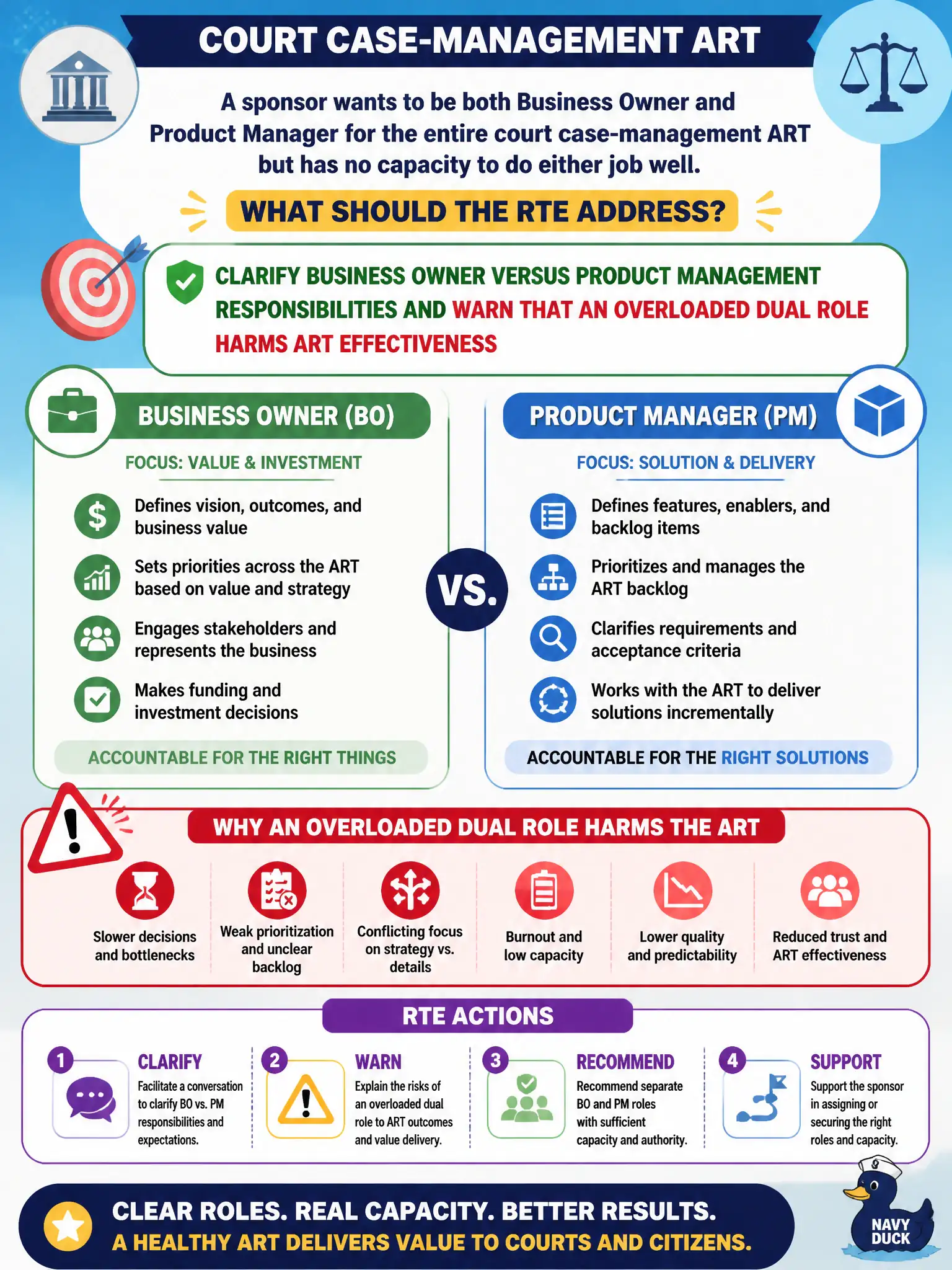
A sponsor wants to be both Business Owner and Product Manager for the entire court case-management ART but has no capacity to do either job well. What should the RTE address?
Select an answer to reveal the explanation.
Short Explanation
Two hats, no hours: Business Owners set value while Product Management owns the Program Backlog. If one court sponsor grabs both and has no time, both jobs fail, so clear roles beat a stacked title.
Full Explanation
Clarify Business Owner versus Product Management responsibilities and warn that an overloaded dual role harms ART effectiveness. When a sponsor wants both titles for an entire court case-management ART without capacity to do either well, the RTE should address role clarity and capacity rather than celebrating concentrated authority. Combining the roles permanently so one person can skip coordination often yields neglected backlog and neglected value assignment for the court. Adding RTE duties to the same sponsor so all authority sits in one chair creates a single point of failure and role soup. Leaving the titles stacked and measuring success only by meeting attendance ignores whether Program Backlog prioritization and business value assignment actually occur. Exam caveat: Dual roles can work briefly with enough time; the exam focus is honesty about capacity and distinct responsibilities. Operational check: Map hours required for Business Owner and Product Management duties on the court ART, compare to the sponsor's available time, and split or staff accordingly before the next PI. In municipal settings, pressure to look busy, compliant, or politically safe is constant; the RTE earns trust by holding the principle through that pressure and verifying the next cadence event shows improved civic delivery, not just a quieter meeting. Capture the before/after signal so sponsors see the operational evidence.