
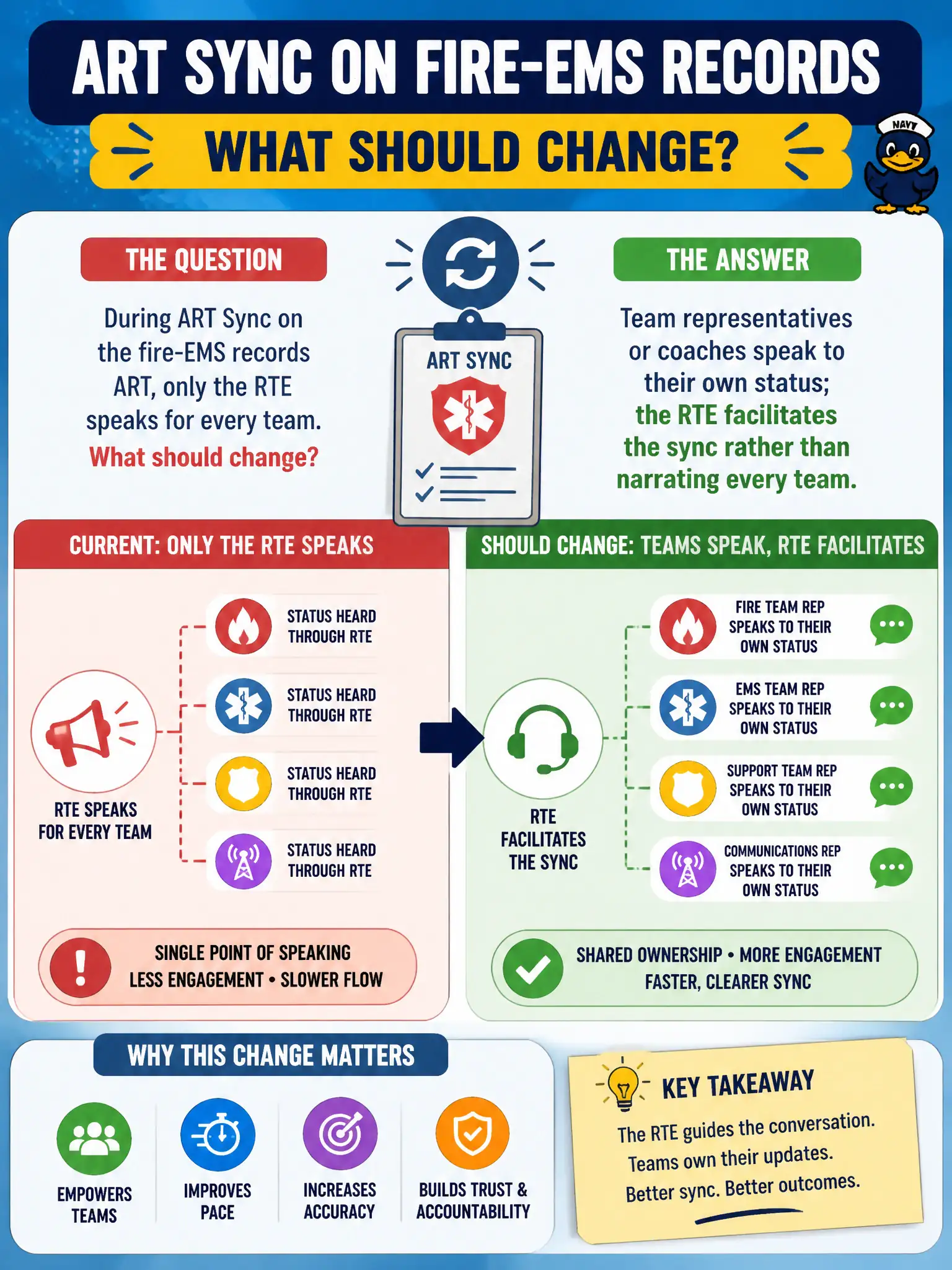
During ART Sync on the fire-EMS records ART, only the RTE speaks for every team. What should change?
Select an answer to reveal the explanation.
Short Explanation
ART Sync is a conversation among the train, not a one-person radio show. The RTE holds the microphone, then hands it over. Fire-EMS teams and their coaches should speak their own status.
Full Explanation
Team representatives or coaches speak to their own status; the RTE facilitates ART Sync rather than narrating every team. When only the RTE speaks for every team on a fire-EMS records ART Sync, the event becomes a one-person radio show that hides team reality and weakens ownership. The RTE should hand the microphone to teams and coaches. Writing every team's iteration goals so the narrative stays consistent further centralizes control and falsifies team planning. Skipping ART Sync and emailing the RTE a weekly paragraph removes real-time coordination for records dependencies. Replacing teams with Product Management at ART Sync because content owners know more excludes the people closest to delivery impediments. Exam caveat: The RTE may summarize themes after teams speak; summarizing is not a substitute for teams speaking first. Operational check: Change the fire-EMS ART Sync agenda to team-led updates with RTE facilitation prompts, and measure speak-time returning to teams. In municipal settings, pressure to look busy, compliant, or politically safe is constant; the RTE earns trust by holding the principle through that pressure and verifying the next cadence event shows improved civic delivery, not just a quieter meeting. Capture the before/after signal so sponsors see the operational evidence.