
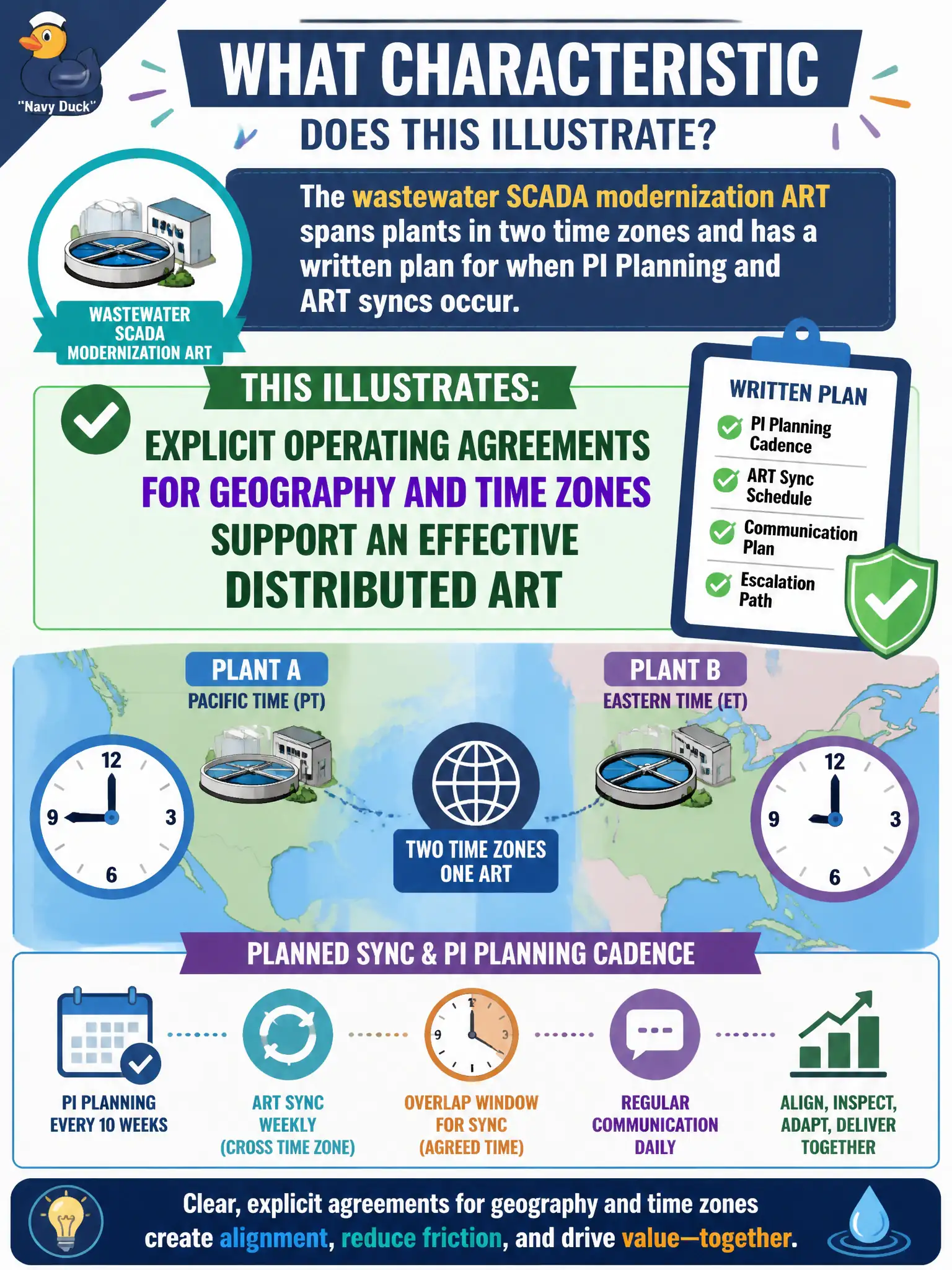
The wastewater SCADA modernization ART spans plants in two time zones and has a written plan for when PI Planning and ART syncs occur. What characteristic does this illustrate?
Select an answer to reveal the explanation.
Short Explanation
Two plants, two clocks, one train—someone has to write down when the huddle happens. Operating agreements are that written deal. Without them, distributed just means nobody shows up.
Full Explanation
Explicit operating agreements for geography and time zones support an effective distributed ART. A wastewater SCADA modernization ART spanning plants in two time zones with a written plan for when PI Planning and ART syncs occur illustrates that characteristic—clarity that keeps plant modernization coordinated. Saying distributed ARTs should avoid any calendar so plants can improvise guarantees missed syncs and dependency surprises. Claiming SCADA work cannot use SAFe events because plants are 24-by-7 ignores that operating agreements can respect shift realities while preserving cadence. Allowing only the day shift to attend ART events excludes night-shift knowledge critical to SCADA operations. Exam caveat: Agreements should be revisited when shift patterns change; writing them once is not forever. Operational check: Publish the SCADA ART's time-zone event matrix, confirm representation from each plant, and adjust once after a PI based on attendance and decision-quality feedback. In municipal settings, pressure to look busy, compliant, or politically safe is constant; the RTE earns trust by holding the principle through that pressure and verifying the next cadence event shows improved civic delivery, not just a quieter meeting. Capture the before/after signal so sponsors see the operational evidence.