
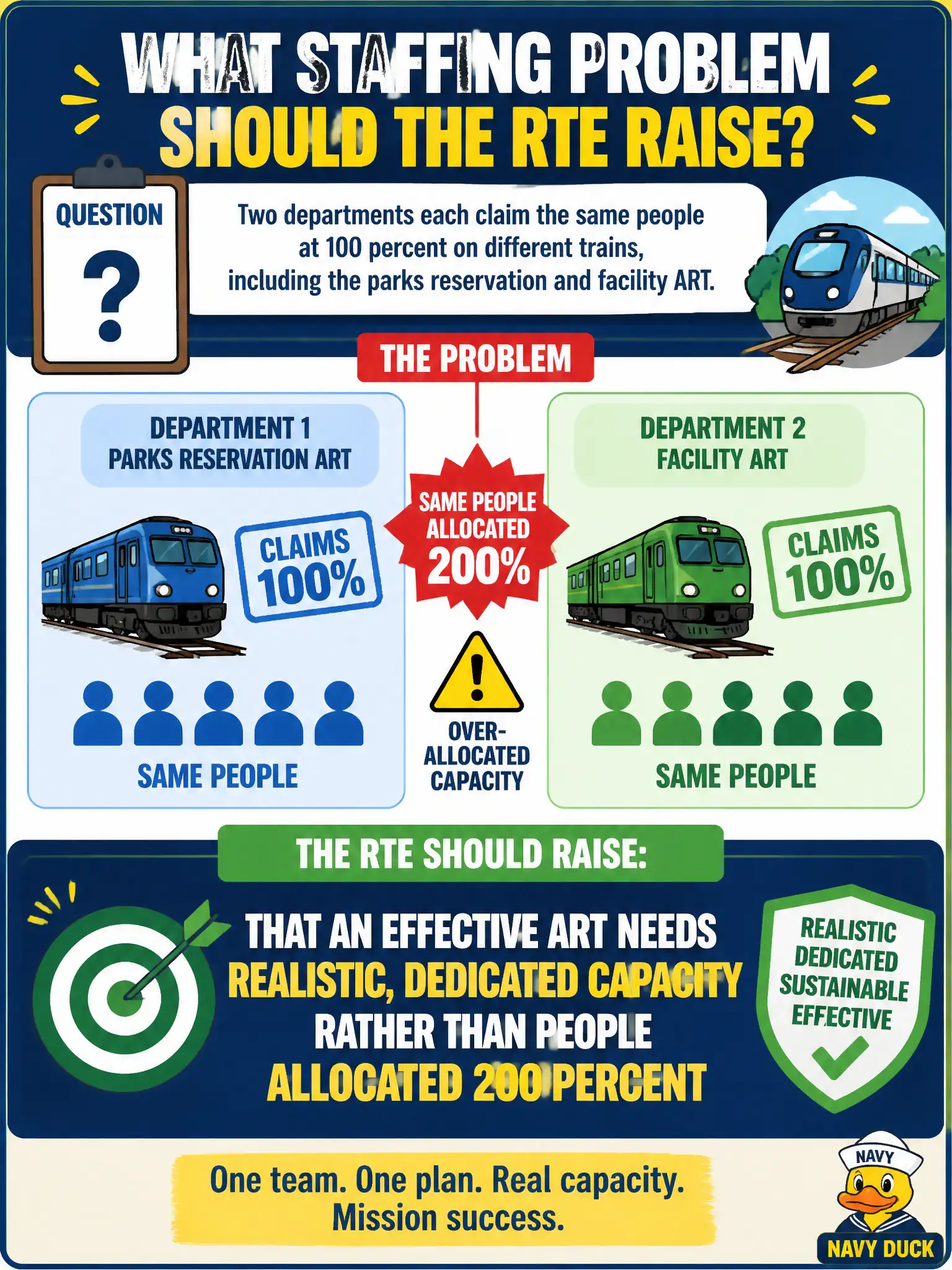
Two departments each claim the same people at 100 percent on different trains, including the parks reservation and facility ART. What staffing problem should the RTE raise?
Select an answer to reveal the explanation.
Short Explanation
Nobody is two full-time people, even on a parks reservation train. If two departments each claim 100 percent, the ART is planning on fiction. Dedicated, realistic capacity is what makes a train real.
Full Explanation
An effective ART needs realistic, dedicated capacity rather than people allocated 200 percent. When two departments each claim the same people at 100 percent on different trains, including a parks reservation and facility ART, the RTE should raise that the plan is fiction and will miss civic reservation outcomes. Assuming double-booked people will automatically increase ART velocity confuses headcount math with available hours. Adding a third 100 percent allocation to a utilities train worsens the over-allocation. Ignoring allocation math because the org chart lists everyone as matrixed accepts a structural lie in PI Planning. Exam caveat: Some shared specialists are normal; the failure mode is planning as if partial people are fully present on every train. Operational check: Build a capacity sheet for parks PI Planning that shows true available FTEs after other train claims, and renegotiate dedications before committing PI Objectives. In municipal settings, pressure to look busy, compliant, or politically safe is constant; the RTE earns trust by holding the principle through that pressure and verifying the next cadence event shows improved civic delivery, not just a quieter meeting. Capture the before/after signal so sponsors see the operational evidence.