
The municipal transit fare-system ART is being restaffed after every project charter instead of keeping long-lived teams. What characteristic of an effective ART should the RTE defend?
Select an answer to reveal the explanation.
Short Explanation
Fare-system teams are more like a transit line than a one-off construction crew. Keep the same people on the same route so they learn the work. Constant reshuffles reset the train every time.
Full Explanation
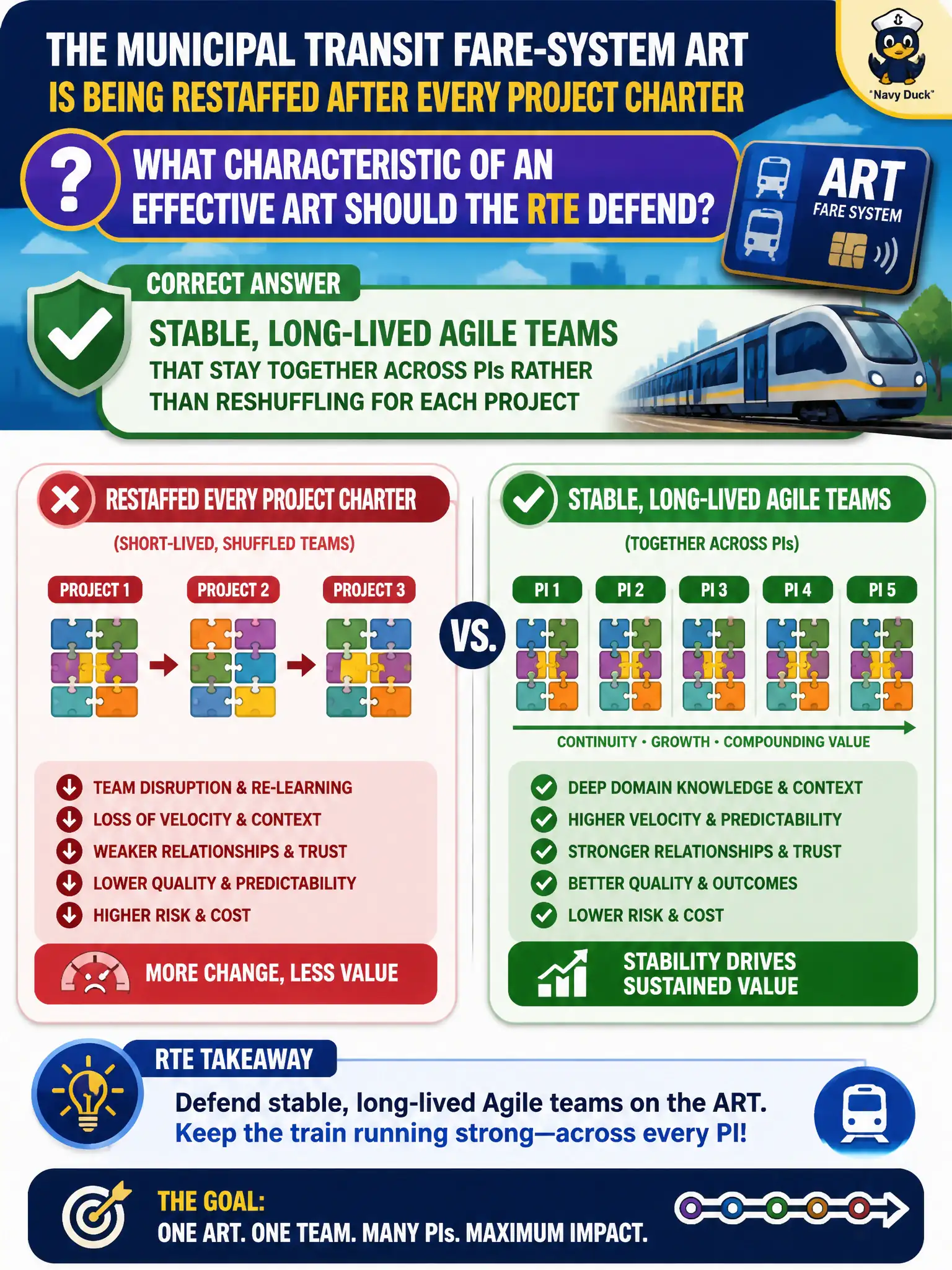
Stable, long-lived Agile teams that stay together across PIs are a characteristic of an effective ART. When a municipal transit fare-system ART is restaffed after every project charter, the train loses team identity, estimating history, and improvement momentum riders depend on. The RTE should defend long-lived teams rather than project-shaped churn. Project-by-project reassignments so each charter gets a fresh org chart recreate handoff waste SAFe tries to eliminate. Disbanding teams at the end of every PI to keep people flexible destroys the social and technical fabric that makes fare increments predictable. Hiring only temporary contractors so no team identity can form may fill seats while preventing high-performing teams from emerging. Exam caveat: Capacity can flex and specialists can rotate with care; the anti-pattern is wholesale reshuffling as the default staffing model. Operational check: Compare fare ART membership across the last two PIs; if churn is high, escalate a stability target and measure predictability before and after retaining core teams. In municipal settings, pressure to look busy, compliant, or politically safe is constant; the RTE earns trust by holding the principle through that pressure and verifying the next cadence event shows improved civic delivery, not just a quieter meeting. Capture the before/after signal so sponsors see the operational evidence.