
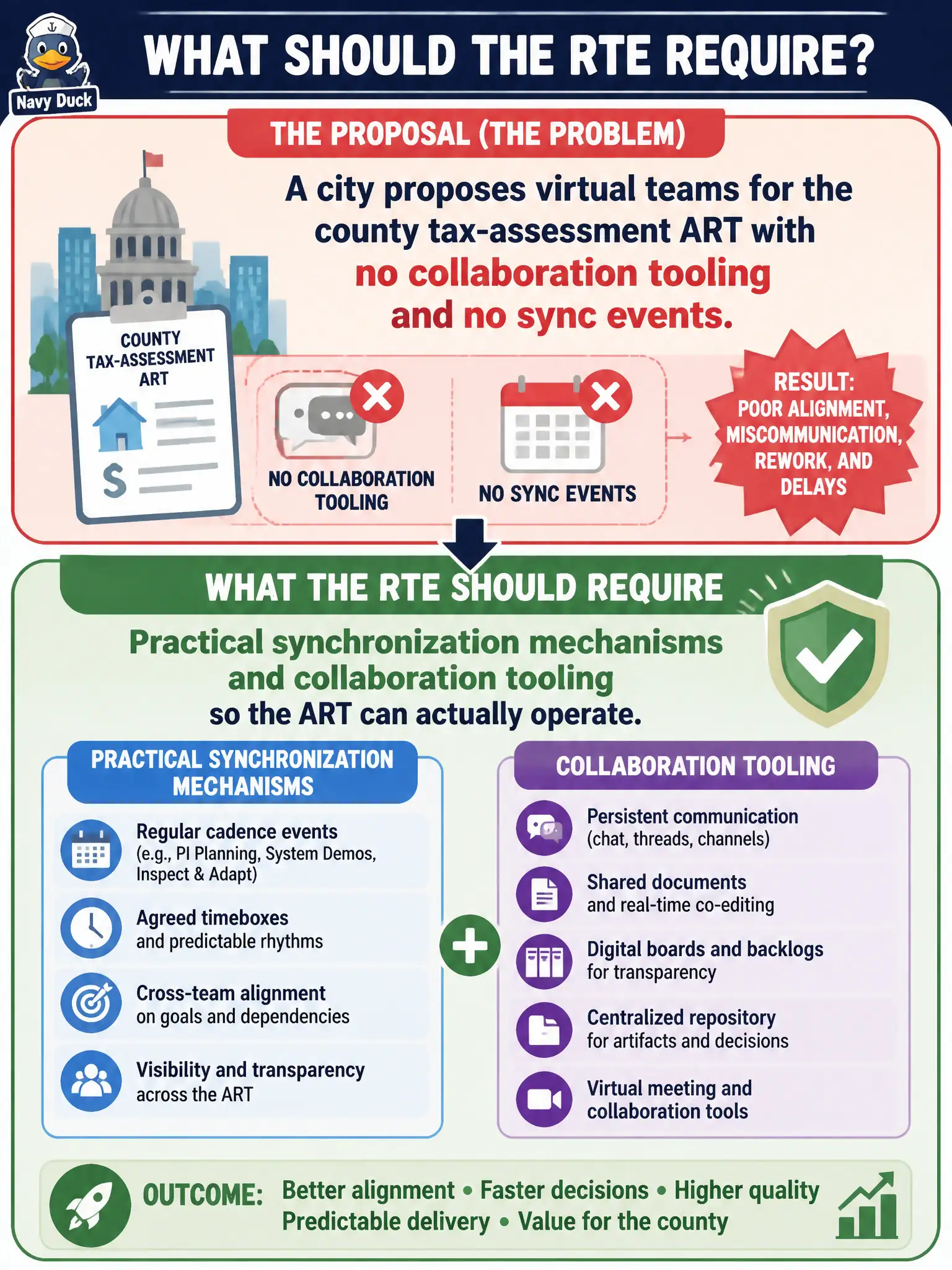
A city proposes virtual teams for the county tax-assessment ART with no collaboration tooling and no sync events. What should the RTE require?
Select an answer to reveal the explanation.
Short Explanation
Virtual is not a strategy if nobody has a room, a board, or a clock. Tax-assessment teams still need real sync events and working tools. A train that never meets is just a roster.
Full Explanation
Distributed or virtual ARTs still need practical synchronization mechanisms and collaboration tooling. When a city proposes virtual teams for a county tax-assessment ART with no collaboration tooling and no sync events, the RTE should require the operating agreements and tools that make remote assessment delivery real. Written status memos instead of any ART event remove dialogue needed for dependencies and impediments. A policy that virtual teams must never speak across department lines institutionalizes silos that break county-wide assessment value. Canceling PI Planning because virtual teams cannot share a cadence mistakes tooling gaps for an impossibility; virtual ARTs plan successfully with deliberate design. Exam caveat: Time zones and equipment constraints shape the design of events, but they do not excuse abandoning sync. Operational check: Publish operating agreements for tax-assessment ART events, ensure video/board tooling works in a dry run, and verify remote teams can update the program board live during planning. In municipal settings, pressure to look busy, compliant, or politically safe is constant; the RTE earns trust by holding the principle through that pressure and verifying the next cadence event shows improved civic delivery, not just a quieter meeting. Capture the before/after signal so sponsors see the operational evidence.