
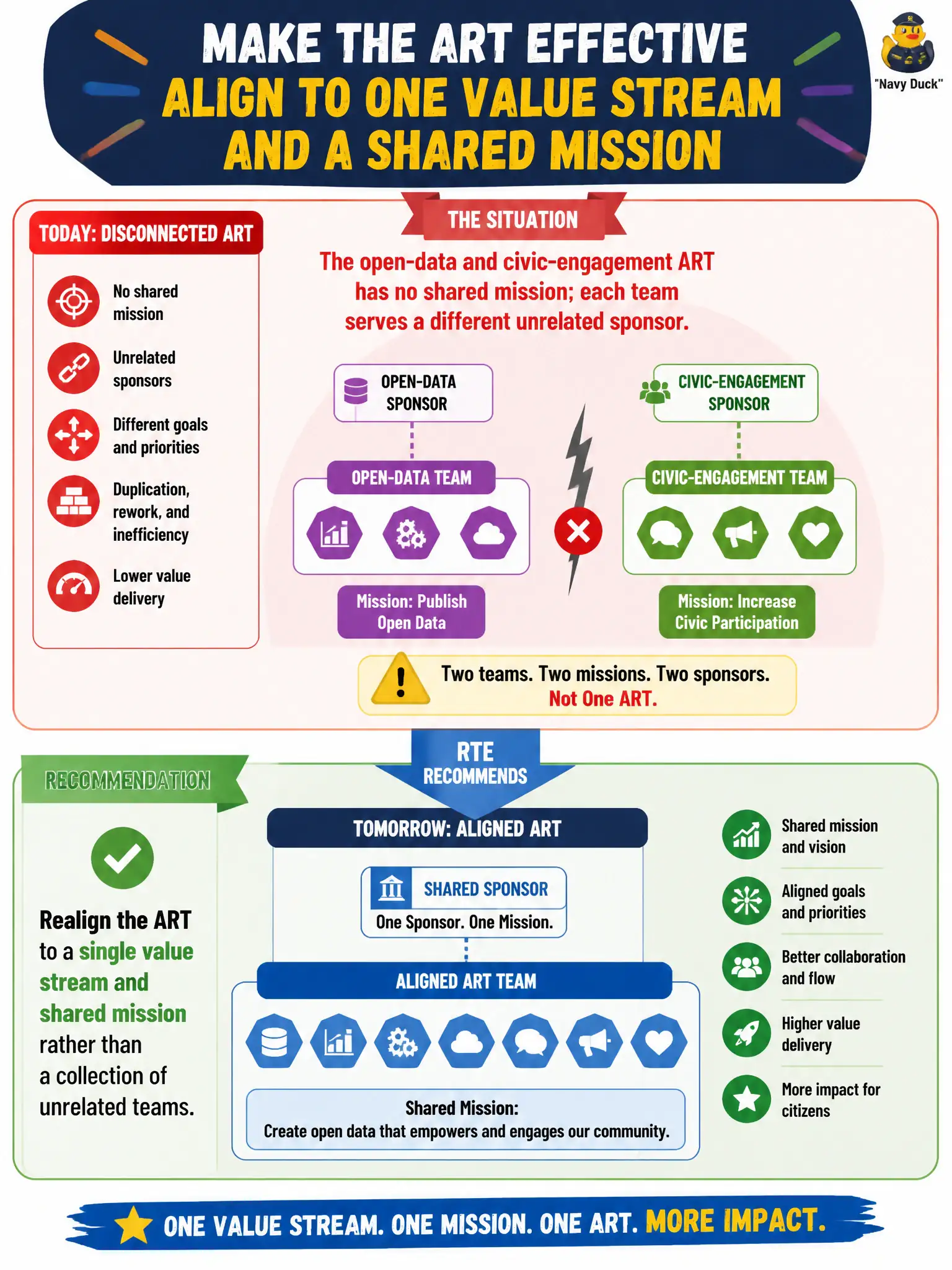
The open-data and civic-engagement ART has no shared mission; each team serves a different unrelated sponsor. What should the RTE recommend to make the ART effective?
Select an answer to reveal the explanation.
Short Explanation
A train that heads to four different stations at once is just four cars on the same track. An ART needs one value stream and a shared mission, not a grab bag of unrelated civic sponsors. Align the destination first.
Full Explanation
An effective ART aligns to a single value stream and shared mission rather than a random collection of unrelated teams. When an open-data and civic-engagement ART has no shared mission and each team serves a different unrelated sponsor, the RTE should recommend realignment so planning, dependencies, and System Demos make sense for residents and council. Keeping the random collection and grading each sponsor's velocity separately preserves a branding fiction without ART economics or coherent civic outcomes. Rotating sponsors weekly so no mission lasts long enough to conflict adds churn and destroys focus on any public value stream. Splitting every team in half so more sponsors can claim a squad worsens fragmentation and further weakens shared cadence. Exam caveat: An ART can serve multiple related products in one value stream; the failure mode is unrelated missions forced under one train label. Operational check: List each team's primary sponsor outcome; if they do not contribute to one civic value stream, propose splitting into separate trains or teams with coherent missions and backlogs. In municipal settings, pressure to look busy, compliant, or politically safe is constant; the RTE earns trust by holding the principle through that pressure and verifying the next cadence event shows improved civic delivery, not just a quieter meeting.