
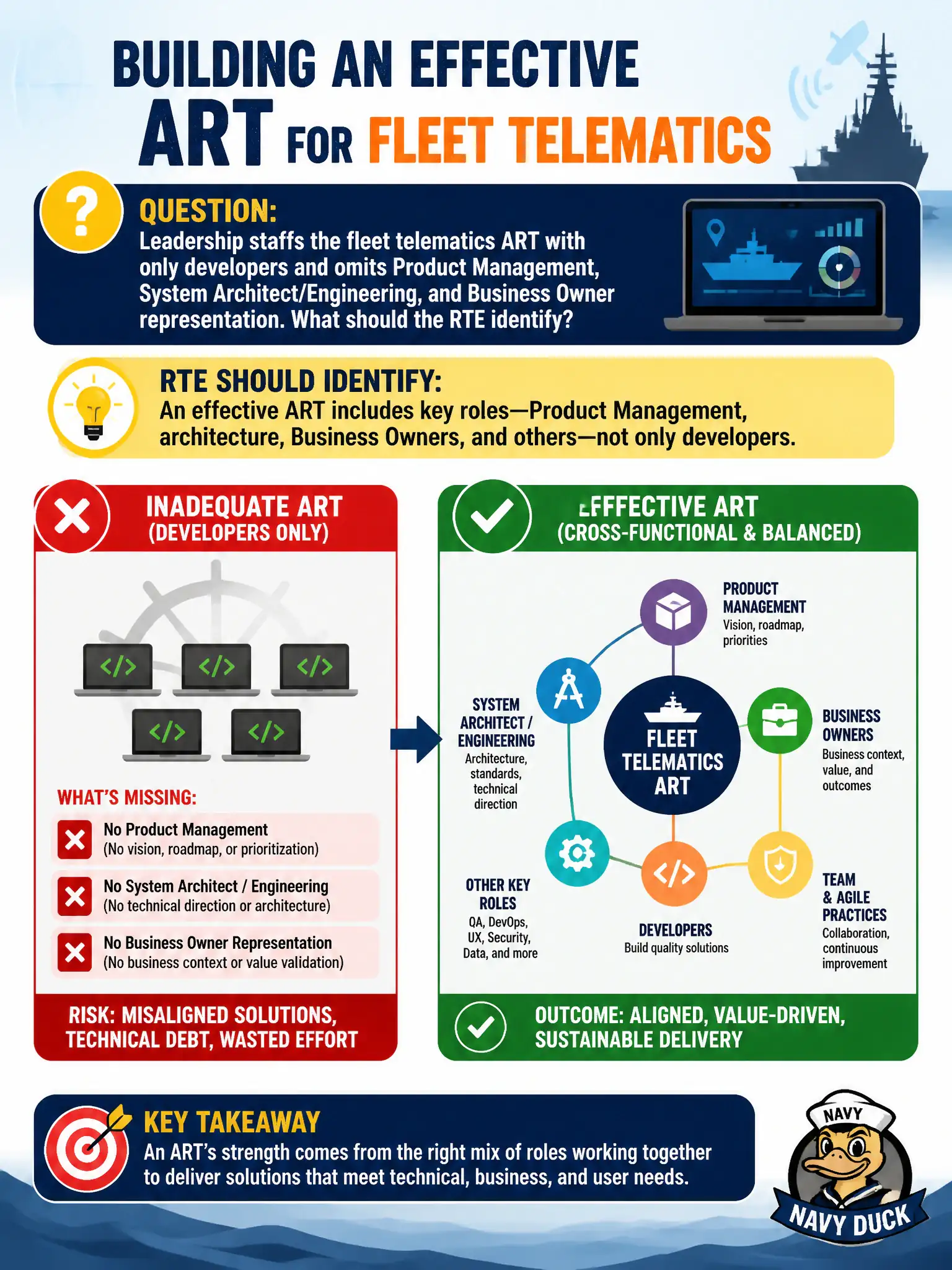
Leadership staffs the fleet telematics ART with only developers and omits Product Management, System Architect/Engineering, and Business Owner representation. What should the RTE identify?
Select an answer to reveal the explanation.
Short Explanation
A garage full of mechanics still needs someone to pick the work, someone to design the wiring, and someone who owns the fleet outcome. An ART is the same: developers alone are not a train. Missing Product Management, architecture, and Business Owners is incomplete organization.
Full Explanation
An effective ART includes key roles—Product Management, System Architect/Engineering, Business Owners, and others—not only developers. When leadership staffs a fleet telematics ART with developers alone, the train lacks content authority, technical runway guidance, and economic decision-makers for vehicle and operations outcomes. The RTE should identify the missing roles before pretending PI Planning can succeed. Claiming developers can rotate weekly into every missing role without changing organization creates shallow coverage and role confusion. Excluding Product Management because vehicles supposedly have no users ignores operators, maintenance, and public-facing telematics consumers. Parking architecture only on a separate PMO committee after each release removes runway from planning and forces late technical thrash. Exam caveat: People may wear multiple hats on a small municipal train, but the responsibilities must still be explicitly covered—title theater is not enough. Operational check: Before the next telematics PI Planning, confirm named Product Management, architecture, and Business Owner participation on the agenda and in capacity plans. In municipal settings, pressure to look busy, compliant, or politically safe is constant; the RTE earns trust by holding the principle through that pressure and verifying the next cadence event shows improved civic delivery, not just a quieter meeting. Capture the before/after signal so sponsors see the operational evidence.