
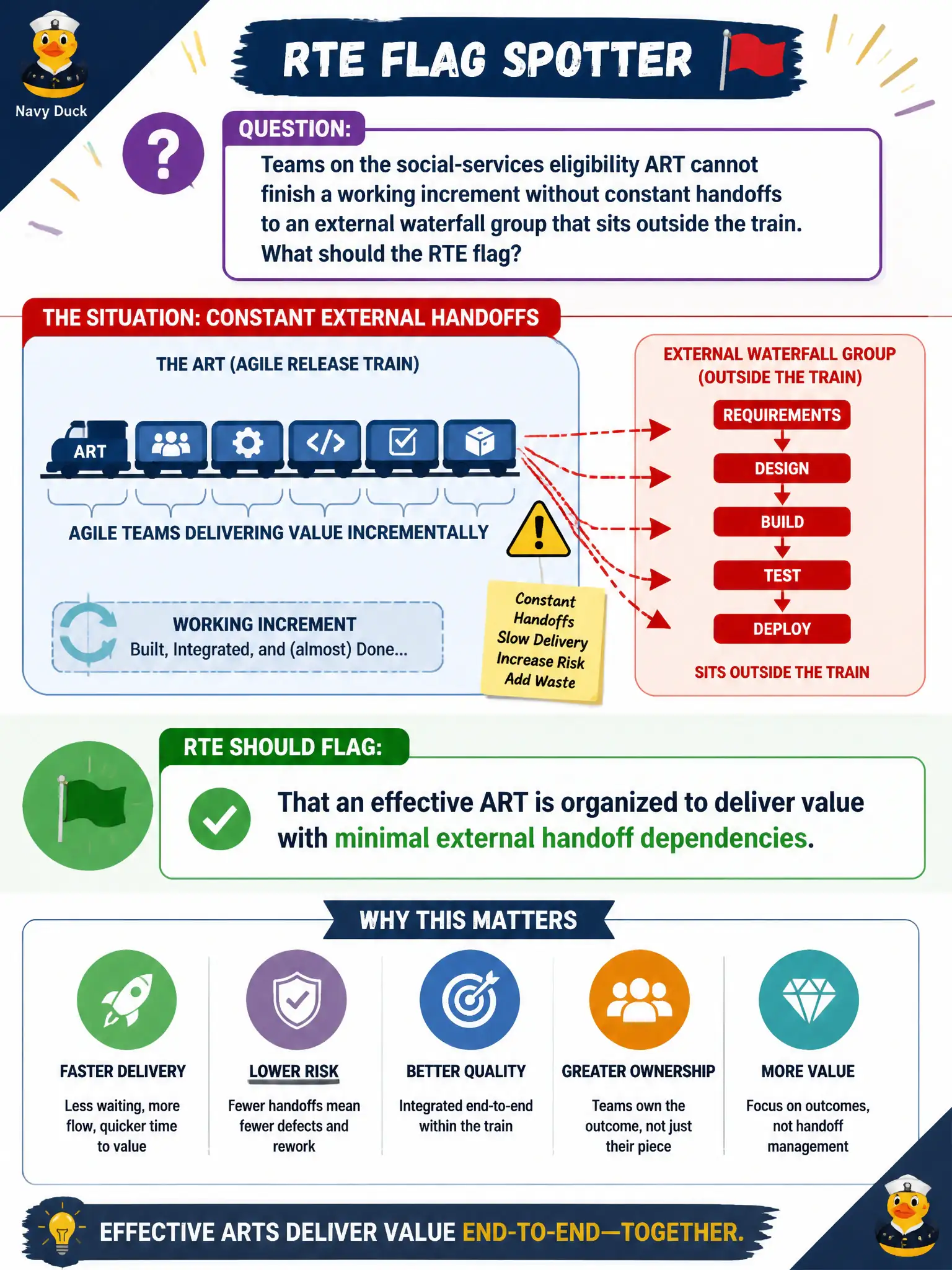
Teams on the social-services eligibility ART cannot finish a working increment without constant handoffs to an external waterfall group that sits outside the train. What should the RTE flag?
Select an answer to reveal the explanation.
Short Explanation
If every eligibility increment has to wait in someone else's lobby, the train is not really a train. Effective ARTs are staffed to deliver value with as few outside handoffs as possible. Constant parking at an external waterfall desk is a design smell, not a scheduling quirk.
Full Explanation
An effective ART is organized to deliver value with minimal external handoff dependencies. When social-services eligibility ART teams cannot finish a working increment without constant handoffs to an external waterfall group outside the train, the RTE should flag that design as a threat to flow for clients awaiting eligibility decisions. Requiring waterfall groups to estimate every eligibility story in story points does not fix the structural handoff delay that stalls the increment. Adding more status meetings with the waterfall group while leaving the design unchanged increases coordination cost without bringing capability inside the ART's delivery boundary. Moving eligibility work to a project charter so handoffs become official legitimizes the delay instead of fixing value-stream design for residents. Exam caveat: Some specialized external groups will remain; the principle is to minimize critical-path handoffs and bring enough capability onto the ART to deliver increments. Operational check: Map the eligibility increment's external wait time, quantify handoff delay, and propose bringing the constraining capability into the ART or changing the architecture to reduce dependency. In municipal settings, pressure to look busy, compliant, or politically safe is constant; the RTE earns trust by holding the principle through that pressure and verifying the next cadence event shows improved civic delivery, not just a quieter meeting.