
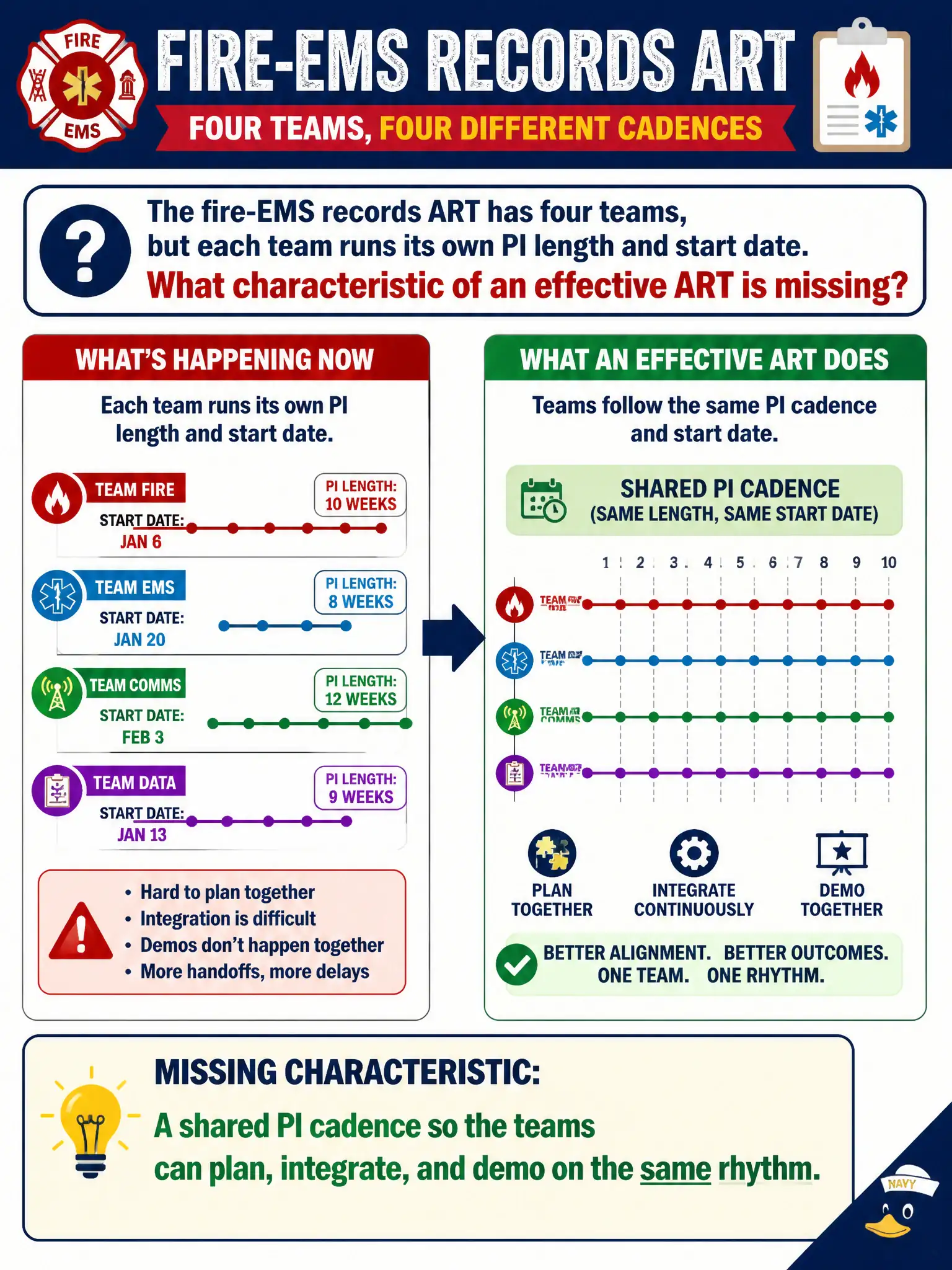
The fire-EMS records ART has four teams, but each team runs its own PI length and start date. What characteristic of an effective ART is missing?
Select an answer to reveal the explanation.
Short Explanation
Four clocks that never meet are four projects, not a train. Shared PI cadence is the drumbeat that lets fire-EMS records teams plan, integrate, and demo as one system. Without that beat, ART is just a mailing list.
Full Explanation
An effective ART shares a PI cadence so teams can plan, integrate, and demo on the same rhythm. When a fire-EMS records ART has four teams each running their own PI length and start date, synchronization collapses and integrated records value for responders becomes accidental rather than planned. The missing characteristic is shared cadence across the train. Requiring fire and EMS to keep separate product vision documents may sometimes be valid for content ownership, but it does not fix misaligned PI clocks. A rule that only one team may ever touch the records database is an architecture constraint discussion, not a substitute for shared cadence. A mandate to drop iteration reviews so dispatch records ship faster removes feedback and still leaves teams unsynchronized. Exam caveat: Teams keep their own iterations inside the shared PI; the anti-pattern is different PI boundaries across teams on the same ART. Operational check: Align all fire-EMS records teams to one PI calendar, one planning event, and one System Demo, then verify cross-team dependencies can be managed on a single program board. In municipal settings, pressure to look busy, compliant, or politically safe is constant; the RTE earns trust by holding the principle through that pressure and verifying the next cadence event shows improved civic delivery, not just a quieter meeting.