
Council sponsors want to label a 12-person court case-management group as an Agile Release Train so the city can claim SAFe at scale. What should the RTE explain about an effective ART?
Select an answer to reveal the explanation.
Short Explanation
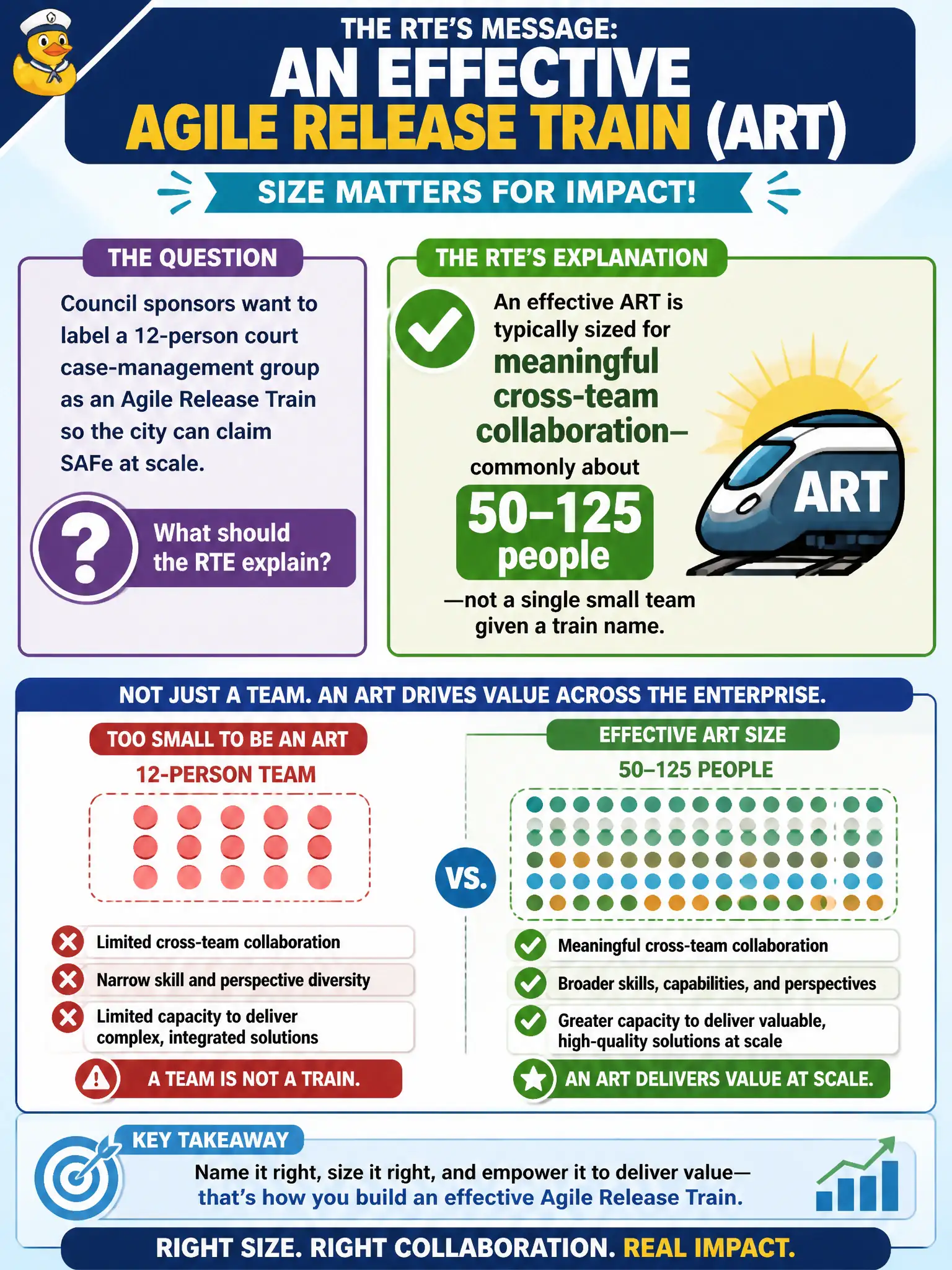
Calling a 12-person crew a railroad does not give you a railroad. An ART is a virtual organization big enough for several Agile teams to ship one case-management value stream together—think about 50 to 125 people, not a renamed Scrum team. The label is not the train.
Full Explanation
An effective ART is typically sized for meaningful cross-team collaboration—commonly about 50–125 people—not a single small team given a train label. When council sponsors want to call a 12-person court case-management group an Agile Release Train so the city can claim SAFe at scale, the RTE should explain that renaming a small team does not create ART economics, roles, or cross-team cadence benefits. Any group does not become an ART once it holds a daily standup and uses story points; those are team practices, not train design for judicial digital services. Saying court systems should stay at 12 people forever because ARTs must never exceed one Scrum team misunderstands both team agility and ART scaling. Claiming ART size is irrelevant as long as council minutes use the word train confuses branding with organizational design for case-management delivery. Exam caveat: Numbers are guidelines, not sacred law, but a dozen people is generally a team (or two), not a multi-team ART. Operational check: If scale is truly needed, identify the value stream and multiple teams that must collaborate on court case management; otherwise keep team-level Scrum/Kanban without forcing an ART label. In municipal settings, pressure to look busy, compliant, or politically safe is constant; the RTE earns trust by holding the principle through that pressure and verifying the next cadence event shows improved civic delivery, not just a quieter meeting.