
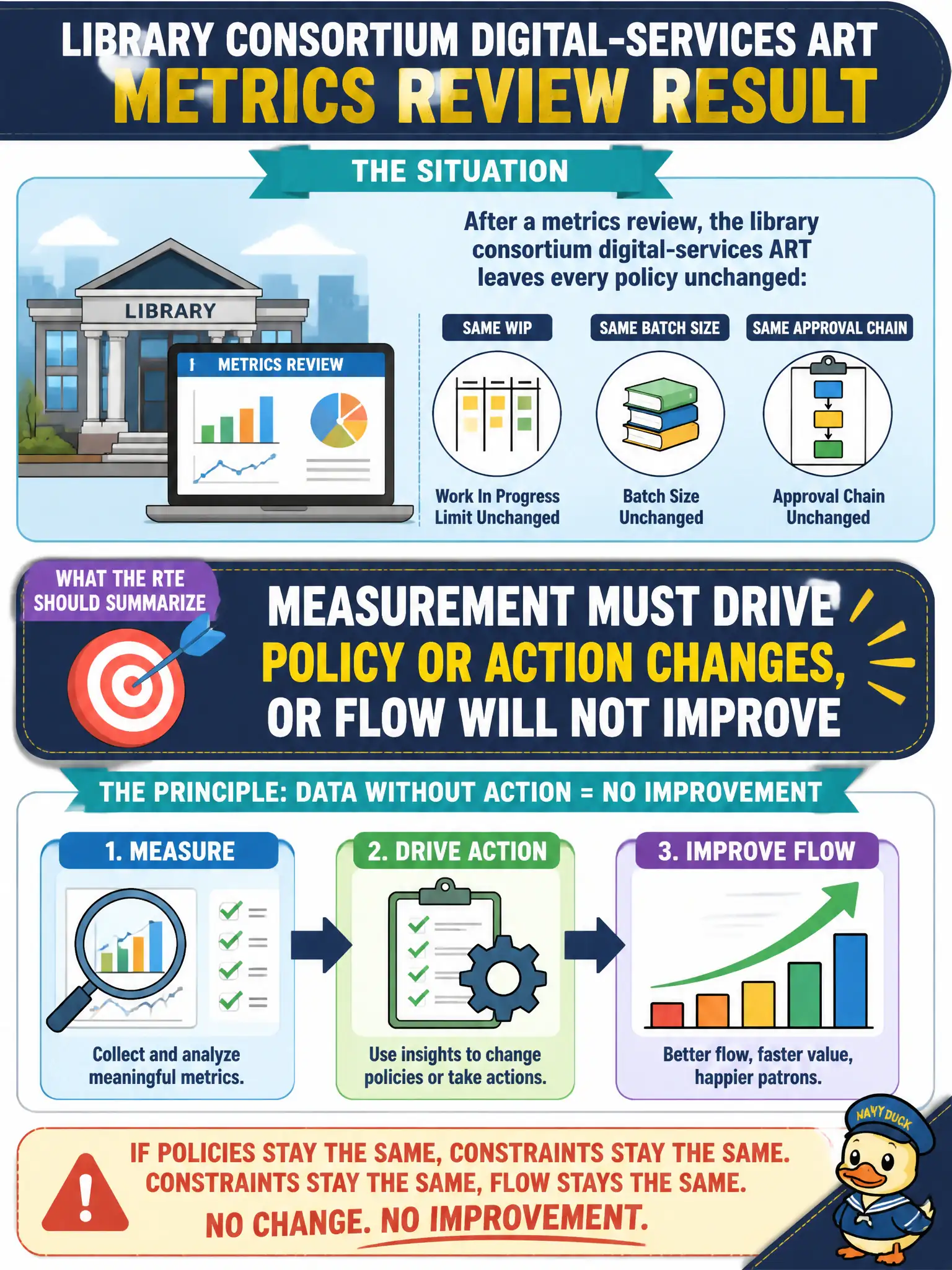
After a metrics review, the library consortium digital-services ART leaves every policy unchanged: same WIP, same batch size, same approval chain. What should the RTE summarize?
Select an answer to reveal the explanation.
Short Explanation
You don’t shelve books by weighing the cart. Metrics are a scale, not a librarian. If WIP, batches, and approvals stay the same, your charts were a slideshow.
Full Explanation
Measurement must drive policy or action changes, or flow will not improve on the library consortium digital-services ART. Charts without experiments—same WIP, same batch size, same approval chain—are a slideshow, not optimization. SAFe relentless improvement expects the RTE to convert metric reviews into explicit changes and then re-measure. Treating measurement as sufficient while freezing policy leaves lead time for patrons and member libraries unchanged. The claim that stable dashboards prove the ART optimized and all rules should be frozen mistakes visibility for improvement; if the work system does not change, the flow signal does not improve. Publishing the charts to the consortium board and stopping there is transparency without improvement. Swapping metric names each planning interval so the packet looks fresh without changing work is vanity relabeling. Exam caveat: not every review yields a large change; a documented 'hold and watch' with a trigger threshold is still an action, whereas silent inaction after red flow signals is not. Operational check: end the next metrics review with one owned policy experiment (WIP limit, batch-size cut, or approval streamlining), a success measure, and a re-check date inside the innovation and planning interval or next planning interval. Record the decision in the civic ART's improvement backlog so consortium leadership sees follow-through, not only dashboards. In municipal and civic service contexts, record the rationale in the ART working agreements or improvement backlog so future planning intervals preserve the control, and re-validate the same measure or policy after the next Inspect and Adapt against resident-facing outcomes rather than activity theater.