
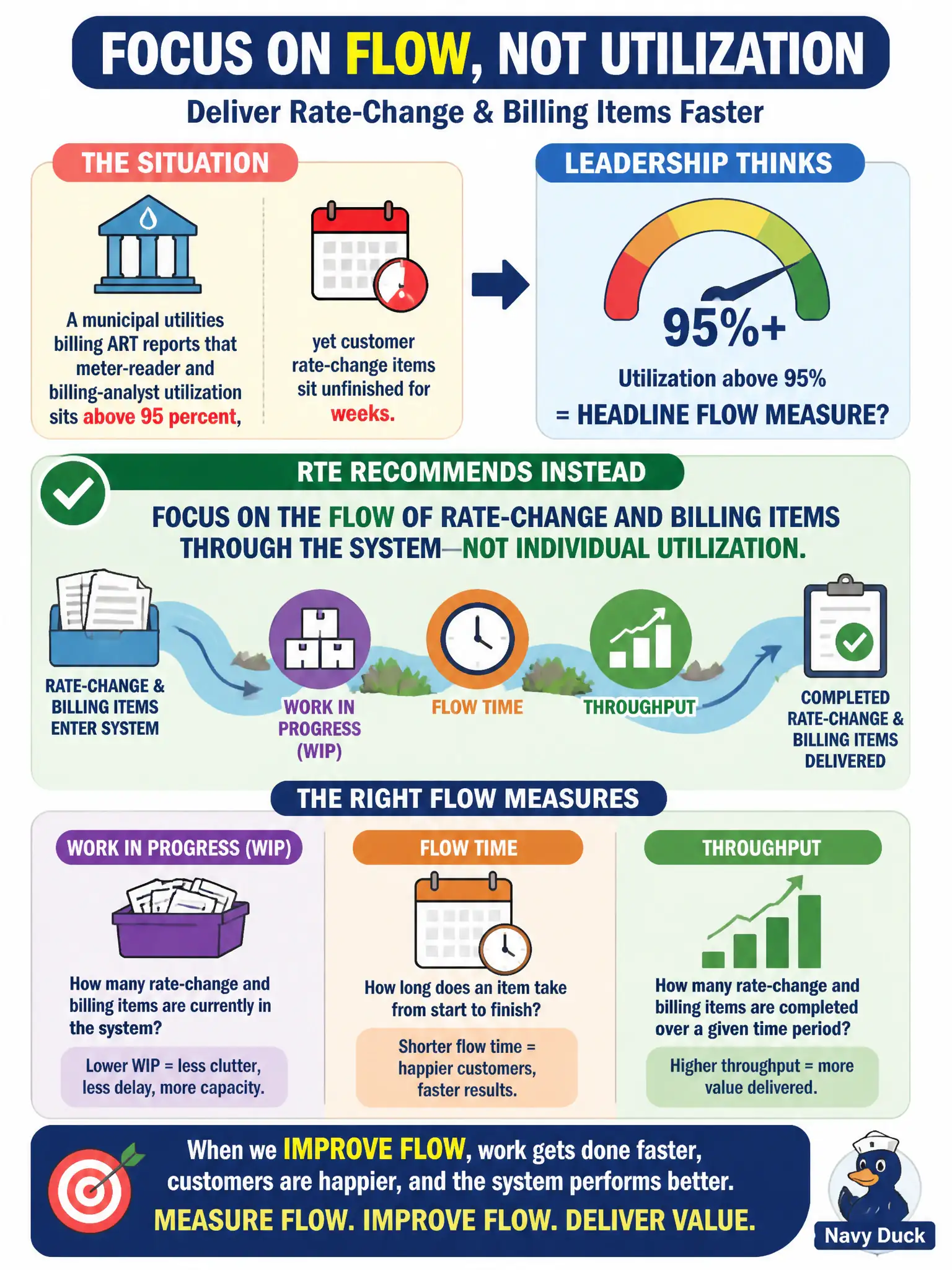
A municipal utilities billing ART reports that meter-reader and billing-analyst utilization sits above 95 percent, yet customer rate-change items sit unfinished for weeks. Leadership wants utilization treated as the headline flow measure. What should the RTE recommend instead?
Select an answer to reveal the explanation.
Short Explanation
A packed parking lot does not mean cars are leaving. Utilization just says people are busy; flow metrics say whether rate-change items actually finish. Watch the items, not how full each desk looks.
Full Explanation
On a municipal utilities billing ART, SAFe flow measurement treats the movement of value items—rate-change and billing work—as the primary signal. Flow load (WIP), flow time, and throughput (or flow velocity) describe whether customer rate changes actually finish; utilization near 95 percent only proves desks are busy and often correlates with longer queues. The RTE should therefore recommend system-level flow metrics rather than individual utilization as the headline measure. Treating each billing analyst's utilization as proof of delivery confuses local busyness with finished value and invites overload. Hours booked to the utilities cost center are timekeeping and finance controls, not Lean flow signals of item completion. Story-point estimates per person per week are local productivity proxies that still ignore wait states, blockers, and end-to-end flow time for ratepayer work. Exam caveat: utilization can still matter for capacity planning and cost recovery, but SAFe flow coaching does not elevate it above WIP, flow time, and throughput when leadership asks for the headline flow measure. Operational check: in the next ART Sync, show WIP and aging for rate-change items beside any utilization chart, pick one unfinished billing item and walk its flow time, and agree that board packets lead with item flow rather than packed calendars.