
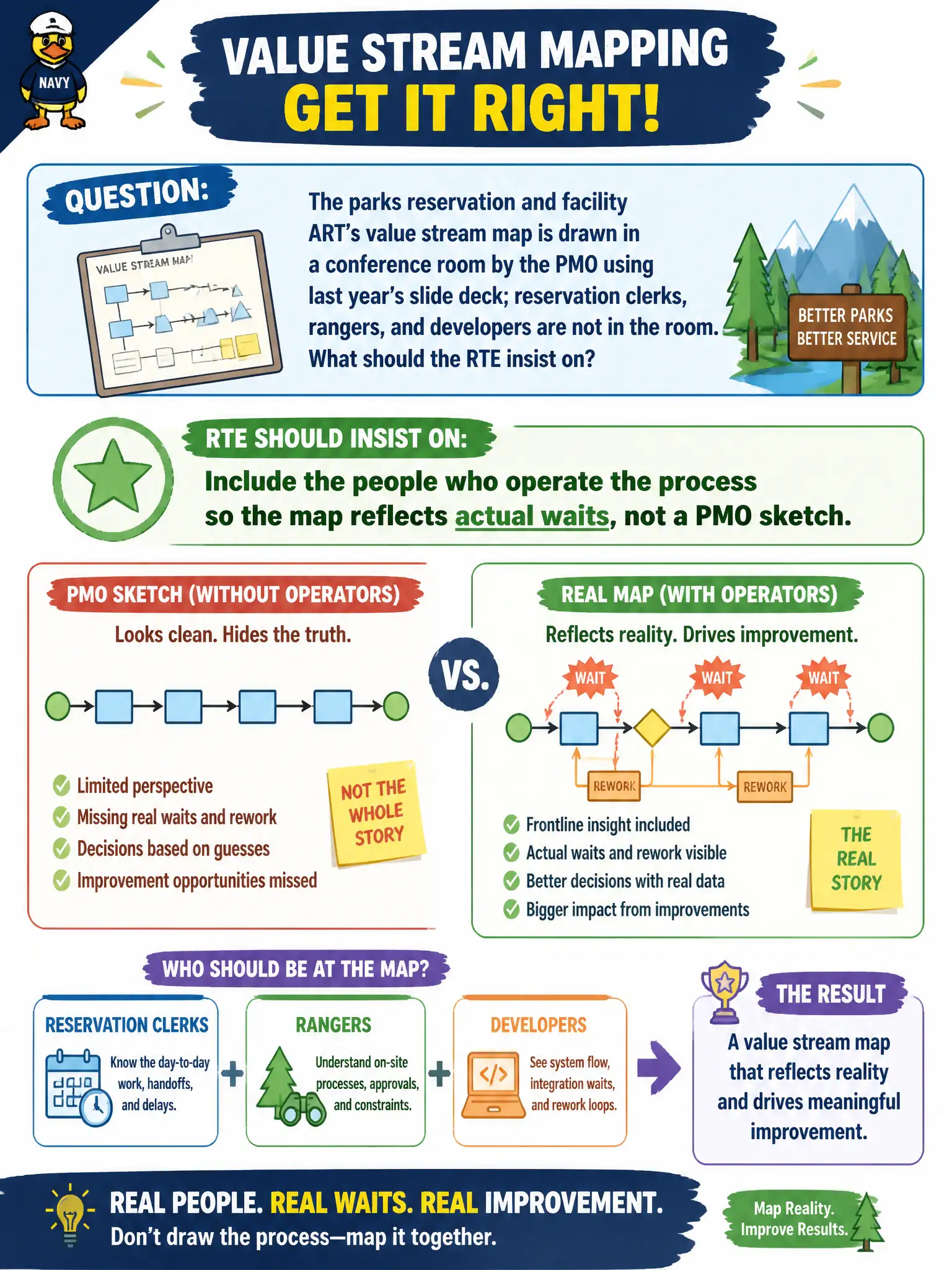
The parks reservation and facility ART's value stream map is drawn in a conference room by the PMO using last year's slide deck; reservation clerks, rangers, and developers are not in the room. What should the RTE insist on?
Select an answer to reveal the explanation.
Short Explanation
A trail map drawn without rangers is a brochure, not a map. The people who take reservations and ship facility changes know where the work actually sits. Bring them into the room or the wall will lie.
Full Explanation
Insist that parks reservation and facility value stream mapping include the people who operate the process—clerks, rangers, and developers—so the map reflects actual waits, not a PMO sketch from last year's slides. Mapping is reliable only when performers validate times and rework. Keeping operators out for "objectivity" encodes fiction. Vendor benchmarks using industry averages omit this ART's queues. Letting System Architect publish a map after interviewing only the steering committee misses shop-floor delay. Exam caveat: PMO and architects may facilitate; they cannot substitute for operator validation. Operational check: staff the workshop with role representatives from each major step, validate wait estimates with recent examples, and reject maps that lack operator sign-off before funding civic parks flow experiments. In municipal and civic service contexts, record the rationale in the ART working agreements or improvement backlog so future PIs preserve the control, and re-validate after the next Inspect and Adapt against resident-facing outcomes rather than activity theater. Confirm owners, success measures, and a re-check date so the practice remains inspectable. In municipal and civic service contexts, record the rationale in the ART working agreements or improvement backlog so future PIs preserve the control, and re-validate after the next Inspect and Adapt against resident-facing outcomes rather than activity theater. Confirm owners, success measures, and a re-check date so the practice remains inspectable.