
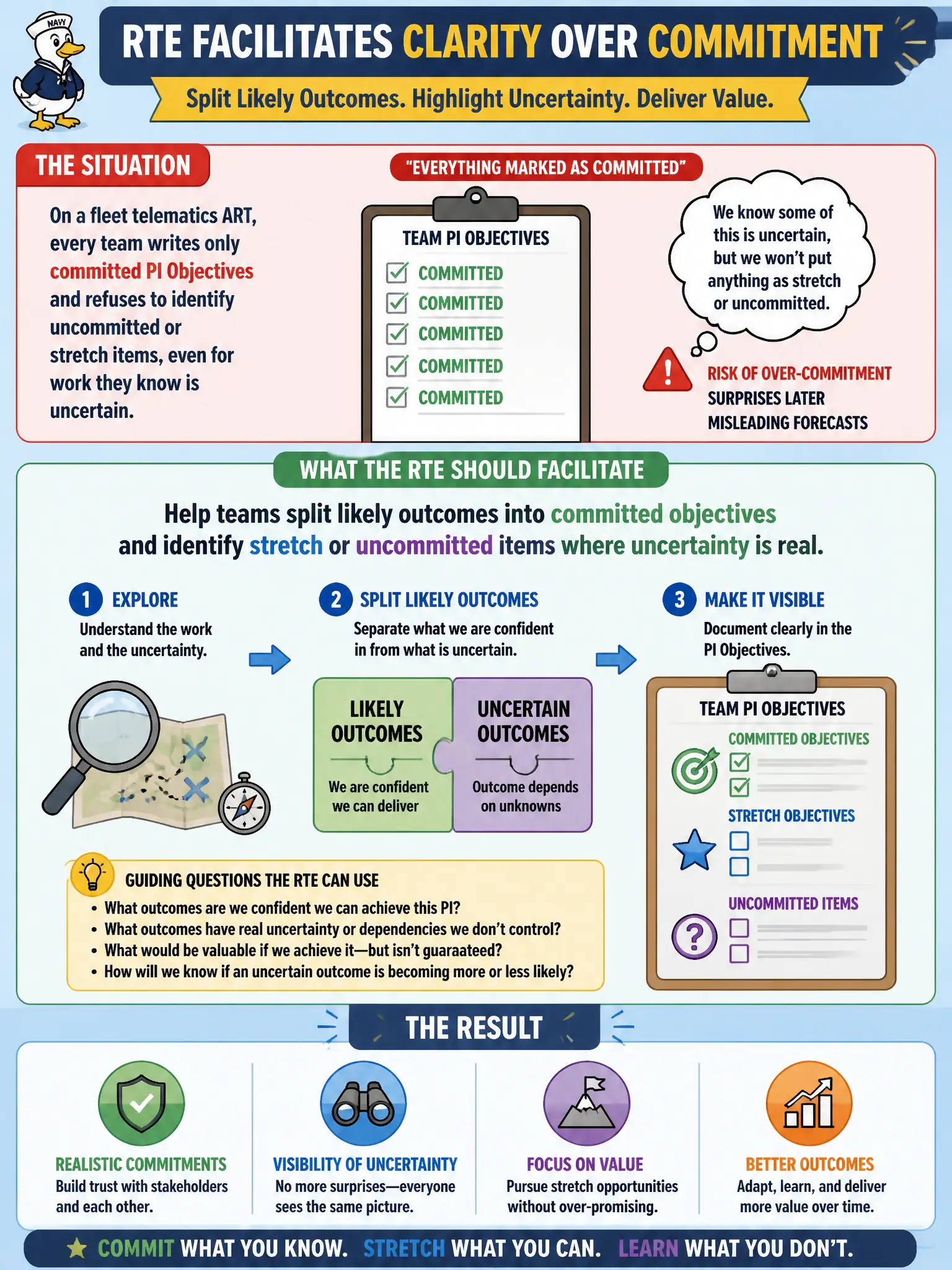
On a fleet telematics ART, every team writes only committed PI Objectives and refuses to identify uncommitted or stretch items, even for work they know is uncertain. What should the RTE facilitate?
Select an answer to reveal the explanation.
Short Explanation
Committed objectives are the handshake. Stretch or uncommitted items are the "if the weather holds" extras. Fleet teams that pretend everything is certain either sandbag or break the handshake.
Full Explanation
Committed PI Objectives communicate the forecast the ART intends to deliver; uncommitted or stretch items communicate extra value if capacity allows. On a fleet telematics ART where every team writes only committed objectives and refuses to identify uncertain stretch work, the RTE should help teams split likely outcomes into committed objectives and mark stretch or uncommitted items where uncertainty is real. Requiring every objective to be committed so Business Owners treat the entire plan as guaranteed creates false certainty and punishes honesty. Converting all telematics features into uncommitted objectives so no team can be held to a forecast abandons commitment discipline. Hiding uncertain work in private team notes removes transparency from Business Owners and dependency partners. Fleet telematics work that touches vehicle safety and public-works routing often carries genuine uncertainty; naming stretch work keeps Business Owners honest about what road crews can rely on this PI. Exam caveat: stretch items are visible and planned lightly—they are not secret side work and should not silently displace committed objectives. Operational check: during objective review, ask each telematics team which items are uncertain and ensure at least the uncertain set is explicitly labeled stretch or uncommitted when appropriate. Review the committed-versus-stretch split with telematics Business Owners before confidence vote so forecasts match operational risk.