
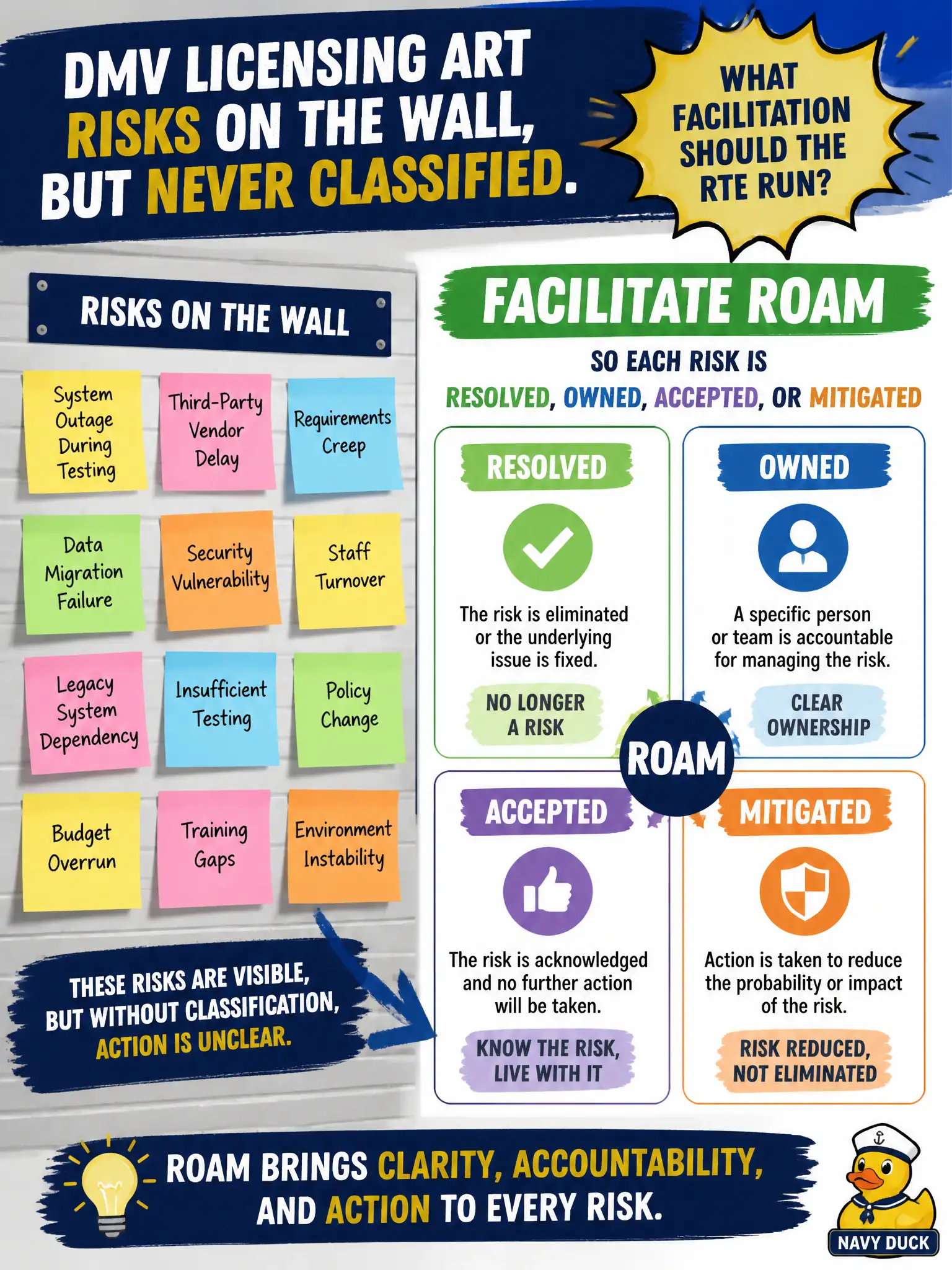
Risks on the state DMV licensing ART are listed on a wall but never classified. What facilitation should the RTE run?
Select an answer to reveal the explanation.
Short Explanation
A wall of unclassified DMV risks is just wallpaper. ROAM them: Resolved, Owned, Accepted, or Mitigated. That is how a list becomes a plan the train can live with.
Full Explanation
PI Planning facilitation includes structured risk management using ROAM: Resolved, Owned, Accepted, or Mitigated. Listing state DMV licensing risks on a wall without classification leaves ownership and next actions unclear for the train. Ranking risks by who spoke loudest in the licensing Q&A substitutes volume for judgment and silences quieter expertise. Deleting any risk that cannot be fixed before adjournment hides real uncertainty the plan must acknowledge. Transferring every risk to a city attorney without discussion avoids ART ownership and skips mitigation design the licensing teams can actually run. Facilitating ROAM so each risk receives a category is the correct move. Exam caveat: Accepted risks remain visible acceptances with owners of the acceptance decision; they are not discarded from the risk set. Operational check: before closing, walk the DMV risk wall and confirm every item has a ROAM label, an owner where required, and a next step for ART execution. Keeping the civic ART's planning artifacts visible to Business Owners and teams after the event preserves continuity from preparation into execution. Keeping the civic ART's planning artifacts visible to Business Owners and teams after the event preserves continuity from preparation into execution.