
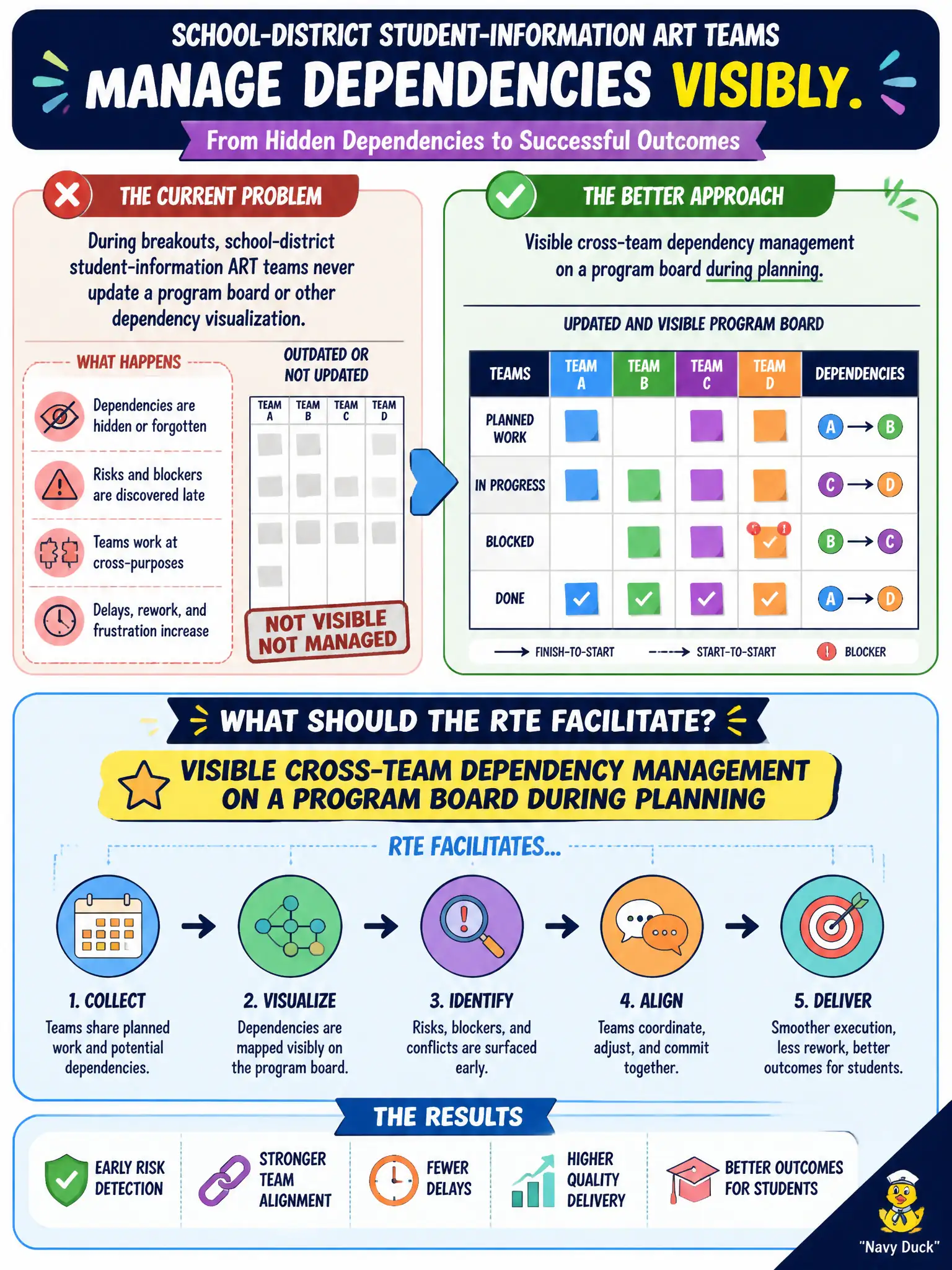
During breakouts, school-district student-information ART teams never update a program board or other dependency visualization. What should the RTE facilitate?
Select an answer to reveal the explanation.
Short Explanation
Student-information features collide on shared data and district calendars. If nobody updates a program board, those collisions stay tribal knowledge. Facilitate a living dependency visual while teams plan, not an email after everyone leaves.
Full Explanation
During PI Planning breakouts the RTE facilitates visible management of cross-team dependencies, typically on a program board or equivalent visualization. Features, timing, and handoffs must be seen by the whole school-district student-information ART so registrar, SIS, and integration teams negotiate collisions in the open. Private dependency lists emailed after the event keep the board clean only by hiding coupling until it is too late. A single registrar volunteer remembering all handoffs without a visual creates a single point of failure and cannot scale across the train. Deferring all student-data dependencies to production-support tickets after go-live moves discovery into outage mode. Visible cross-team dependency management during planning is the correct facilitation. Exam caveat: the board must stay current as plans change on Day 2; a Day 1 snapshot that is never updated is theater. Operational check: during each breakout cycle, verify new student-data dependencies appear with owning teams and planned timing before the confidence vote. Keeping the civic ART's planning artifacts visible to Business Owners and teams after the event preserves continuity from preparation into execution.