
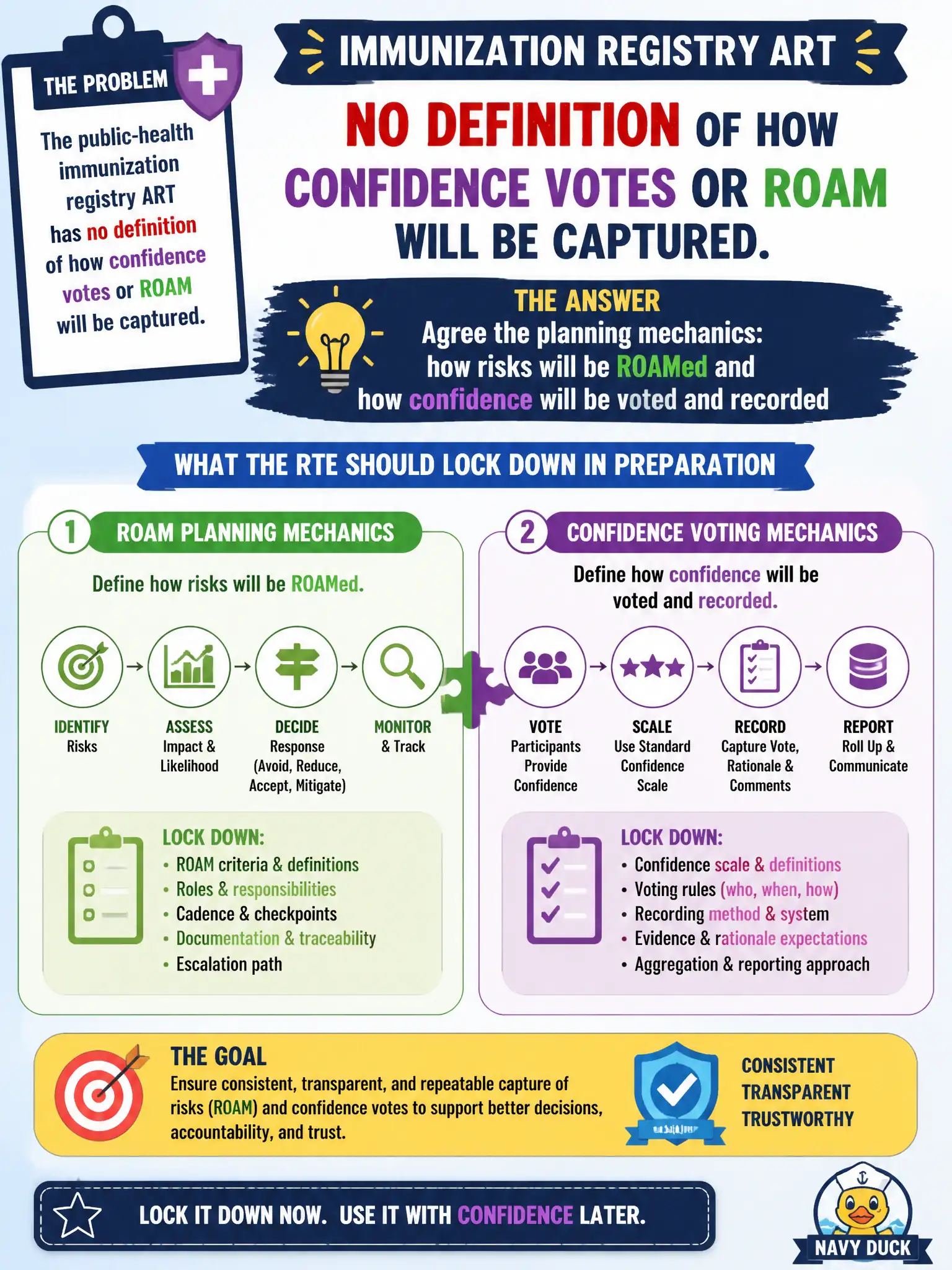
The public-health immunization registry ART has no definition of how confidence votes or ROAM will be captured. What should the RTE lock down in preparation?
Select an answer to reveal the explanation.
Short Explanation
If nobody agrees how the room will vote or ROAM, Day 2 turns into a shrug. Decide the mechanics in prep: how risks get Resolved, Owned, Accepted, or Mitigated, and how confidence is captured. Public-health planning needs a visible method, not a pile of leftover notes.
Full Explanation
Facilitation prep includes agreeing how PI Planning mechanics will run: risk ROAM and the confidence vote. Those practices only work if capture, visibility, and follow-up are defined for the public-health immunization registry ART before the room fills. Leaving mechanics to each clinic team so votes stay private and unrecorded destroys ART-level signal and prevents rework triggers. Replacing ROAM with a parking-lot of unread sticky notes after the event fails to classify ownership and next actions. Skipping both practices because an experienced health ART supposedly no longer needs them ignores that every PI introduces new risks and commitments that still require structured facilitation. Agreeing how risks will be ROAMed and how confidence will be voted and recorded locks the operating rules the RTE will run. Exam caveat: tools can be physical or digital; the standard is shared visibility and follow-through, not a specific sticky-note brand. Operational check: publish a one-page mechanics sheet covering ROAM categories, vote method, recording location, and who updates the ART risk list after the event. Keeping the civic ART's planning artifacts visible to Business Owners and teams after the event preserves continuity from preparation into execution.