
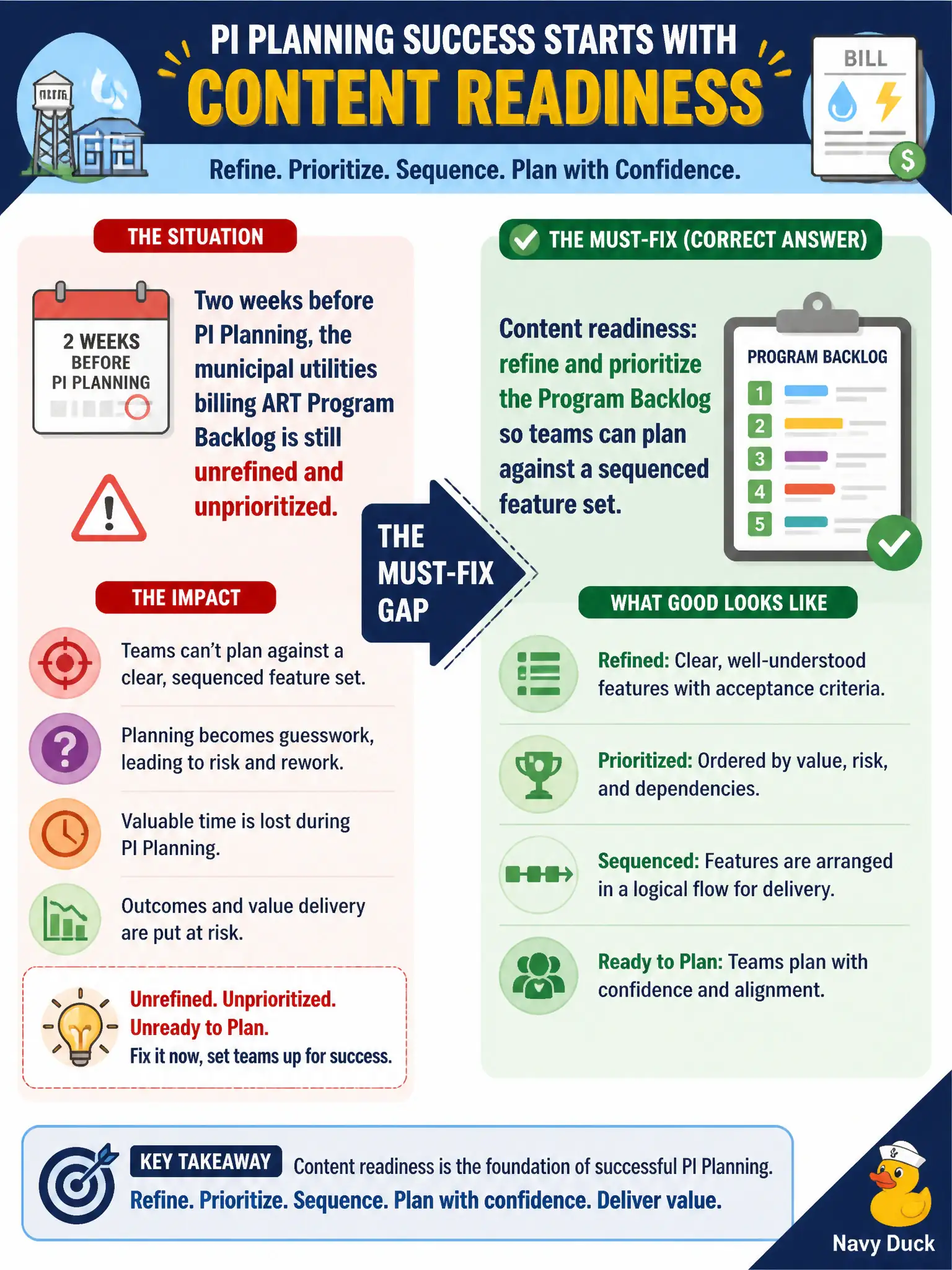
Two weeks before PI Planning, the municipal utilities billing ART Program Backlog is still unrefined and unprioritized. Which preparation gap should the RTE treat as a must-fix?
Select an answer to reveal the explanation.
Short Explanation
Think of PI Planning like opening the city utility window on billing day: if the work queue is a jumble, nobody gets served in the right order. Teams cannot match demand to capacity against a pile of unrefined, unprioritized features. Get the Program Backlog ready first, then the room can actually plan.
Full Explanation
Content readiness is a PI Planning prerequisite in SAFe: the Program Backlog must be refined and prioritized so Agile teams can plan against a sequenced feature set rather than inventing scope in the room. For a municipal utilities billing ART two weeks out, an unrefined, unprioritized backlog is the must-fix preparation gap because demand-to-capacity matching collapses without a credible feature sequence. The RTE's job is to coach Product Management and Product Owners to refine, split, and prioritize features and to surface readiness risk if that work is not done before the event. Skipping backlog work and inventing every feature from a blank board during PI Planning fails because the timebox cannot absorb discovery, estimation, and sequencing for an entire ART. Replacing PI Planning with a two-week waterfall schedule lock owned by the billing director abandons ART planning cadence and concentrates decisions outside the train. Having the RTE personally write every team's iteration stories violates role boundaries—the RTE facilitates readiness and the event; teams and Product Owners own story-level backlog. Exam caveat: content readiness is necessary but not sufficient—logistics, capacity, and architecture prep still matter, yet without a prioritized Program Backlog the other prep cannot produce a feasible plan. Operational check: before Day 1, confirm a visible, prioritized Program Backlog with enough refined features for teams to draft PI Objectives, and log any remaining readiness risks on the planning risk list.