
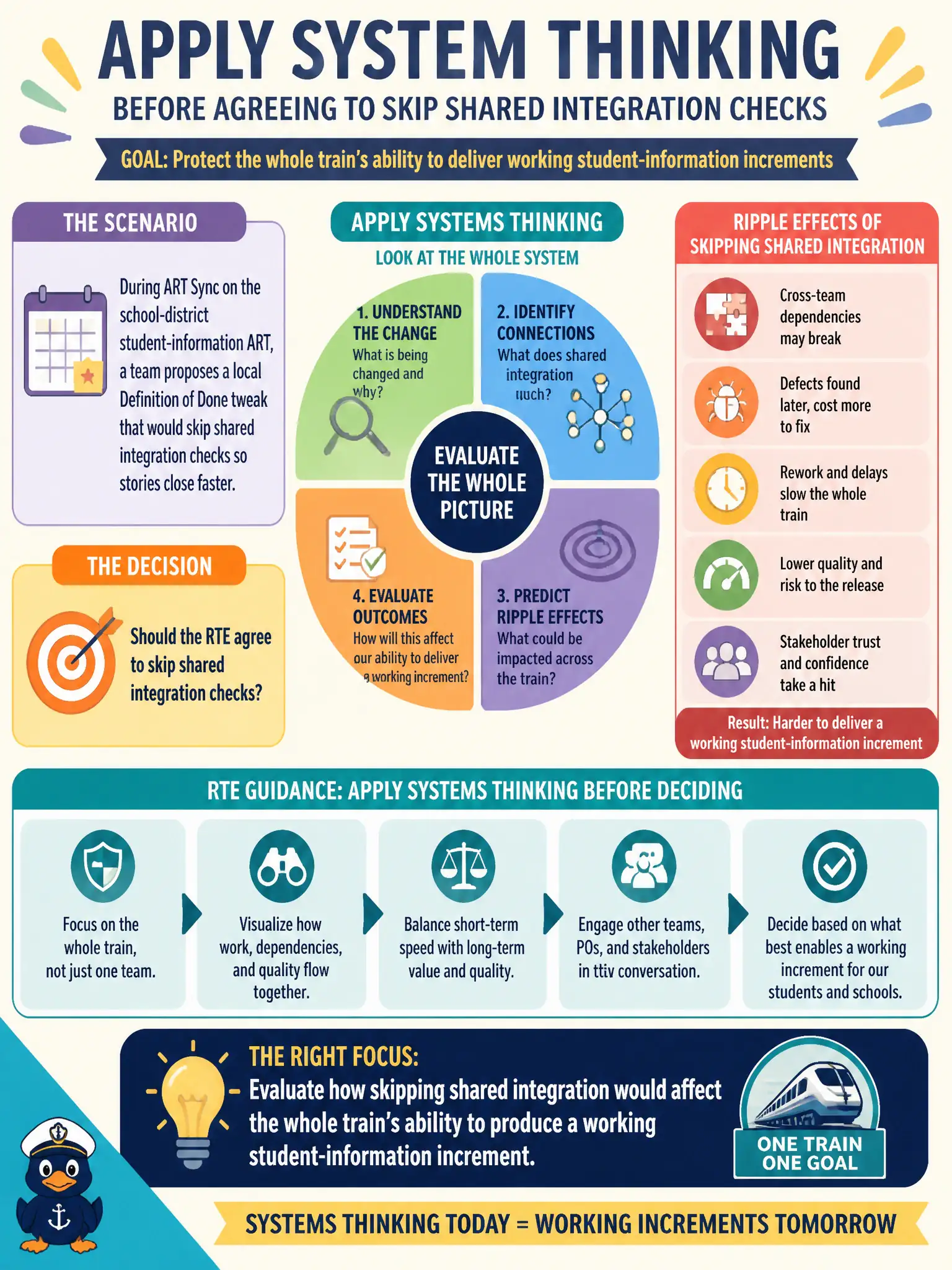
During ART Sync on the school-district student-information ART, a team proposes a local Definition of Done tweak that would skip shared integration checks so stories close faster. How should the RTE apply systems thinking before agreeing?
Select an answer to reveal the explanation.
Short Explanation
A local shortcut can feel like a faster commute until it blocks the intersection. Systems thinking asks what that Definition of Done skip does to every team assembling one student-information increment. If integration breaks, the speed was theater.
Full Explanation
Systems thinking evaluates local changes by their effect on the whole. During ART Sync on a school-district student-information ART, a team proposing to skip shared integration checks in its Definition of Done for faster story closure must be assessed for impact on the train's ability to produce a working student-information increment for schools and families. Approving the tweak immediately so that team's velocity chart looks healthier next iteration optimizes a local metric while risking broken enrollment or records integration. Requiring every team to copy the same tweak without reviewing integration effects spreads a harmful local optimization across the ART. Escalating the tweak to the school board as a policy vote instead of examining ART flow turns a technical quality-system question into unnecessary politics. Exam caveat: Definitions of Done can evolve, but shared integration agreements are system constraints that need ART-level review, not silent local exceptions. Operational check: Map which shared integration checks protect the student-information System Demo, facilitate a cross-team decision on the proposed tweak, and keep local speed from breaking the increment. In municipal settings, pressure to look busy, compliant, or politically safe is constant; the RTE earns trust by holding the principle through that pressure and verifying the next cadence event shows improved civic delivery, not just a quieter meeting.