
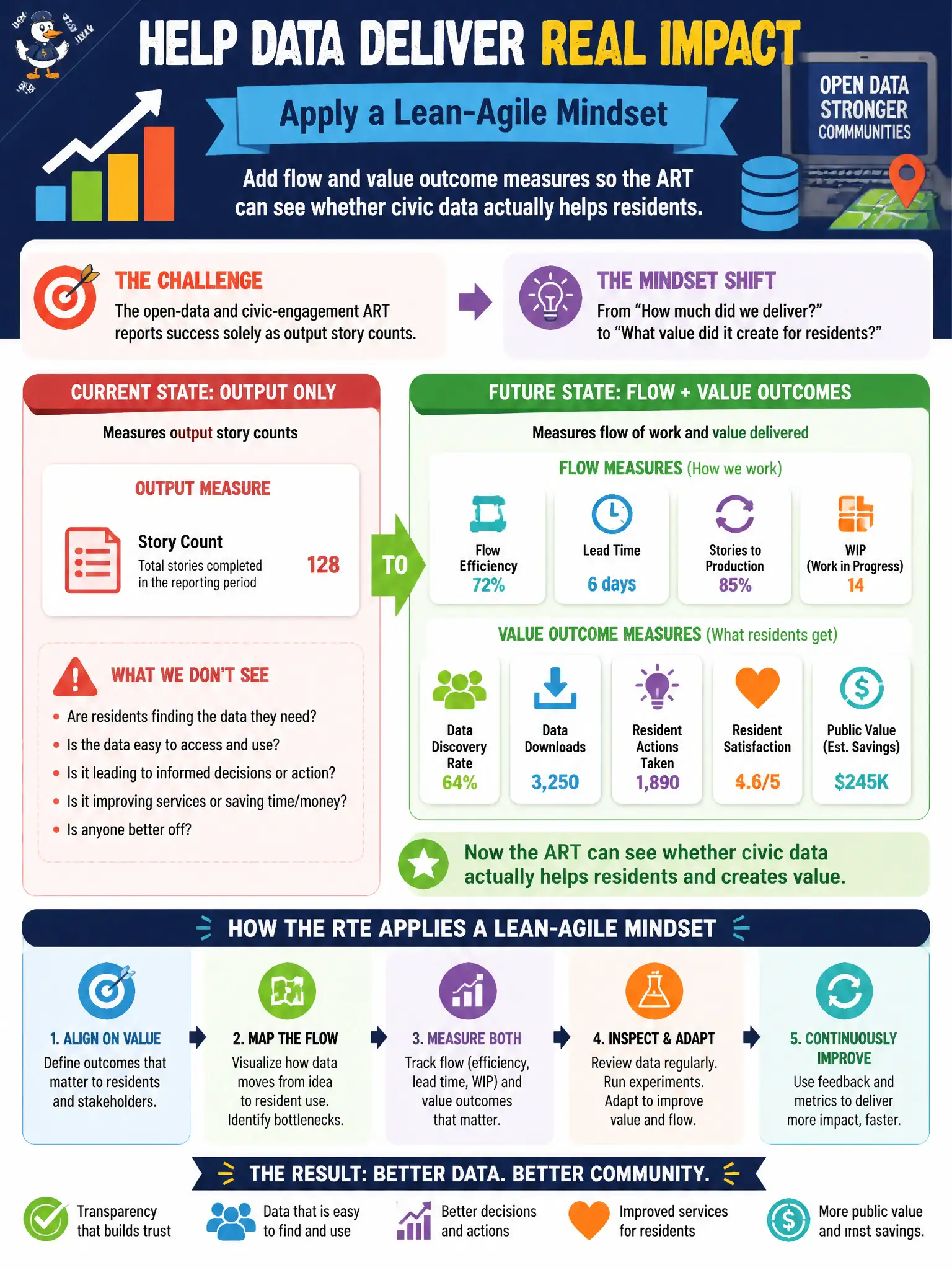
The open-data and civic-engagement ART reports success solely as output story counts. How should the RTE apply a Lean-Agile mindset?
Select an answer to reveal the explanation.
Short Explanation
Counting stories is counting bricks, not whether the civic portal is a building people can use. Lean-Agile thinking cares if open data moved a resident outcome, not how many tickets closed.
Full Explanation
A Lean-Agile mindset measures flow and value outcomes, not only output story counts. When an open-data and civic-engagement ART reports success solely as stories closed, it may look productive while residents still cannot find usable civic data or complete a self-service task. The RTE should add flow and outcome measures that show whether open data actually helps the public, complementing—not ignoring—delivery hygiene. Increasing story-point targets each PI so output always trends up encourages inflation and local optimization without outcome evidence. Hiding flow metrics from council because only story counts are easy to chart prioritizes simplicity of reporting over truth about delivery health. Replacing PI Objectives with a ranked list of story IDs abandons outcome-oriented planning for a task inventory. Exam caveat: Story counts can be a supporting signal; they become harmful when they are the sole definition of ART success in a civic context. Operational check: Pair the next council update with a flow metric and a resident-facing outcome (for example, dataset freshness or portal task completion), not only points completed on the open-data ART. In municipal settings, pressure to look busy, compliant, or politically safe is constant; the RTE earns trust by holding the principle through that pressure and verifying the next cadence event shows improved civic delivery, not just a quieter meeting.