
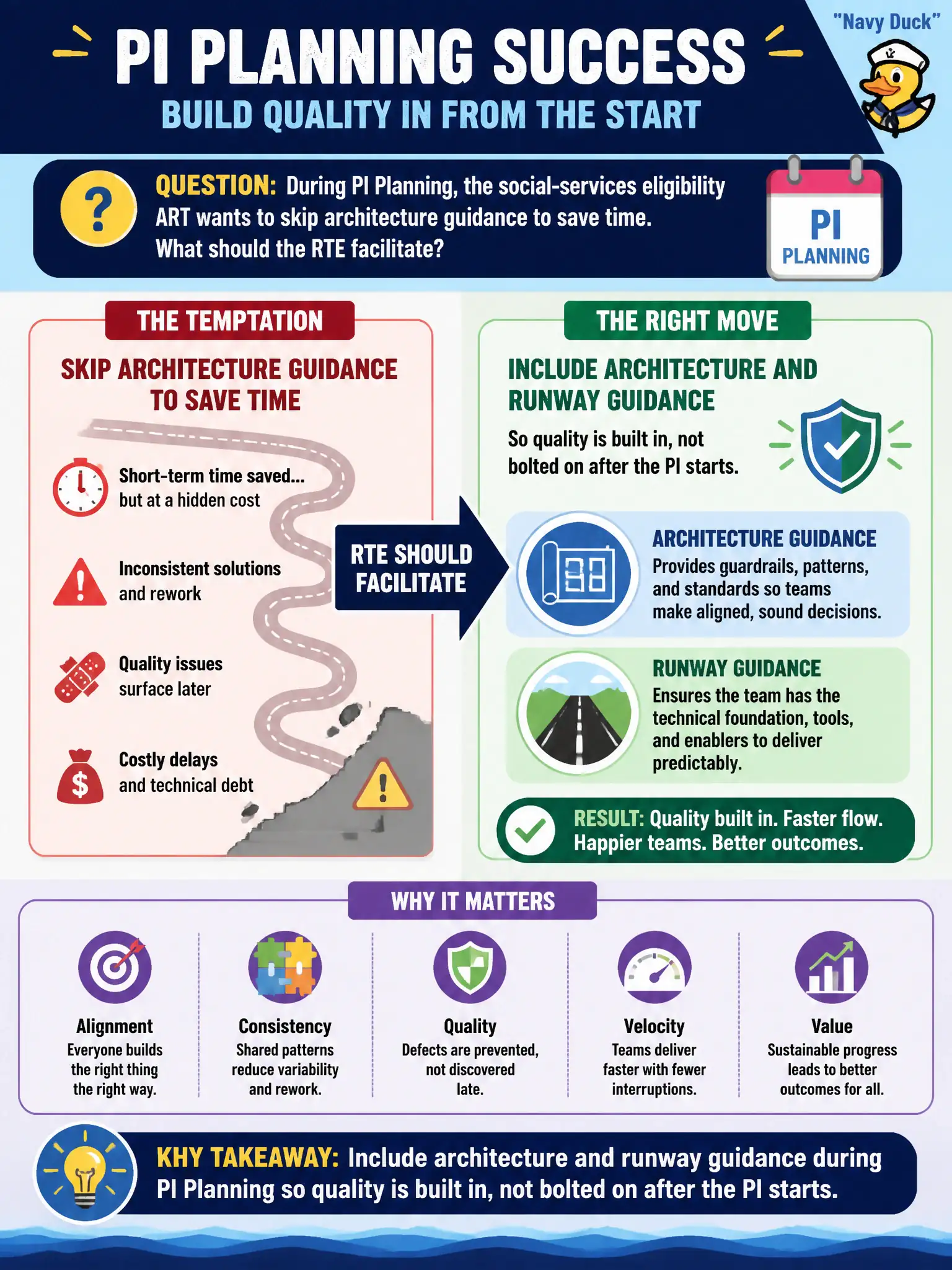
During PI Planning, the social-services eligibility ART wants to skip architecture guidance to save time. What should the RTE facilitate?
Select an answer to reveal the explanation.
Short Explanation
Skipping architecture to save an hour of planning is like pouring a sidewalk with no grade. Eligibility rules look fast until every team paves in a different direction.
Full Explanation
Built-in quality and architectural runway need explicit time in PI Planning. When a social-services eligibility ART wants to skip architecture guidance to save time, the RTE should facilitate including architecture and runway so eligibility rules, identity, and data foundations are not bolted on after features are already mid-flight. Skipping the architect briefing because features can supposedly be refactored after go-live at no cost ignores the real cost to caseworkers and clients when models diverge in production. Letting each team invent a separate eligibility data model to maximize autonomy creates integration debt that will block a working system increment. Parking all architectural work in a later PI so Product Management can fill the entire program board with features starves enablers and usually causes mid-PI stalls. Exam caveat: Architecture guidance should be right-sized—enough runway for the PI, not a multi-year design freeze before any eligibility value ships. Operational check: Ensure System Architect briefing and enabler capacity appear on the eligibility planning agenda, and verify at least the critical runway items are sequenced with features on the program board. In municipal settings, pressure to look busy, compliant, or politically safe is constant; the RTE earns trust by holding the principle through that pressure and verifying the next cadence event shows improved civic delivery, not just a quieter meeting.