
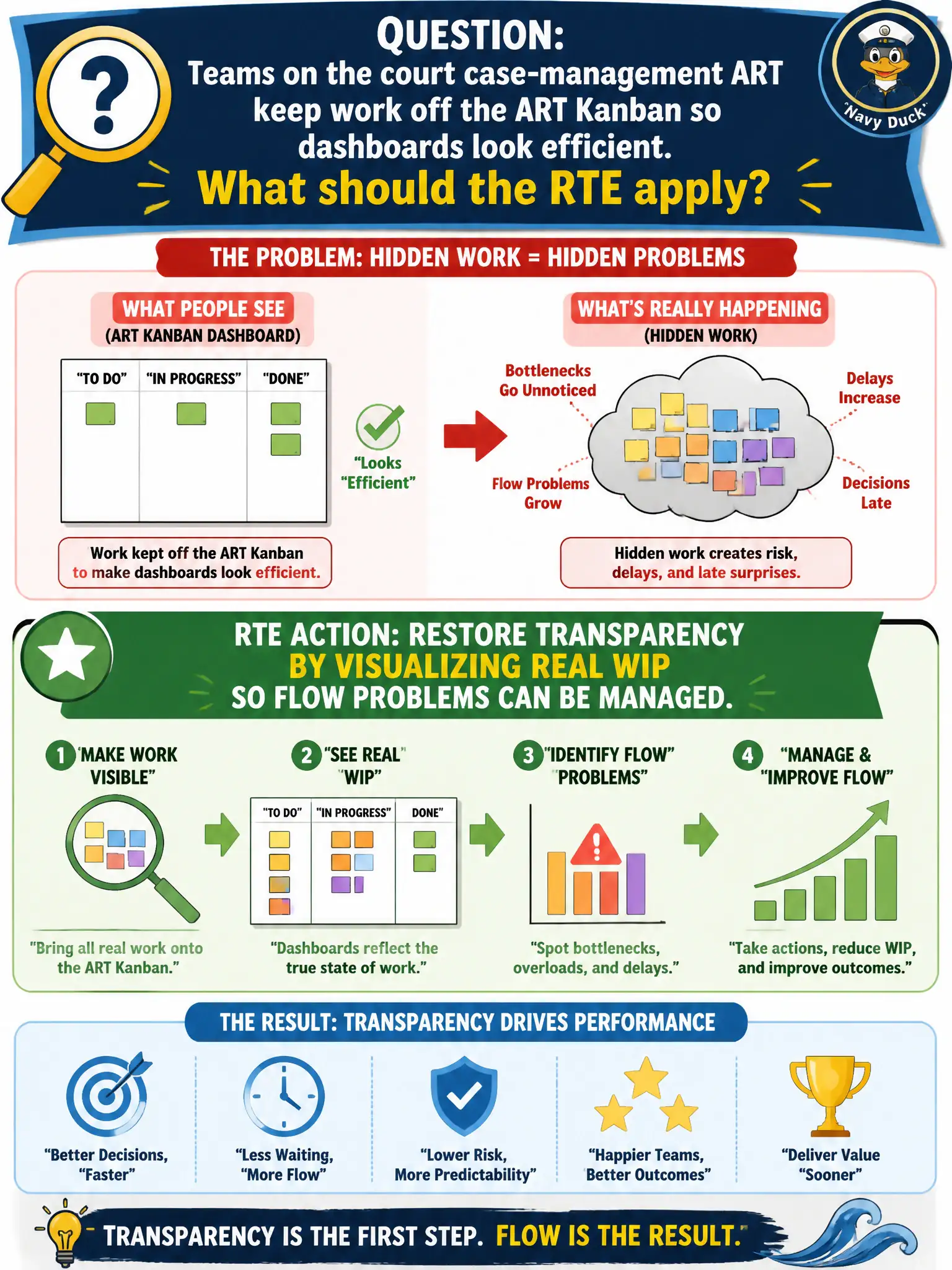
Teams on the court case-management ART keep work off the ART Kanban so dashboards look efficient. What should the RTE apply?
Select an answer to reveal the explanation.
Short Explanation
Hidden WIP is a courtroom with cases stuffed in a desk drawer. The docket looks tidy; the justice system is still clogged. Flow cannot be managed if nobody will put the work on the wall.
Full Explanation
Transparency requires visualizing real WIP so flow problems can be managed. When court case-management ART teams keep work off the ART Kanban to make dashboards look efficient, they hide queues that delay filings, hearings support, and clerk workflows for the public. The RTE should restore visible WIP and coach that a clean board with hidden work is a lie that blocks Relentless Improvement. Praising the clean board because low visible WIP supposedly proves the ART is Lean reinforces the concealment and teaches teams to game the signal. Allowing hidden WIP as long as status reports to the bench stay green prioritizes optics over flow management for the court. Deleting the Kanban and tracking only closed cases so queues never appear removes the primary tool for seeing bottlenecks before citizens feel them. Exam caveat: Not every informal chat needs a ticket, but material delivery work that consumes capacity must be visible on the ART's system. Operational check: Compare calendar load and repository activity to Kanban WIP on the case-management ART; pull hidden work onto the board and set WIP limits that match real capacity. In municipal settings, pressure to look busy, compliant, or politically safe is constant; the RTE earns trust by holding the principle through that pressure and verifying the next cadence event shows improved civic delivery, not just a quieter meeting.