
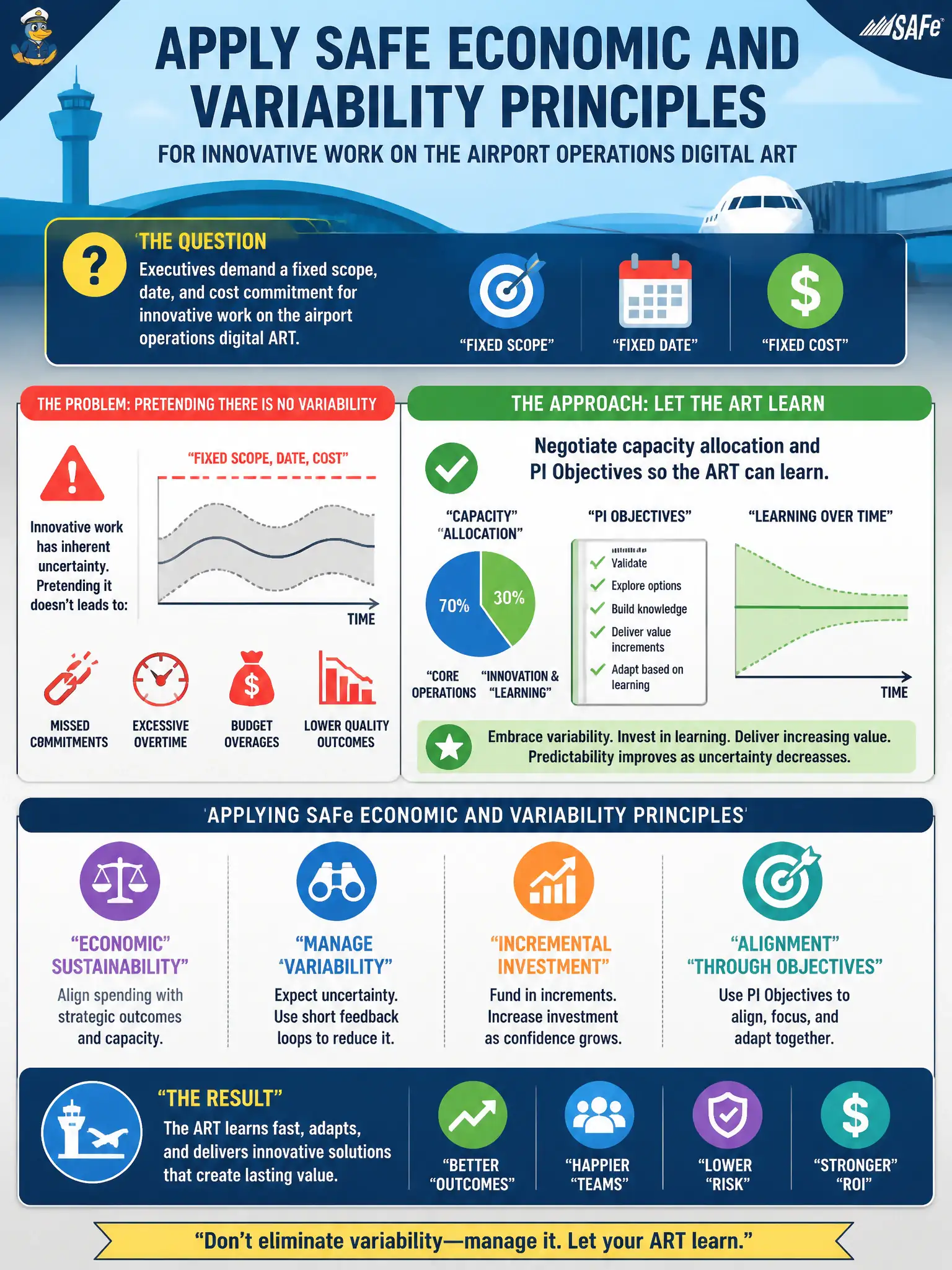
Executives demand a fixed scope, date, and cost commitment for innovative work on the airport operations digital ART. How should the RTE apply SAFe economic and variability principles?
Select an answer to reveal the explanation.
Short Explanation
Innovative airport work is a weather forecast, not a bus timetable. The ART can commit capacity and near-term objectives; it cannot honestly freeze scope, date, and cost on stuff nobody has built yet.
Full Explanation
Innovative work carries variability; SAFe economics favor negotiating capacity allocation and PI Objectives so the ART can learn rather than pretending uncertainty can be locked with a fixed scope, date, and cost. On an airport operations digital ART, signing a triple constraint for exploratory work usually produces either false certainty or a death-march. The RTE should help leaders allocate capacity for learning and commit to objectives that can adapt as evidence arrives from operations stakeholders. Signing the triple constraint and converting unknown work into a detailed 12-month specification invents precision the airport domain does not yet have. Pausing the ART until every requirement is known, then restarting as a predictive project, delays learning that only building and demos can provide. Promising all three constraints and hiding uncertainty until after go-live transfers risk onto passengers and airport staff at the worst moment. Exam caveat: Some compliance-driven airport work is more constrained; still separate truly innovative slices so they are not forced into fake certainty. Operational check: Split the portfolio ask into fixed regulatory must-dos versus exploratory digital bets, and plan the bets with capacity allocation and measurable learning objectives for the next PI.