
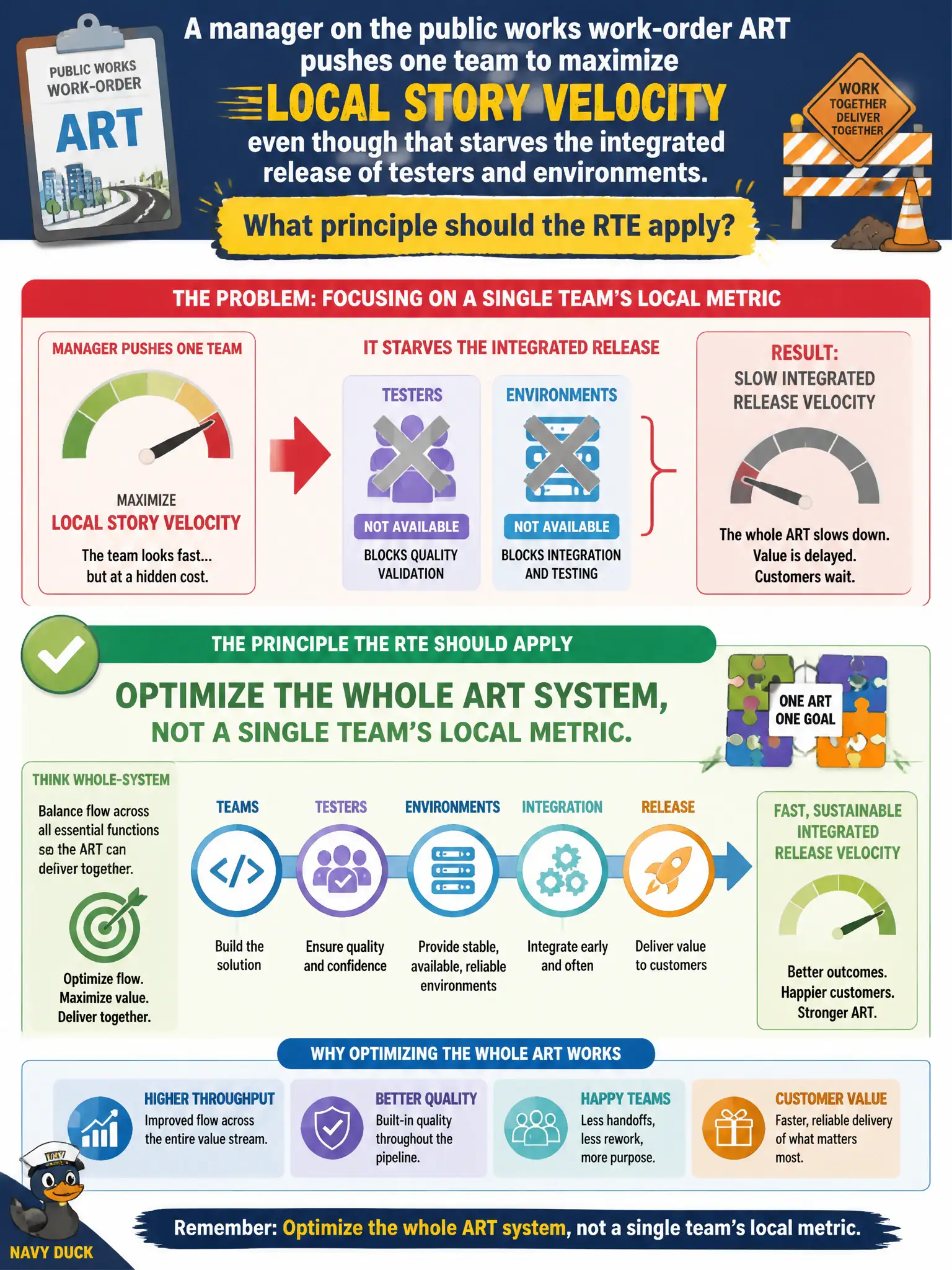
A manager on the public works work-order ART pushes one team to maximize local story velocity even though that starves the integrated release of testers and environments. What principle should the RTE apply?
Select an answer to reveal the explanation.
Short Explanation
A work-order ART is a relay, not a set of solo sprints. If one team runs a record split while the testers have no baton, the city still has no release.
Full Explanation
Optimize the whole ART system, not a single team's local metric. When a manager on a public works work-order ART pushes one team to maximize local story velocity while starving the integrated release of testers and environments, local optimization damages city work-order outcomes that residents feel as delayed repairs. The RTE should coach leaders back to system flow—shared constraints, integration health, and end-to-end cycle time—rather than celebrating a star squad's chart. Ranking teams on velocity so the fastest group sets the ART standard encourages gaming and ignores whether work-orders actually close in production. Freezing the other teams until the high-velocity team is fully utilized worsens flow and creates artificial idle time across the train. Reporting only local velocity to council because integrated-release health is dismissed as a DevOps concern hides the real citizen-facing delivery signal. Exam caveat: Team metrics can still inform coaching; the failure mode is elevating a local speed metric above ART-level value delivery. Operational check: Show WIP and wait time for test environments alongside the star team's velocity, and facilitate a rebalance so the next integrated work-order increment can finish.