
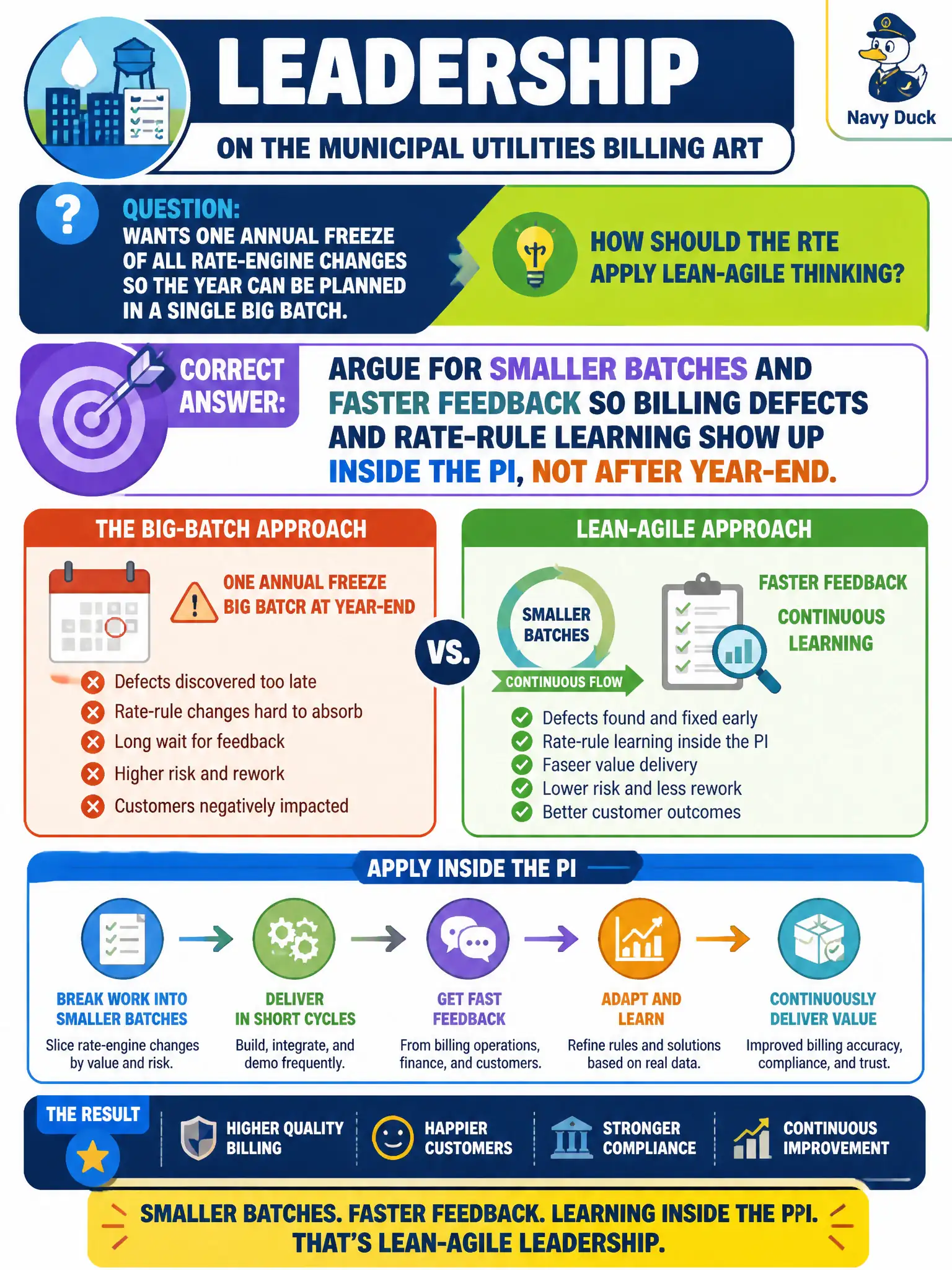
Leadership on the municipal utilities billing ART wants one annual freeze of all rate-engine changes so the year can be planned in a single big batch. How should the RTE apply Lean-Agile thinking?
Select an answer to reveal the explanation.
Short Explanation
One giant yearly freeze is a snowplow that waits until July. Smaller batches let the billing ART learn from real meters instead of discovering a year of wrong rates on the same Tuesday.
Full Explanation
Lean-Agile thinking favors smaller batches and faster feedback so defects and learning appear inside the PI, not after a year-end freeze. When leadership on a municipal utilities billing ART wants one annual freeze of all rate-engine changes, the RTE should argue for incremental delivery so billing rule mistakes surface while they are still cheap to correct for ratepayers. Supporting the annual freeze because large batches supposedly reduce coordination overhead ignores the cost of delayed feedback and huge integration risk in billing engines. Agreeing to freeze all changes except executive specials, which may enter anytime, creates an unfair fast lane that destroys prioritization and predictability. Replacing PI Planning with a yearly steering committee that locks scope on day one abandons cadence and synchronization for a predictive batch that SAFe is designed to avoid. Exam caveat: Some regulated rate filings create real external batch constraints; the principle is still to minimize batch size where the ART controls the work and to avoid using regulation as an excuse for freezing everything. Operational check: Propose a PI-sized rate-engine increment with a feedback demo to billing operations, and compare defect discovery timing against the last annual-freeze release.