
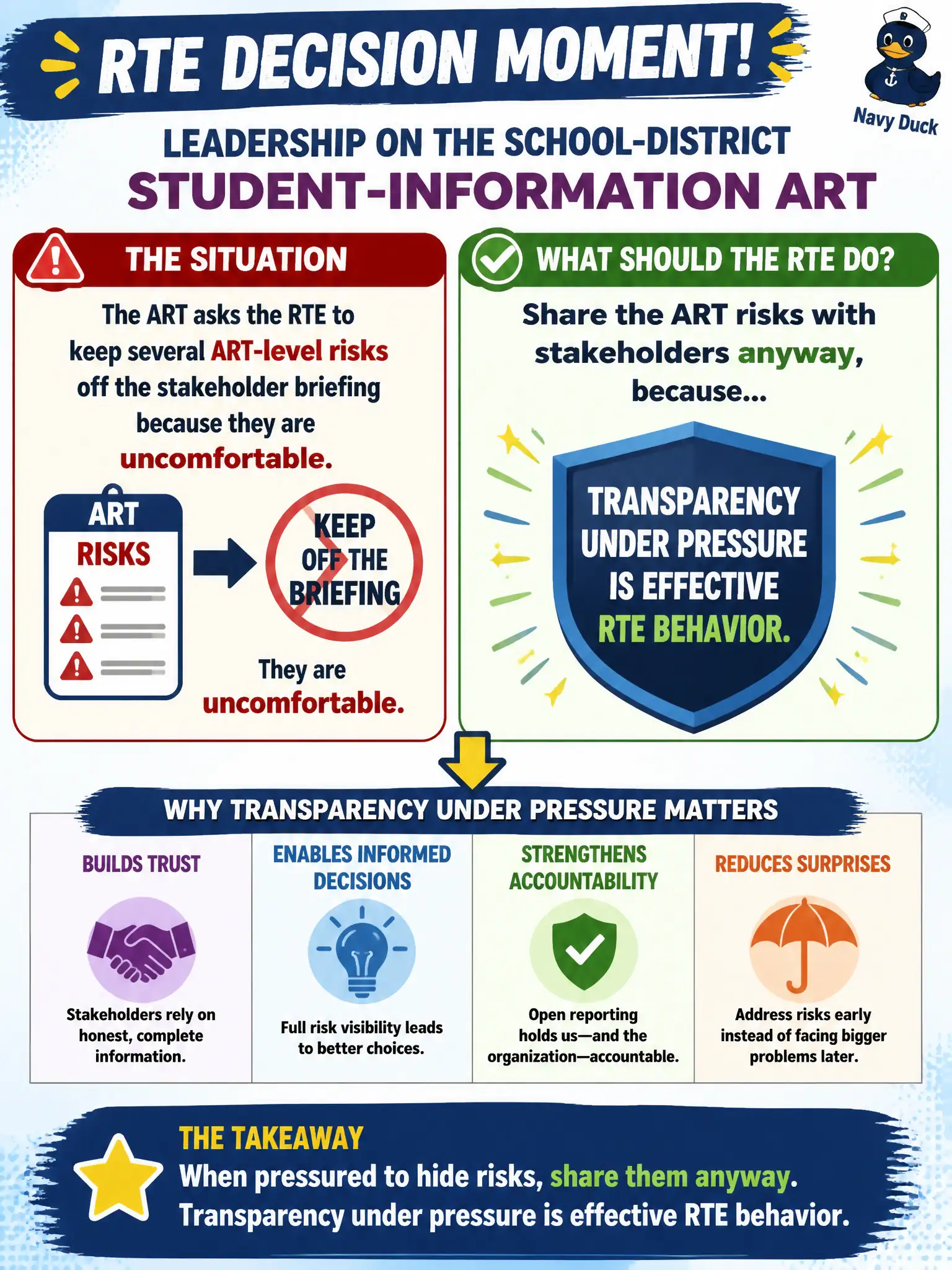
Leadership on the school-district student-information ART asks the RTE to keep several ART-level risks off the stakeholder briefing because they are uncomfortable. What should the RTE do?
Select an answer to reveal the explanation.
Short Explanation
Uncomfortable risks are still risks. Stuffing student-information outages in a drawer does not make them smaller; it just guarantees the school board learns about them the hard way.
Full Explanation
Transparency under pressure is effective RTE behavior. When leadership on a school-district student-information ART asks to keep uncomfortable ART-level risks off a stakeholder briefing, the RTE should still share the risks so sponsors can support mitigations affecting enrollment, transfers, and records integrity. Hiding risk protects feelings in the moment and blinds the system that serves families. Hiding the risks this PI and logging them only in a private RTE notebook after the meeting removes collective ownership and delays help from people who control funding and policy. Sharing only risks that already have funded mitigations so stakeholders hear good news selects for comfortable narratives and leaves unfunded student-information threats invisible until they explode. Delegating the briefing to a Scrum Master so the RTE is not the one delivering bad news avoids the facilitation accountability of ART-level communication without removing the underlying problem. Exam caveat: Framing and sequencing matter—present risks with owners, impacts, and clear asks—but omission of material ART risks is not a valid facilitation tactic. Operational check: Include the uncomfortable risks in the stakeholder pack with proposed next actions, and confirm Business Owners acknowledge them before the student-information PI proceeds as if nothing were wrong.