
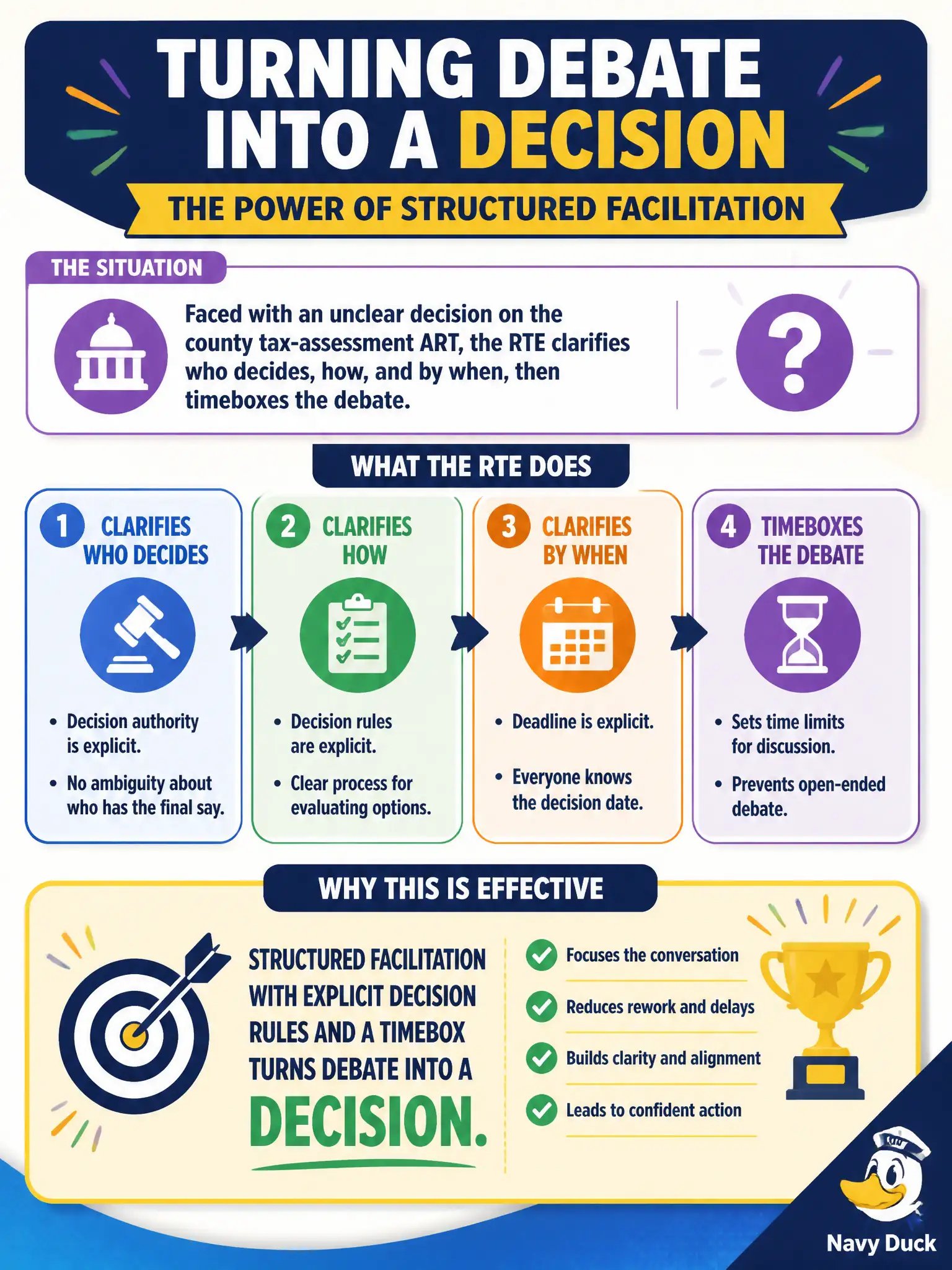
Faced with an unclear decision on the county tax-assessment ART, the RTE clarifies who decides, how, and by when, then timeboxes the debate. Why is that effective?
Select an answer to reveal the explanation.
Short Explanation
Fuzzy decisions eat tax-assessment PIs alive. Naming the rule—consent, majority, a named owner—and putting a clock on the talk is how a facilitator earns the room. Endless "we'll know it when we agree" is how nothing ships.
Full Explanation
Structured facilitation with explicit decision rules and a timebox turns debate into a decision. Facing unclear choices on a county tax-assessment ART, clarifying who decides, how, and by when—then timeboxing discussion—is effective RTE behavior that respects people's time and keeps assessment delivery moving for the county. Decision rules are not unnecessary, and the RTE should not always decide after hearing both sides; many decisions belong to Product Management, System Architects, or Business Owners depending on the content. Claiming timeboxing assessment debates is disrespectful ignores that unbounded discussion often blocks assessors and residents waiting on system capability; respect includes finishing and deciding. Saying only Business Owners may set timeboxes so the RTE should stay silent on process misunderstands facilitation: the RTE owns process clarity for ART events even when content decisions sit elsewhere. Exam caveat: A timebox without a named decision-maker just creates a cliff; always pair the clock with who decides and what happens if consensus fails inside the box. Operational check: For the next contested tax-assessment topic, write the decision owner, method, and deadline on the board before debate starts, and stop on time with either a decision or an explicit escalation path.