
The open-data and civic-engagement ART RTE models asking for help and admitting uncertainty in ART Sync. Why is that effective?
Select an answer to reveal the explanation.
Short Explanation
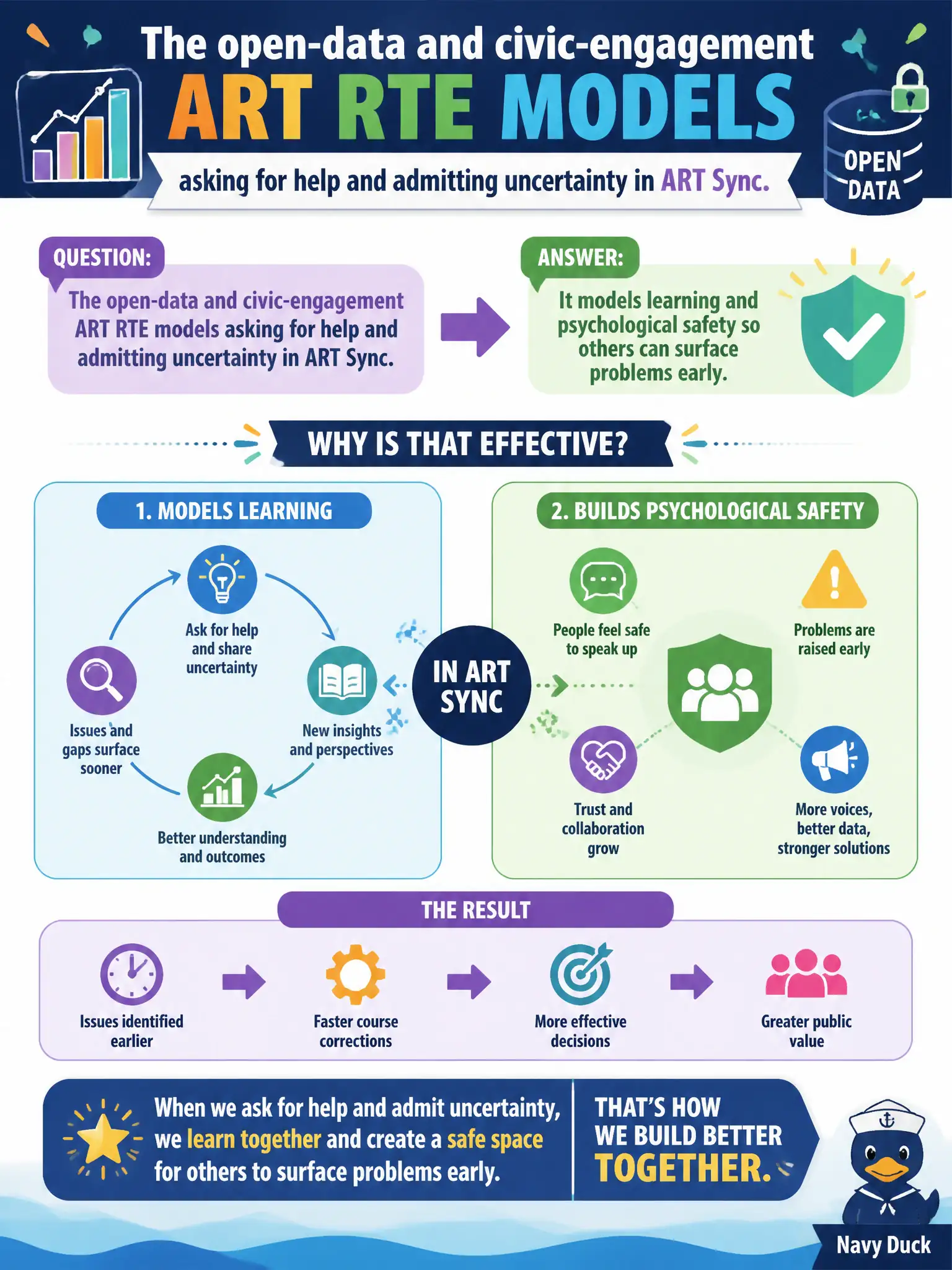
When the RTE says "not sure—need help" in civic-data sync, the room learns that is allowed. That is psychological safety, not weakness. People flag risks earlier, and the train actually learns.
Full Explanation
Modeling asking for help and admitting uncertainty builds psychological safety and a learning culture. When an open-data and civic-engagement ART RTE does this in ART Sync, others are more likely to surface blockers early—before council demos and public data releases fail in front of residents. That is effective servant-leadership modeling, not weakness or abdication. It does not let the RTE avoid owning facilitation when the answer is unclear; facilitation continues, often by pulling the right Product Management or architecture experts into the room with a timebox. It does not signal that ART Sync is optional or that teams may skip when unsure; cadence remains mandatory while honesty inside the event increases. It does not transfer architectural decisions to whoever speaks first after the admission; System Architect and Product Management authorities remain intact, and the RTE still facilitates a proper decision path. Exam caveat: Vulnerability without follow-through becomes empty performance; admitting uncertainty should lead to a clear next step, owner, and deadline. Operational check: In the next ART Sync, note whether teams raise risks earlier after the RTE models uncertainty, and ensure each raised item gets an owner rather than dissolving into open-ended discussion on the open-data train.